Showing posts with label Orang Asli and the modern world. Show all posts

Sunday, March 30, 2025

The Fatal Curse of Tempurungism (reprise)


They say an idle mind is the devil’s workshop and this is especially evident in the case of Malaysian bureaucracy in general and the Jabatan Hal Ehwal Orang Asli in particular.

I have resided in and around Kampung Pertak since 1992. During this period I have witnessed how the Orang Asli Affairs Department favors diabolical initiatives that strengthen their psychological and political control over the Orang Asli - while creating opportunities for stuffing their own pockets.

Whether it be logging concessions, dam projects, turning ancestral lands into leasehold lots, or tarring roads that lead nowhere (except to environmental degradation), the JHEOA invariably finds a sneaky way to corrupt, oppress, intimidate, exploit and ultimately devour the Orang Asli.

Sagong Tasi of the Temuan tribe wins a landmark lawsuit (courtesy of Suaram)

The JHEOA ought to have been dismantled and abolished 20 years ago, following the surrender of the Malayan Communist Party in 1989. Instead, it became a tool to assimilate the Orang Asli into mainstream Malay culture - by pressuring them to embrace Islam and systematically pillaging their ancestral lands under the guise of kemajuan or “progress.”

Recently there has been talk of the JHEOA being “corporatized” into the Perbadanan Orang Asli (Orang Asli Corporation) using the Federal Land Development Authority (FELDA) as a model. Blurring the boundary between business and politics facilitates hanky-panky on a massive scale. As we have seen in the case of FELDA, feudal-style top-down management by aristocrat-politicians results in the ignorant peasantry being robbed totally blind without their knowledge. In most cases the public only finds out when it’s already too late because the thefts occur in remote rural areas.

Photo: Colin Nicholas/COAC

This, of course, has been UMNO’s modus operandi since the era of Mahathir and Daim. Leveraging on an atavistic appeal to bangsa and ugama to promote the fascistic notion of Ketuanan Melayu, UMNO warlords have siphoned off a great deal more than 30% of the nation’s wealth since the nefarious NEP was launched in 1970.

The JHEOA – like so many government agencies – has long served the UMNO agenda instead of the Orang Asli’s genuine interests. That’s nothing new. What has become alarmingly obvious is that they no longer bother concealing their narrow self-interests and their deeply ingrained racism.

Photo: Antares

During the Ulu Selangor by-election that ran from April 17-25, 2010, the JHEOA openly stage-managed the Barisan Nasional campaign in Orang Asli communities throughout the region. In one or two villages the Orang Asli batin (headman) called the police to prevent Pakatan Rakyat campaigners from entering their settlements.

In Kg Pertak the JHEOA facilitated the entry and encampment of dozens of UMNO campaign workers recruited from various ethno-fascist groups like Pekida and Perkasa. They were annoyed to find Pakatan Rakyat insignia proudly displayed in a couple of houses. What irked them even more was that a bunch of pro-Rakyat bloggers were comfortably embedded in Kg Pertak’s “diplomatic enclave.”

The JHEOA/UMNO faction reportedly handed RM7,000 in cash to one of the village security officers with instructions to distribute it amongst 70 registered voters as incentives to vote BN. I later heard complaints that the money never left the security officer’s pockets. This is how UMNO corrupts the Orang Asli via the JHEOA – by dragging them into the politics of greed, betrayal, and xenophobia.

Photo: Max Koh

On the eve of the by-election, the UMNO contingent instructed a few young Orang Asli to set up a roadblock at the entrance to the village. Later a skirmish broke out and one of the pro-Rakyat bloggers was assaulted by a Pekida thug. When the police arrived on the scene 30 minutes later, the UMNO thugs were nowhere to be seen. This small outbreak of violence was reported in Malaysiakini the next morning. In terms of negative publicity, JHEOA/UMNO came out with a black eye and began plotting revenge.

Xenophobia can also be called tempurungism – a regressive psychomental condition akin to acute jingoitis that commonly afflicts those who have never left the provincial and parochial confines of a monolingual, monocultural matrix. Those suffering from xenophobia have great difficulty accepting people with different linguistic and cultural imprints as close friends or family. They tend to label others as pendatang (immigrants), orang asing (outsiders), or Mat Salleh (Caucasians).

Working through a couple of Orang Asli agents, the JHEOA reactivated its xenophobic agenda by pressuring Asli families who had rented out their houses to “outsiders” to evict their tenants. The Asli were given to understand that the houses they were living in was government property – when in truth it was the dam developer that built the houses.

What the JHEOA had done in 2004 was to cheat the Orang Asli of their ancestral hunting grounds by issuing them 99-year leases instead of formally gazetting the whole area as a permanent Orang Asli Reserve (as promised in 1965). The Orang Asli have never seen a land grant in their life – nor have their ancestors. They don’t understand what a 99-year lease means – but they do know they have very little power over their own destinies as long as the JHEOA exists as an extension of UMNO.

[First posted 2 August 2010]

Saturday, September 21, 2024

Remembering Mak Minah ~ Diva of the Malaysian Rainforest (repost)

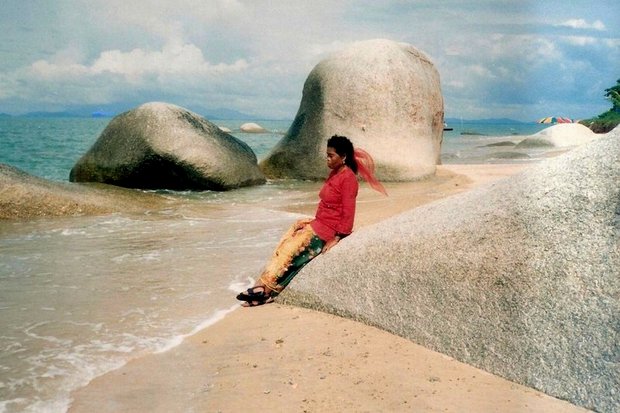
Minah Angong (14/9/1930 ~ 21/9/1999), better known as Mak Minah, greets the sea at 
Batu Ferringhi, Penang (photo: Rafique Rashid)
Minah, as she appears on the cover of Akar Umbi  Songs of the Dragon - an album released 
3 years after her untimely return to the spirit realms in September 1999 (photo: Antares)


Minah and her younger sister Indah in Kampung Pertak (photo: Antares)
Antares on Balinese flute at the Rainforest World Music Festival in Sarawak, 
August 1998 (photo: Wayne Tarman)
Nai Anak Lahai aka Mak Nai, bamboo percussionist and oldest woman in the village 
(photo: Antares)
Mak Minah & Antares with Dr Chandrabhanu after performance of 
"Birthplace Reclaimed" in January 1994 (photo by Rafique Rashid)
Mak Minah: celebrated Temuan ceremonial singer of the dragon clan 
(photo: Peter Lau)

LISTEN TO  AKAR UMBI ~ Songs of the Dragon HERE!
[First posted 5 May 2012, reposted 21 September 2014]

Wednesday, September 18, 2024

Mak Minah would have celebrated her 94th birthday...


Video footage featuring the Chiling, Luit and Selangor rivers in Ulu Selangor, Malaysia edited to the song 'Sungai Makao' by Akar Umbi. This video officially launches the Ecowarriorz blogspot and is my personal tribute to Mak Minah who was a true guardian of the environment and an inspiration to many. ~ Mary Maguire


A Tribute to Mak Minah
(14.9.1930 ~ 21.9.1999)

Ceremonial singer... noblewoman... cultural representative of the Temuan tribe... free spirit and a friend to all.

Mak Minah (Menah Kuntom) was born in Pertak, Ulu Selangor, between the First and Second World Wars. Those who remember her in her youth report that she was extremely feisty and perhaps even a little wayward. But her second husband, Batin Angong of Gerachi, was a mature tribal leader who groomed Minah for the important role of Batin’s wife, and taught her all the songs he knew. They had a daughter and five sons – the eldest of whom, Ramsit, is now Batin of Gerachi.

When Batin Angong died, Mak Minah moved back to Pertak to live with her sister Indah. It was around this time that Minah befriended Antares and Rafique, two musicians seeking sanctuary in Kuala Kubu Bharu from the clangor of the Klang Valley. Before long a musical collaboration began which led to the formation of Akar Umbi – a “trance-ethnic” fusion group – and widespread acclaim for Mak Minah as a cultural representative of her tribe. Her goodnatured willingness to be a friend to all made her an ideal ambassador for the marginalized Orang Asli community.

Audiences everywhere were uplifted by Mak Minah’s soulful voice. Her songs reflected the love and reverence indigenous peoples feel for the land. They were a powerful antidote to the cynicism and myopia of a “modern” worldview centered on money and power.

Offstage, Mak Minah was a fearless and outspoken advocate of cultural and spiritual autonomy for the Orang Asli. She fiercely opposed the State government’s plan to relocate two Temuan villages for a dam project on Sungai Selangor which would destroy the wild beauty and sanctity of the Pertak area.

“I will fight the dam as long as I live,” Mak Minah repeatedly said. But it is a heart-rending fight that has set brother against brother, mother against son, neighbor against neighbor. The psychological conflict and uncertainty exhausted her.

Mak Minah’s passionate love for the rainforest where her tribe has lived for countless generations is an inspiration to all of us who share an alternative vision – one where mutual respect for all tribes and the healing of the earth take precedence over economic and political
expediency.

POSTSCRIPT

The last time I saw Minah alive was around midday on the 21st of September, 1999. The day before I had taken her to the clinic because she was complaining of aches all over her chest and back, and she had no appetite. The doctor said Minah had a viral infection and prescribed some medicine, suggesting that she drink lots of Glucolin to get her energy back. I was on my way to Kuala Lumpur and told Minah I'd look in on her the next day.

At 3 a.m. I received a phone call informing me that she had died in her sleep at 7:03 p.m. at the Kuala Kubu Bharu hospital.

Her granddaughter Sembo and another friend were by her side. A week ago she turned 69 and three weeks earlier she had returned happy and fulfilled from Sarawak, after performing with Akar Umbi at the 2nd Rainforest World Music Festival.

Mak Minah had a very sweet smile on her face when they buried her on a hill we shall henceforth call Bukit (Mount) Minah. Ironically, she was the first to be interred in a virtually inaccessible new tribal gravesite allocated to Gerachi Villagers in view of the government's determination to inundate the old Temuan burial site with the proposed Selangor Dam. Minah swore to resist the dam to her last breath and she did.

[Reposted 14 September 2011. Source: Magick River website. Listen to Mak Minah's musical legacy here!]


Friday, May 20, 2022

Flesh of the Ancestors (revisited)

On 17 March 2010, forty busloads of Orang Asli descended on Putrajaya to air their grievances directly to the prime minister. They were prevented by police from marching to the PM's office, but their strong showing and vigorous protest made the headlines in Malaysiakini. I am heartened to note that the worm has finally turned and that our indigenous tribes are no longer politically passive. As a tribute to their semangat (fighting spirit), I'm reposting this essay originally published here on 29 January 2007 and reposted 17 March 2010...


I can relate to the French painter Gauguin who took a libidinal shine to the native girls of Tahiti. There is something irresistible about bronze, rubbery, supple, brown skin - and the edenic innocence that flashes in their shy smiles. Pagan eyes that turn prudish at puberty, because their mothers keep yelling "Malu!" ("Shame!") when they skinny-dip with ripening bosoms and pubes. Contact with "civilization" taught them to feel ashamed of their own simplicity, made them into "primitives" living below the poverty line.

And yet, seeing a bunch of Orang Asli kids play like otters in the river is nothing less than a glimpse of paradise. You can't stay cynical or depressed in such an environment. The verdant landscape itself is balm for the eyes, as much as the sparkling waters are a treat for the senses.

The Orang Asli soul is bonded with the land, the living earth, nature itself. In mythic terms they regard their wild habitats as the petrified flesh of their ancestors.

Just as Native Americans once revered the buffalo as a benevolent manifestation of Wakan Tanka (Great Spirit), a parental sacrifice to feed the children, the Temuan view each species of flora and fauna as a gift from heaven, as food, medicine, friend, or shelter.

The younger ones have all but forgotten, born as they were into homes with TV sets bombarding all and sundry with images of a Brave New World, where ancient wisdom and traditional ways are dismissed as irrelevancies or mere superstition. But the older ones know there is no separation between the land and life itself.

To destroy nature is to murder the Life Force that sustains all existence - and therefore it is viewed as the ultimate wrongdoing, akin to forgetting one's roots and turning one's back on all that is considered divine.

Well, that's a very general overview of the Temuan mythos, which applies to just about every indigenous culture you can name - at least the ones that haven't been completely assimilated and subsumed by industrial society. However, admiring their resilience of spirit, their innocence, and their wealth of hand-me-down knowledge is one thing. Living with them at close quarters is quite another. They can certainly drive an essentially middle-class, former urbanite like myself round the bend with exasperation.

There seems to be a testosterone-related problem with the males: as soon as they turn 18, a sullen surliness bordering on xenophobia grips them. The modest wages they earn cutting grass on road verges or gathering bamboo for the Chinese towkays are mostly spent getting totally pissed at the local bar; and then they fall off their motorbikes and the rest of their hard-earned pay goes into repairing them. If they happen to be married with kids, their wives quickly turn into nags - because it's not uncommon that their husbands will stagger home late at night stinking of cheap plonk, without any food for the family. Apparently, this happens wherever indigenous "dreamtime" cultures collide with industrial "machinetime" societies. Anthropologists generally agree that the trauma of "culture shock" so disorientates the tribal folk they become dispirited - and therefore attempt to regain their spirits by imbibing vast amounts of the bottled variety.


But as long as our tribal folk have the forest to return to, they have a chance of eventually regaining their psychic equilibrium. My chief contractor on the Bamboo Palace project, Yam Kokok, really enjoyed the process of gathering about 3,000 bertam leaves to weave into roofing material for Anoora's hut. First he built a cozy lean-to while his wife began lining bamboo tubes with fragrant leaves, before stuffing them with rice to boil on a woodfire. The widow Lumoh had packed some salted fish and bottles of clear spring water. They were all set for a long day's work, cutting the thorny bertam leaves and carefully weaving them into attap. Yam Kokok's grandson and nephews all came along to help and I could see that the six days they spent "camping out" in the forest reminded them of the good old days - even though every evening I'd pick them up in my van and chauffeur them back to the village and some home comforts.

The forest is the Orang Asli's briar patch; their racial memory of being sustained by Mother Nature goes back thousands of generations. Chop down the trees and replant the land with cash crops like rubber and oil palm - and the Orang Asli become rootless, disconnected from their own past, insecure about their future and therefore apathetic.

True, some of the younger generation have adapted quite well to video games and factory jobs; a handful of Semai and Semelai have even made it all the way through university, and have become academics and doctors.

A year ago or so I was contacted by three enterprising young Temuans with university degrees. They told me they had stumbled upon my website back in 2003, but waited till they were fluent in English to send me an email! One of them, Shahar Koyok, is a fine arts graduate who's beginning to make his mark in the local art scene; another, Mor Ajani, graduated in multimedia design and maintains a Temuan blog. What deeply gratified me was their passionate interest and pride in their own mythic roots.

It's easy to demonize the Jabatan Hal Ehwal Orang Asli (Aboriginal Affairs Department) but it's really just a case of horribly misaligned worldviews. JHEOA officers, mostly urbanized Malays, scorn their own humble ancestry and sincerely believe they can persuade the Orang Asli to join the mainstream Malay community. Their strategy is two-pronged: first, systematically convert the jungle into plantations, so the Orang Asli can't hide in the past; and then convert these diehard animists into pious little Muslims.

I've long advocated that the JHEOA (instituted in 1954 during the Emergency years) be dismantled, as it serves little real purpose today except to breed the most loathsome varieties of bureaucratic ineptitude and corruption.

Think about it: how would you like being treated as a minor all your life and have some government agency manage your affairs as if you were severely retarded? If everybody else who enjoys Malaysian citizenship is free to live without an official guardian, why must our first peoples endure such an ignominy?

The argument that Orang Asli need a "protector" because they are still largely illiterate and can't cope with the demands of the modern world is a totally spurious one. First of all, after more than fifty years under the JHEOA's thumb, the Orang Asli have gained little ground in mastering left-brained activities like learning to manipulate alphanumeric symbols. The question is: why not capitalize on their strengths instead?

Most Orang Asli are physically agile, imaginative, fun-loving, and possess incredible stamina: in areas like sports and the arts, they would certainly be champs. Well, some descendants of African slaves in America have made their mark as athletes, musicians, actors, and dancers: would you think of Charlie Mingus, Michael Jordan, B.B. King, Eddie Murphy, Tina Turner, Ludacris, or Will and Jada Pinkett Smith as handicapped or backward?

What keeps the Orang Asli insulated from the outside world is the Jabatan Orang Asli's feudal mentality. That and the noxious effects of a patriarchal bias the Orang Asli got infected with along the way. Traditionally, the menfolk have been the hunters and womenfolk, the gatherers and nurturers.

In Kampung Pertak, there are quite a few unmarried mothers - girls of 17 who got knocked up after some smooth-talking fellow handed them a Guinness at an all-night wedding party. With so many kids bawling and crawling around the house, 12-year-old girls are often forced to look after their younger siblings while both parents are out working. By the time they reach 15 or 16, many end up as mothers themselves, which gives them little time or opportunity to grow mentally. So we have generation after generation of Orang Asli kids raised by completely ignorant mothers with little on their minds apart from neighborhood gossip and a bleak view of marital life.

All this would change if teenaged dating was accepted as something perfectly natural. When I first asked my mother-in-law if I could take Anoora down to town and buy her a meal, I was told we would have to be engaged before she would allow it. In other words, the relationship between men and women is always a sexual one; post-pubescent boys and girls simply cannot be friends and go out together. They end up getting married very young, prompted by hormonal surges, and never really have the chance to interact with a variety of friends, of different ages and genders, and therefore lack the means of acquiring communication skills and a broader perspective on things.

Most families in the past slept together in one large room with no partitions - or only very thin ones, at best. Obviously, sex was something carried out under cover of darkness, furtively, quietly (so as not to wake the kids), almost involuntarily - and never became an artform, or developed any degree of kinkiness, as it has in the cities.

I witnessed what happened when a young friend of mixed parentage from the big city started dating a village beauty from Pertak. On their very first secret rendezvous, she had asked if he was going to marry her (that's what he reported). Soon, the whole village was bristling with resentment at the urban Romeo. Even little children, no more than 8 or 9 years old, would taunt him as he drove past; the men in the village became more and more hostile, sabotaging his vehicle wherever he parked it, glaring at him with hands on their parangs. Posses of grandmothers and babes-in-arm would confront him at his rented lodgings in the village, demanding to know where he was hiding the girl. They gave him no peace until he buckled under the pressure and married the girl in a tribal ceremony.

Now the girl in question has had several lovers, and at 18 gave birth unexpectedly to a baby girl while trying to move her bowels, thinking it was one huge stomach upset she was experiencing. As to be expected, she's a lot more savvy and sophisticated than the other girls in the village. She could certainly learn to cope with life in the city, and has actually expressed a desire to someday get a job in KL.

Now, is there any correlation between an active sex life and intellectual curiosity? Remember that biblical myth about the forbidden fruit? Sex, drugs and rock'n'roll (or hip-hop or techno-rave, if you prefer) are definitely evolutionary triggers - that's why the patriarchy everywhere is so determined to outlaw them. What would happen to the Orang Asli if their youth got into sex, drugs and rock'n'roll in a big way?

Soon, they'd become pretty much the same as you and me, don't you think? And maybe that will prompt cityfolks to adopt more of the Orang Asli lifestyle - to reconnect with the earth, with Mother Nature, fresh air and sunshine. Sort of a cultural exchange: they become more experienced like us, and we become more innocent like them. Perhaps that's how things will ultimately balance out, and paradise will be regained on earth.

------
Recommended reading:

Proposed Orang Asli land policy: Planned poverty? [Aliran]

[First posted 24 May 2014]

Friday, May 13, 2022

Flesh of the Ancestors (reprise)

Halus in 1999 (photo: Colin Nicholas)

I can relate to the French painter Gauguin who took a libidinal shine to the native girls of Tahiti. There is something irresistible about bronze, rubbery, supple, brown skin - and the edenic innocence that flashes in their shy smiles. Pagan eyes that turn prudish at puberty, because their mothers keep yelling "Malu!" ("Shame!") when they skinny-dip with ripening bosoms and pubes. Contact with "civilization" taught them to feel ashamed of their own simplicity, made them into "primitives" living below the poverty line. 

And yet, seeing a bunch of Orang Asli kids play like otters in the river is nothing less than a glimpse of paradise. You can't stay cynical or depressed in such an environment. The verdant landscape itself is balm for the eyes, as much as the sparkling waters are a treat for the senses. The Orang Asli soul is bonded with the land, the living earth, nature itself. 

In mythic terms they regard their wild habitats as the petrified flesh of their ancestors. Just as Native Americans once revered the buffalo as a benevolent manifestation of Wakan Tanka (Great Spirit), a parental sacrifice to feed the children, the Temuan view each species of flora and fauna as a gift from heaven, as food, medicine, friend, or shelter. 

The younger ones have all but forgotten, born as they were into homes with TV sets bombarding all and sundry with images of a Brave New World, where ancient wisdom and traditional ways are dismissed as irrelevancies or mere superstition. 

But the older ones know there is no separation between the land and life itself. To destroy nature is to murder the Life Force that sustains all existence - and therefore it is viewed as the ultimate wrongdoing, akin to forgetting one's roots and turning one's back on all that is considered divine. 

Well, that's a very general overview of the Temuan mythos, which applies to just about every indigenous culture you can name - at least the ones that haven't been completely assimilated and subsumed by industrial society. However, admiring their resilience of spirit, their innocence, and their wealth of hand-me-down knowledge is one thing. Living with them at close quarters is quite another. They can certainly drive an essentially middle-class, former urbanite like myself round the bend with exasperation. 

There seems to be a testosterone-related problem with the males: as soon as they turn 18, a sullen surliness bordering on xenophobia grips them. The modest wages they earn cutting grass on road verges or gathering bamboo for the Chinese towkays are mostly spent getting totally pissed at the local bar; and then they fall off their motorbikes and the rest of their hard-earned pay goes into repairing them. If they happen to be married with kids, their wives quickly turn into nags - because it's not uncommon that their husbands will stagger home late at night stinking of cheap plonk, without any food for the family. 

Apparently, this happens wherever indigenous "dreamtime" cultures collide with industrial "machinetime" societies. Anthropologists generally agree that the trauma of "culture shock" so disorientates the tribal folk they become dispirited - and therefore attempt to regain their spirits by imbibing vast amounts of the bottled variety. But as long as our tribal folk have the forest to return to, they have a chance of eventually regaining their psychic equilibrium. My chief contractor on the Bamboo Palace project, Yam Kokok, really enjoyed the process of gathering about 3,000 bertam leaves to weave into roofing material for Anoora's hut. First he built a cozy lean-to while his wife began lining bamboo tubes with fragrant leaves, before stuffing them with rice to boil on a woodfire. The widow Lumoh had packed some salted fish and bottles of clear spring water. They were all set for a long day's work, cutting the thorny bertam leaves and carefully weaving them into attap. 

Yam Kokok's grandson and nephews all came along to help and I could see that the six days they spent "camping out" in the forest reminded them of the good old days - even though every evening I'd pick them up in my van and chauffeur them back to the village and some home comforts. The forest is the Orang Asli's briar patch; their racial memory of being sustained by Mother Nature goes back thousands of generations. Chop down the trees and replant the land with cash crops like rubber and oil palm - and the Orang Asli become rootless, disconnected from their own past, insecure about their future and therefore apathetic. 

True, some of the younger generation have adapted quite well to video games and factory jobs; a handful of Semai and Semelai have even made it all the way through university, and have become academics and doctors (though I know of no such examples from the Temuan tribe). It's easy to demonize the Jabatan Orang Asli (Aboriginal Affairs Department or JAKOA) but it's really just a case of horribly misaligned worldviews. JAKOA officers, mostly urbanized Malays, scorn their own humble ancestry and sincerely believe they can persuade the Orang Asli to join the mainstream Malay community. 

Their strategy is two-pronged: first, systematically convert the jungle into plantations, so the Orang Asli can't hide in the past; and then convert these diehard animists into pious little Muslims. I've long advocated that JAKOA (instituted in 1954 during the Emergency years) be dismantled, as it serves little real purpose today except to breed the most loathsome varieties of bureaucratic ineptitude and corruption. 

Think about it: how would you like being treated as a minor all your life and have some government agency manage your affairs as if you were severely retarded? If everybody else who enjoys Malaysian citizenship is free to live without an official guardian, why must our first peoples endure such an ignominy? The argument that Orang Asli need a "protector" because they are still largely illiterate and can't cope with the demands of the modern world is a totally spurious one. 

First of all, after more than fifty years under the JAKOA's thumb, the Orang Asli have gained little ground in mastering left-brained activities like learning to manipulate alphanumeric symbols. The question is: why not capitalize on their strengths instead? Most Orang Asli are physically agile, imaginative, fun-loving, and possess incredible stamina: in areas like sports and the arts, they would certainly be champs. Well, some descendants of African slaves in America have made their mark as athletes, musicians, actors, and dancers: would you think of Charlie Mingus, Michael Jordan, B.B. King, Eddie Murphy, Tina Turner, Ludacris, or Will and Jada Pinkett Smith as handicapped or backward?

What keeps the Orang Asli insulated from the outside world is the Jabatan Orang Asli's feudal mentality. That and the noxious effects of a patriarchal bias the Orang Asli got infected with along the way. Traditionally, the menfolk have been the hunters and womenfolk, the gatherers and nurturers. In Kampung Pertak, there are quite a few unmarried mothers - girls of 17 who got knocked up after some smooth-talking fellow handed them a Guinness at an all-night wedding party. With so many kids bawling and crawling around the house, 12-year-old girls are often forced to look after their younger siblings while both parents are out working. By the time they reach 15 or 16, many end up as mothers themselves, which gives them little time or opportunity to grow mentally. 

So we have generation after generation of Orang Asli kids raised by completely ignorant mothers with little on their minds apart from neighborhood gossip and a bleak view of marital life. All this would change if teenaged dating was accepted as something perfectly natural. When I first asked my mother-in-law if I could take Anoora down to town and buy her a meal, I was told we would have to be engaged before she would allow it. 

In other words, the relationship between men and women is always a sexual one; post-pubescent boys and girls simply cannot be friends and go out together. They end up getting married very young, prompted by hormonal surges, and never really have the chance to interact with a variety of friends, of different ages and genders, and therefore lack the means of acquiring communication skills and a broader perspective on things.

Most families in the past slept together in one large room with no partitions - or only very thin ones, at best. Obviously, sex was something carried out under cover of darkness, furtively, quietly (so as not to wake the kids), almost involuntarily - and never became an artform, or developed any degree of kinkiness, as it has in the cities. 

I witnessed what happened when a young friend of mixed parentage from the big city started dating a village beauty from Pertak. On their very first secret rendezvous, she had asked if he was going to marry her (that's what he reported). Soon, the whole village was bristling with resentment at the urban Romeo. Even little children, no more than 8 or 9 years old, would taunt him as he drove past; the men in the village became more and more hostile, sabotaging his vehicle wherever he parked it, glaring at him with hands on their parangs. Posses of grandmothers and babes-in-arm would confront him at his rented lodgings in the village, demanding to know where he was hiding the girl. 

They gave him no peace until he buckled under the pressure and married the girl in a tribal ceremony. Now the girl in question has had several lovers, and at 18 gave birth unexpectedly to a baby girl while trying to move her bowels, thinking it was one huge stomach upset she was experiencing. As to be expected, she's a lot more savvy and sophisticated than the other girls in the village. She could certainly learn to cope with life in the city, and has actually expressed a desire to someday get a job in KL. 

Now, is there any correlation between an active sex life and intellectual curiosity? Remember that biblical myth about the forbidden fruit? Sex, drugs and rock'n'roll (or hip-hop or techno-rave, if you prefer) are definitely evolutionary triggers - that's why the patriarchy everywhere is so determined to outlaw them. What would happen to the Orang Asli if their youth got into sex, drugs and rock'n'roll in a big way? 

Soon, they'd become pretty much the same as you and me, don't you think? And maybe that will prompt cityfolks to adopt more of the Orang Asli lifestyle - to reconnect with the earth, with Mother Nature, fresh air and sunshine. Sort of a cultural exchange: they become more experienced like us, and we become more innocent like them. Perhaps that's how things will ultimately balance out, and paradise will be regained on earth. 

NEWSFLASH: Tanah Tujuh: Close Encounters with the Temuan Mythos will be launched by Silverfish Books during the Kuala Lumpur International Literary Festival, 28-30 March 2007!

[First posted 29 January 2007]

Saturday, February 27, 2021

At long last... the launch of TANAH TUJUH! (repost)

Dear Friends,

Completed the first draft in 1998... and it's taken 8 years to find a publisher who thinks the book is "excellent"! I'm very grateful to Raman Krishnan of Silverfish Books who decided to publish TANAH TUJUH ~ Close Encounters with the Temuan Mythos, thereby putting closure to Magick River's multimedia project for the Orang Asli initiated in 1999. Yeeehah!!!

Phase One was Guardians of the Forest - a 52-minute documentary produced in 2000 by Mary Maguire and directed by Alan D'Cruz (and generously funded by Andrew Bird of Verado Films, Ltd).

Phase Two was AKAR UMBI ~ Songs of the Dragon - a CD featuring the celebrated ceremonial singer Minah Angong and her funky ethnic fusion band comprising well-known local musicians. This 2002 project was made possible by a timely grant from the Japan Foundation.

Phase Three: the launch of TANAH TUJUH ~ Close Encounters with the Temuan Mythos at 2:30PM, 29 March, 2007 @ Alexis Bistro, Jalan Telawi 3, Bangsar. I've edited a special 20-minute documentary for the occasion - hope Raman can arrange projection facilities @ Alexis Bistro!

If you're able, please come and applaud... buy a copy of TANAH TUJUH hot off the press... have a cup of coffee... and celebrate with me!!!

Cheers & Hugs,
Antares
~^@^~
xxxXxxx

P.S. Here's a sneak preview of the backcover blurb:

TANAH TUJUH

… is what a large number of Orang Asli tribes call our planet. The Orang Asli constitute Peninsular Malaysia’s indigenous folk and there are at least 18 distinct tribes. The word tanah means “earth” or “land” and tujuh means “seven.” So Tanah Tujuh literally translates as “Seventh Land” or “Seventh World” or “Planet Seven.”

What does 7 represent in numerology and symbology? There are 7 major keys in the octave, 7 primary colours in the chromatic spectrum, 7 main chakras in the bioenergetic system, 7 days of the week, 7 hills, 7 sisters, 7 dwarfs, 7 wonders…

Front flap:

Antares is a writer, musician, and visionary who moved out of the city in 1992 and found himself living amongst the Temuan (second largest of the peninsular Orang Asli tribes) in the Malaysian rainforest, a few miles from Gunung Raja - a mysterious, mist-enshrouded mountain revered as the birthplace of a postdiluvian humanity.

Tanah Tujuh: Close Encounters with the Temuan Mythos
chronicles his initiation into a fast vanishing aboriginal cosmomythology that offers an alternative view of reality.

Copiously illustrated with sketches and photographs, a Temuan Glossary, and a foreword by eminent anthropologist, Robert Knox Dentan.

Publisher: Silverfish Books, Kuala Lumpur

[First posted 23 March 2007]

Thursday, December 27, 2018

Colonialism, Empire and Neo-Darwinism (repost)


For years the Orang Asli Affairs Department has gone around to the indigenous communities warning them about the "dangerous and subversive NGOs" and human rights activists who have been using the Orang Asli to promote their own covert leftwing political agendas.

Speaking to some Jabatan Orang Asli officers, I can tell they fervently believe the official line about assimilating the Orang Asli into the mainstream, modernizing their attitudes, and eventually bringing them up to economic and academic par with other ethnic communities.

Okay, so they think the Orang Asli are best served by embracing Islam and regarding themselves culturally as Malays - after all, Islam is the ONLY valid belief system (as any "good" Muslim will attest) - but they never doubt for a moment that the government they serve has only the best interests of the Orang Asli at heart. They're moral troopers, brave and selfless missionaries bringing Progress and Development to the rural areas - and they're facing an uphill task because Orang Asli are just so... recalcitrant... so resistant to change... to all the benefits of the consumer culture and cash economy!


Well, Orang Asli are certainly happy to be given loads of cash that they can spend without a thought for tomorrow (they must be natural "Christians" who totally believe in living as the sparrows do and the lilies of the field) - but they are well aware that Orang Asli Affairs personnel have for the most part profited greatly from their role as intermediaries between Orang Asli communities and loggers, miners, developers, and other wannabe ecocidal entrepreneurs. As the official "protectors" of Orang Asli interests, the JOA is well placed to collect "commissions" while facilitating logging licences and so on in Orang Asli reserves.

It all boils down to the issue of CONTROL. Every bureaucrat views CONTROL as his or her god- or government- sanctioned right - nay, sacred duty! The opposite of CONTROL is... ANARCHY! CHAOS! THE END OF THE WORLD AS WE KNOW IT!


Well, that's how the majority of humans view the Anglo-American Empire's behavior in Afghanistan and Iraq - indeed the behavior of all monster corporations whether their shareholders be American, Jewish, British, French, German, Japanese, Korean, Chinese or Reptoids. The US of A operates as a corporate entity with an ultimate agenda of global dominance, so can you not see that it is doing to the peoples of Afghanistan and Iraq (just to mention the most recent atrocities, without bringing up Vietnam, Chile, Ecuador, Salvador, Argentina, Nicaragua, Mexico, Panama, and so on) precisely what the Orang Asli Affairs Department has been doing to the Orang Asli for more than 50 years?

Mainly COLONIZING them in their own homelands! You say it's "survival of the fittest" - it's a dog-eat-dog world and so on. Hey, that's only a belief system used to justify cold-blooded predator programming as "natural." That's how it goes, kiddo, how the cookie crumbles, human nature... ABSOLUTE AND UTTER NONSENSE!


That's hoodlum talk. Only those with strong pirate, robber baron, Jehovian-Anunnaki genetics feel that way about life in general. That only the streetsmart and savvy are fit to rule - it's a cosmic law that the "strong" will always bully, exploit, suppress, devour the "weak."

Well, who's "strong" and who's "weak"? If you use money as a gauge - then of course YOU are "stronger" than ME. And the US is "stronger" than, say, Bangladesh.


But how do you rank when you replace purely financial measurements with, say, capacity for empathy, love and understanding? Perhaps you'd then find yourself near the bottom of the list.

Isn't that what fat cats fear most? That values will abruptly change and that they'll find their mountains of US dollars worth less than Monopoly money? Isn't that why denial becomes more vigorous and violent?


In any case, we're all still rooting for you, no matter how hideous your moral condition - hoping to see you experience a major shift, an opening of the heart to greater truth - beyond your own silly outmoded survival programming!

Antares
2 August 2003

[Reposted 25 March 2011 & 26 August 2015]


Saturday, September 19, 2009

Political one-upmanship is mentally & environmentally ruinous!

Update on the Road to Nowhere in Pertak Village (from Ecowarrioz.blogspot.com)...

MOUNTAINS OUT OF MOLEHILLS

By Mary Maguire

Even though district councilor Chua Yee Ling and some Majlis Daerah Hulu Selangor enforcement officers ordered the road project stopped two days ago, Mr. Tan's workers were still going flat out today. I’m glad they didn’t just walk off the site. At least they’ve put down several layers of stone chips, otherwise the whole place would be awash with mud as it’s been raining a lot this week.

Some people may think I’m making a mountain out of a molehill about the illegal road in Kg. Pertak, but the reason I am making a fuss about it is because the road is being constructed with no regard for the environment. I’m not opposed to the road per se, in fact as far as I’m concerned, it’s Orang Asli land so it’s their decision and if someone wants to build them a road I say, why not? so long as you do it properly.

The problem of course is that it’s turned into a game of political one-upmanship with the Selangor state government left in the unenviable position of having to put a halt to the project (because strictly speaking it’s illegal) and at the same time alienate the Orang Asli big time. After all, who do you think they’ll vote for at the next election, the ones who offered them the road or the ones who stopped it?

[READ THE REST HERE!]