Showing posts with label Tanah Tujuh. Show all posts

Tuesday, June 9, 2026

The Path to Pulau Buah ~ In Memory of Bidar Chik, Batin of Pertak (repost)


Batin Bidar Chik discussing the impending Selangor Dam project in his Kg Pertak residence (1999)

Bidar Chik, Batin (headman) of Pertak, breathed his last on 6 June 2014 around 10:30 a.m. I dedicate this chapter from TANAH TUJUH ~ Close Encounters with the Temuan Mythos to his fond memory.
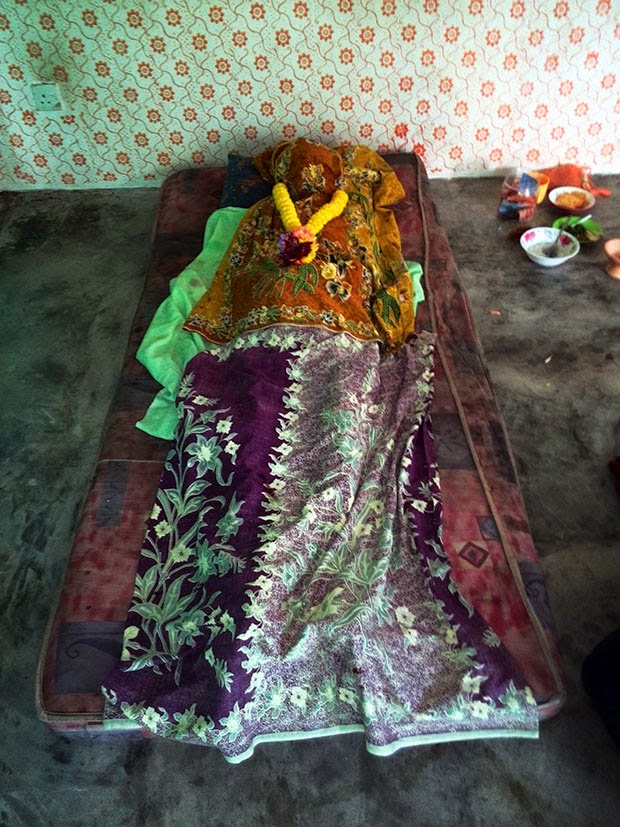
Bidar Chik was appointed Batin of Kampung Pertak in 1994, the year I took up residence
in the High Hut. Initially we had our differences - when he allowed loggers into the area -
but we became close allies during the campaign against the Selangor Dam a few years later. My parting gift to him was this garland.


PULAU BUAH, the Isle of Fruits, is the Temuan paradise, the Garden of Eden we knew as Home before the... what? The Fall? The Great Flood? Even Seri Pagi wasn't too sure what terrible crime we had committed as a species to have warranted banishment from Pulau Buah. Surely the gods would not introduce sexual reproduction to the human race only to punish us for it? (No one seemed to have given this any thought. Indah merely told me the tale she probably heard when her first period arrived: the one about Tuhan finding menstrual stains on the Stairway to Heaven and deciding to seal it forever to humanity.)
    
“Sometimes we can still visit Pulau Buah,” Seri Pagi said, “but only in dreams, or if we're very ill and in a sort of coma. In the old days, we had dukun (shamans) who were powerful enough, and pure enough, to travel there without losing their physical connection to the Earth. Nowadays, we only tell stories about Pulau Buah.”
   
Mak Minah said her great-grandmother used to travel to Pulau Buah in her dreams. “She told us there was a great tree in a beautiful clearing by a crystalline stream. The tree was laden with ripe rambutans (a hairy-skinned, succulent, juicy fruit) - only these were no ordinary rambutans, they were enormous! And best of all, she could reach up and pluck a fruit from the lowest branch without any effort. The spirit of the tree told her not to throw away the peel after she had eaten the fruit. Instead, she had to carefully place the peel on the ground below the branch where the fruit had been growing. One fruit was enough to satisfy her, it was so large and so delicious. The next time she returned to the spot, the same fruit was back on the branch, ready to be plucked and eaten!”
    
Nadi Empok & his wife Lumoh in 1994
Penengah admitted that he had tried to visit Pulau Buah in his youth, and failed. “Before you can proceed, you must go to the foot of Gunung Raja and wait for an invitation. If the guardian favors you, you will somehow find yourself going up the mountain. I've heard the old folks telling of signs and special spirit guides that can show you the path to Pulau Buah, which is not in this world. I didn't even get beyond the foot of Gunung Raja. If the guardian doesn't want you to enter the sacred realm, the mountain itself will move away, so that you find yourself somewhere else. 

Well, that's what happened. I was there with a few friends. We were certain it was Gunung Raja. Then there was heavy rain and strong winds and strange sounds that really frightened us. Of course, it could have been a tiger or leopard, but even if it was, you can bet it was no ordinary tiger or leopard. When the weather cleared, we realized we were nowhere near Gunung Raja. We turned around and somehow found our way back to the village. We were glad to be alive.”
    
Nadi Pak Empok may have been on that expedition. Or he may have made a separate attempt to scale Gunung Raja. He spoke reverently about the very special atmosphere that pervades the Royal Mountain, even around its base. The beautiful birds and plants he saw along the way, the mysterious cries of unknown creatures. “We heard the musical voices of maidens calling to us. It was hard not to obey their call, it was so seductive. But one of the group suddenly told us to flee for our lives, and we did. I don't know what would have become of us if we had tried to find the source of those haunting cries.”
    
Utat Merkol a year before he left for
Pulau Buah in 2007
Soon after the Selangor Dam project was announced, I found Utat lying feverish on a mat in Indah’s house. “I dreamt about Pulau Buah,” he whispered. “I was there, at the peak of Gunung Rajah, and I saw Mamak and Inak Bongsu.” I was all ears. Anoora’s uncle Utat rarely discussed his dreams, being an exceptionally private and shy man, but he revealed that he had twice been summoned to the Sacred Mountain by the Temuan’s tutelary gods - a signal honor for any Temuan.
    
“How did they appear to you, what did they look like?” I prompted Utat.
    
“They were absolutely splendid, more beautiful and much, much grander than kings and queens. They looked human, but in a more luminous, far nobler form.” (Lothlorien and the High Elves immediately came to my mind.)
    
“What did Mamak and Inak Bongsu have to say to you?”
    
Utat was silent for a moment. “They said they were very concerned about the destruction that is about to take place. The dam. It makes them angry and they want me to warn people that this desecration is loathsome to them. They have the capacity to destroy the dam, but they do not wish to harm anybody.”
    
“Well, are you going to tell the rest of the tribe?”
    
Utat shrugged and was silent. “People won’t believe me,” he finally said.
  
“WHEN SOMEONE DIES,” Penengah said, “their soul wanders around familiar places for a while before a longing to go home takes them towards Gunung Raja. After a while, they will find themselves at a fork in the trail. One path leads to Pulau Buah; the other... well, the other leads nowhere.”
    
How does one identify the correct path?
    
Penengah seemed reluctant to reveal the signs that would indicate the correct path. Then a gleam appeared in his eye and he whispered: “We don't usually talk about this, but I think you will understand why. For years people have tried to sway us from our beliefs. They wanted us to convert to Islam or Christianity or whatever. But our ancestors warned us about this. They told us there is a black dog guarding the path to Pulau Buah. If the soul is destined for Pulau Buah, the dog wags its tail and shows the way. But if the dog growls, it means the soul has accumulated too much sin (dosa).    
    
What happens if someone takes the wrong path?  
    
“They find the path easy going at first, very well maintained and attractive to behold. But at the end of the trail, they find themselves on an illusory bridge that goes nowhere.”
    
Can you describe what happens to someone who tries to cross the bridge?
   
“Well, they drop into a pit when the bridge collapses. A pit full of rats and cockroaches, creatures of the dark that devour anything that falls in.”
    
Sounds like hell to me. Is this the influence of Muslim and Christian eschatology on the Temuan belief system? Or is the Heaven-Earth-Hell configuration a common denominator of all human cosmogony?

Bidar (left) officiating at the engagement ceremony of Anoora's pretty niece Halus in 2010

ENGLISH TRANSLATION OF A LETTER FROM BIDAR CHIK (BATIN OF PERTAK) TO ABDULLAH AHMAD BADAWI (5TH PRIME MINISTER OF MALAYSIA)

Batin Bidar Chik
No. 1 Kg Pertak
Batu 8, Jalan Gap
44000 Kuala Kubu Baru
Ulu Selangor

13 April 2004
Y.A.B. Perdana Menteri Malaysia
Datuk Seri Abdullah Ahmad Badawi
Pusat Pentadbiran Kerajaan Malaysia
Putrajaya 62502

Sir:

Why do so many Orang Asli lack motivation?  Because we feel homeless in our own homeland.

1. We congratulate and welcome you as our new prime minister.  It is our hope that with a fresh beginning, a new era of justice and wise governance will dawn.  I am only the humble headman of a small village of Orang Asli from the Temuan tribe in Ulu Selangor, voicing my thoughts and feelings.  But I have faith that my voice will be heard by the Honourable Prime Minister.

2. The beauty of the Pertak Forest Reserve where our small village of 43 houses is located has attracted many visitors from far and near.  Now that the Selangor Dam is complete, even more people are coming here to fish from the artificial lake.  We are glad that people appreciate the beauty of our ancestral homeground, birthplace of the Temuan tribe, indeed, our “pusat negri.”

The High Hut at Lata Puntung where I lived from April 1994 till October 1999

3. When we were resettled by the dam project, the Jabatan Hal Ehwal Orang Asli (JHEOA) assured us that each family would be issued an individual grant for our new houses, along with some dusun land.  However, nothing was said about the 400 acres approved for gazetting in 1965 as Orang Asli Reserve Land.  After 39 years, the status of this land remains uncertain.  We would like this matter clarified in writing.

4. In February 2004, we were informed that our new houses stand on State land for which we have been granted a 99-year lease.  We received a letter from the Land Office asking us to pay an assessment of RM540 by 11 May, 2004, or our land and houses will be forfeit.

5. There are few families in Kg Pertak that can afford to pay this amount in three months, or even six.  I cannot imagine what will happen to my sister-in-law, a widow who receives a monthly cash subsidy of RM70 from the Welfare Department.  How will she pay the assessment? 

6. The JHEOA told us not to worry about it.  They said Splash Sdn Bhd, the dam operator, has offered to pay on our behalf.  As nothing is in writing we have only their verbal promise.  Nearly a year ago the JHEOA organised a 3-day workshop on Fraser’s Hill for a group of villagers.  Each participant will receive RM50, they said.  Those who went are still waiting to be paid.

Bidar Chik came into his own as tribal chief 
during the 1999 campaign against the Selangor Dam 
7. Our ancestors have dwelt here from the dawn of time.  Nobody knows how long the Temuan have been here, but it is safe to say we have been here for a thousand generations.  Now we are told the land is on a 99-year lease, and we must pay an annual rent to live here.  When my great-granddaughter’s children reach a ripe old age, the lease will expire, and the tribe’s future will be decided by the Land Office.  If they choose not to extend the lease, our community will die out, for the life and identity of the Orang Asli are tied to our ancestral lands.

8. The Jabatan Hal Ehwal Orang Asli has existed for 50 years since the Emergency.  Their duty is to look after Orang Asli interests, not to belittle us.  To be honest, we Orang Asli do not have much trust in the JHEOA.  They seem set on destroying our way of life and our beliefs.  In the past they have joined forces with loggers to exploit our forests and pollute our streams.  Now they have turned us into rent-paying tenants on land we have inhabited for thousands of years.  We are not happy about this.  The JHEOA have had 50 years in which to rob us of our dignity, pride, confidence, and self-reliance - not to mention the ground beneath our feet.  For Orang Asli, the Emergency is not over yet.

9. Honourable Prime Minister, we humbly request that you intervene to save us from the JHEOA, which treats Orang Asli like unwanted stepchildren.  They never listen to us and they do not understand or respect us.  They tell us to let loggers clear our beautiful jungle so we can cultivate cash crops.  In the 1960s we were told to plant rubber trees but when they matured there was no demand for latex.  Now they talk about oil palm, but we do not understand the business, and do not wish to be at the mercy of middlemen and unstable market prices.  Most importantly, the forest must be preserved, not only for Orang Asli, but for all who value God’s creation.

10. We would rather be given the Reserve Land promised us 39 years ago so we can hunt and harvest fruit as we have always done.  We can also start small-scale ecotourism-related projects that will preserve the forest, and that will give us a chance to be our own bosses.  Younger Orang Asli who wish to seek their fortune elsewhere are encouraged to do so.  But as long as we have our ancestral lands, they at least have something to return to.

11. We urge that you investigate the unresolved issue of the 400 acres approved for gazetting in 1965 as Orang Asli Reserve Land, and instruct the Land Office to issue a communal title deed.  This is surely not too much to ask, as our ancestors originally roamed the whole of Pahang, Selangor, and Negri Sembilan.  But without the sense of permanency granted by official recognition of our customary lands, our people will be in despair and lack direction.  Grant us the land our ancestors left us as their legacy, and free us from the heavy-handed control of the JHEOA.  This is how we can regain our self-esteem, our spirit of independence, and our ability to prosper from the fruits of our own initiative.

12. The rest of the nation won its independence from colonial rule 47 years ago.  We feel it is time we Orang Asli, too, are allowed to taste the dignity and joy of freedom. 

13. A copy of this letter will be handed to Persatuan Orang Asli Semenanjung Malaysia (POASM) to be shared with my fellow Batins.
Yours faithfully,


Bidar Chik
Batin Kg Pertak
Ulu Selangor


[First posted 6 June 2014, reposted 6 June 2019 & 9 June 2023]

Tuesday, February 10, 2026

'Merdeka' Means Having No Debts! (reprise)

First published in the Sunday Mail, 31 August 1997, in abridged form and subsequently included as a chapter in TANAH TUJUH ~ Close Encounters with the Temuan Mythos (Silverfishbooks, 2007)
Uman, Anoora's stepmother, in 2005

“UNFORTUNATELY, many of us still owe the Chinese towkays (Big Bosses) thousands of ringgit,” a Temuan elder admitted with a sardonic grin. “Every durian season we have to give them first option on our harvest.”

But how did this vicious cycle of hutang (indebtedness) begin?

“Well, no bank will loan us a cent, so we ask the Chinese towkays for help. When our sons and daughters get married, we need money to hold feasts. Sometimes we need a motorbike or a bushcutter. Usually it's just an accumulation of basic necessities like rice, cooking oil, cigarettes - which we buy on credit. If there's no durian season, hutang lah!”

We were sitting around my mother-in-law's shanty in Kampung Pertak, drinking sweet black tea. Some were chewing betelnut while others just chewed the fat. The fortieth anniversary of Merdeka was approaching. I asked Utat Merkol, who must have been about twenty when Malaya became independent, if he remembered the changing of the guards on 31 August 1957.

Utat Merkol in the late 1990s
He knit his already furrowed brow and slowly shook his head.

“Doesn't Merdeka have any significance at all for you?” I probed.

“Not really,” Utat replied. “In the days of Hukum Orang Putih (White Man Rule) we were treated quite well. Every month the government supplied us with rice, sugar, cooking oil and other necessities.”

His younger sister Indah piped in: “I remember that everything cost so much less!”

This triggered off animated talk about the bounty of nature in pre-Merdeka days. My sister-in-law Anggu recalled her father's stories of the days when one could just dip a basket in the stream and return with a fishy feast for the whole family.

From conversations I've had over the past few years with various Orang Asli, it's obvious that they don't have a clearly defined notion of nationhood as a political abstraction. In the old days they identified themselves along purely tribal lines. Intermarriage with other tribes or ethnic groups would occur from time to time, but the idea of being part of a larger Orang Asli community is a fairly recent one - and one that has been thrust on them by anthropologists and bureaucrats.

Lumoh & Awa playing the Buloh Limbong at a gig in 2009
Broadly speaking the Orang Asli simply think of themselves as Manusia - Human Beings. They know this much: their nenek-moyang (ancestors) have inhabited certain bioregions at least since the Great Flood (perhaps 13,000 years ago). And before that? Who knows? Their tutelary gods, Mamak and Inak Bongsu, often spoke of returning to a home “beyond Pulau Buah (the Isle of Fruits or Paradise), beyond Tanah Sejuk (The Cold Land), beyond the highest heavens.”

Wherever they came from must be very, very far away from Tanah Tujuh (the Seventh Land or Seventh Planet).

Utat and his elder brother Diap (who was probably the last Keeper of the Stories) had hinted once or twice of battles between gods, between planets and stars... cosmic events beyond their comprehension. The Temuan, who used to be classified Proto-Malay by anthropologists (these days the preferred academic description is “Austronesian”), share linguistic roots with Malay, Tagalog, and other “Austronesian” tongues - including dialects spoken among certain Northern Territory aboriginal tribes in Australia. Many basic words are borrowed from Sanskrit. Manusia, for example, is from Manu - Progenitor, Archetypal Father. When we hear the word pusat, we usually think of “headquarters” or “administrative centre.” But to the Temuan, pusat means “belly button” or “navel,” which is its original sense in Sanskrit. This demonstrates that they have an earthier, gutsier, more visceral apprehension of reality. We urbanites have become too intellectual, too head-centred.

Halus in 1999 (photo by Colin Nicholas/COAC)
So what could Merdeka (Independence) possibly mean to an Orang Asli?

Colonizers come and go, but the indigenous tribes have rolled with the punches, assimilating whatever they could from the invaders. They themselves might once have been “invaders,” migration patterns being what they are, due to the vagaries of climate and tectonic upheavals that created whole new mountain ranges and land mass link-ups. One generation arrives to replace the previous - and life goes on in Tanah Tujuh (the Seven-Storied Land or Seventh Planet). This physical world that we inhabit is merely one of the middle stories.

Now and again, certain individuals may experiment with new-fangled lifestyles, as in the legendary case of Si Tenggang, a Temuan boy who ran off to join a trading ship and eventually became captain of his own galleon (after marrying a Malay princess, the story goes). Alas, success went to his head and Tenggang refused to recognize and receive his aged parents in their loincloths and crude dugout canoe, when they rowed out to his ship, anchored in a bay near his home village.

Heartbroken and humiliated, Tenggang's parents cursed the day he was born. Before long, a violent storm capsized Tenggang's ship and his roomy cabins were transformed into the limestone outcrop now known as Batu Caves, For generations the Temuan regarded it as a sacred site - until the land was acquired and developed into a Hindu shrine and tourist attraction.

(Even the fable of Si Tenggang has been assimilated into mainstream Malay literature. The 1992 New Straits Times Annual, for instance, featured a story by Adibah Amin - called The Stony Penitence of Si Tenggang - in which Tenggang and his family were recast as Malays.)

As tribal entities, the Orang Asli feel magnetically bound to their familiar hunting grounds. When forcibly evicted from their ancestral lands, they tend to wither spiritually and acquire negative traits like alcoholism and apathy.

My adopted kinfolk have told me hair-raising tales of massacres inflicted on their tribe over the last few centuries. Pirates from nearby islands used to hunt the Orang Asli for sport. The ones they captured alive were sold into slavery. Some ended up in Batak cooking pots. The White Man came and put a stop to all this - not so much for altruistic reasons but because the pirates were a threat to his merchant ships.

But why did the Orang Asli offer no resistance? Surely they had hunters and warriors amongst them who could be pahlawan and wira (defenders and heroes)?


“We are not an aggressive people,” Mak Minah explained. “Even though we feel anger, humiliation, and acute distress, we try to endure whatever befalls us. We believe that Tuhan (God) loves and looks after all his children.”

In true stoical tradition, the Orang Asli have generally sought peaceful co-existence rather than armed conflict. Even after wave upon wave of migrants arrived and began staking claims on their ancestral lands, the Orang Asli were more inclined to show hospitality instead of hostility. However, as in the famous story of the Arab and his camel, they now find themselves crowded out of their own domicile by pendatang (newcomers) armed with “legal” documents. Some say the meek shall inherit the earth. But when? After the earth has been turned into an industrial wasteland, a virtual Neraka (Hell)? Would an Orang Asli be shouting “Merdeka” in Neraka?

Yam Kokok & Karim reroofing the Bamboo Palace (2008)
Merdeka, as a political concept, holds no emotive meaning for the Orang Asli. In their own eyes, they have always been free. Even when foreign invaders called them sakai (the equivalent of “nigger” or “slave”) and treated them no better than cattle, they remained free in spirit by retreating deeper into the mysterious jungle - and into their own myth-bound psyches.

And they shall always be free (though the left-brained among us may perceive their love of independence as “backwardness” or “obstinacy” or “unreliability” or “indiscipline” or “recalcitrance”). Whether it's Hukum Orang Putih (White Man Rule), Hukum Melayu (Malay Rule), or Hukum Hutang (Rule of Perpetual Debt) - you'll never catch an Orang Asli yelling, “Merdeka!”

Only those who lack the reality resort to shouting slogans.

[First posted 30 August 2010. Reposted 9 February 2020]

Friday, January 30, 2026

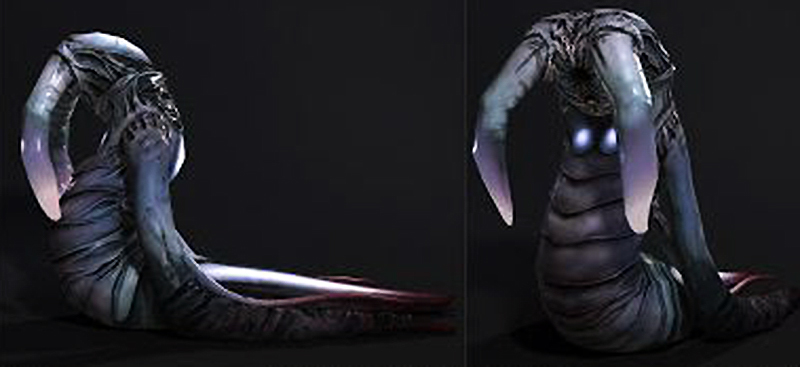
The A Bao A Qu Mystery Revisited

Fanciful depiction of the A Bao A Qu found on the internet

IN APRIL 1993 I received a strange request in the post. John Hagedorn - an American educationist-cum- percussionist then based in Alexandria, Egypt - wrote asking me to research the Malayan origins of the legend of "A Bao A Qu." Hagedorn's travel-writer colleague, Christopher Green, had unearthed this obscure tale from Jorge Luis Borges's 1967 Book of Imaginary Beings.

Borges claimed he had found the "A Bao A Qu" story in the appendix of C.C. Iturvuru's 1937 treatise, On Malay Witchcraft. I finally tracked down Borges's version of the "A Bao A Qu" story in the University of Malaya library - so I can vouch for the reliability of Green's succinct summary of this hoary tale:

To see the most lovely landscape in the world, a traveler must climb the Tower of Victory in Chitor

King Kumbhakaran
aka Rana Kumbha
[Green says he found on a map of India a town named Chitor. For what it's worth, there is indeed a town named Chittorgarh in Rajasthan province where the legendary warrior king Rana Kumbha constructed a Tower of Victory in 1448.]

A winding staircase gives access to the circular terrace on top, but only those who do not believe in the legend dare climb the tower.

On the stairway there has lived since the beginning of time a being sensitive to the many shades of the human soul known as A Bao A Qu. It sleeps until the approach of a traveler and some secret life within it begins to glow and its translucent body begins to stir.

As the traveler climbs the stairs, the being regains consciousness and follows at the traveler's heels, becoming more intense in bluish color and coming closer to perfection. But it achieves its ultimate form only at the topmost step, and only when the traveler is one who has already attained Nirvana, whose acts cast no shadows.

Otherwise, the being hesitates at the final step and suffers at its inability to achieve perfection

["Its moan is a barely audible sound, something like the rustling of silk."]

It tumbles to the first step as the traveler climbs down and collapses weary and shapeless, awaiting the approach of the next traveler.

In the course of the centuries, A Bao A Qu has reached the terrace only once.

For some reason I felt sure that C.C. Iturvuru (what an amazing name!) had heard the tale from an Orang Asli. The first person I asked happened to be Seri Pagi (though I only knew him as Pak Diap then). I gave him a simplified rendering of the A Bao A Qu legend and waited while the rusty gears of his memory whirred. His brow furrowed and then he broke into a broad grin, exclaiming in triumph: "Abang Aku! You mean Abang Aku!"

But of course. The way Orang Asli slur their vowels (especially in the states of Negri Sembilan and Pahang), Iturvuru might well have heard it as "A Bao A Qu." My Elder Brother, Abang Aku.*

I felt a jolt of electrifying knowledge. Diap said he remembered hearing a story similar to that when he was very young. It involved a spiral stairway connecting one dimension to another. A stairway once used by visiting or incarnating stargods. They say some got caught out by the calamitous closing of the interdimensional pathways. Once brilliant stars in their own universe, they fell to Earth and became ensnared in Time. Some of them ended up just like poor Abang Aku alias A Bao A Qu. A spirit fragment of cosmos caught in the gravity of human karma; a glorious starbeing lying inert at the bottom of the stairway to heaven, dependent on messy human destiny for its own fulfilment.

Only one other Elder seemed to have heard of Abang Aku. Village shaman Sudin Aus kept nodding sagely when I outlined the A Bao A Qu story to him. Then he smiled and said, “My Elder Brother is a reference to the Orang Asli. Our spirit will not be free until the younger races achieve nobility of purpose and purity of heart.”

Almost everyone, however, was familiar with the cryptic image of the long and winding stairway to the most wonderful view on Earth.

THE A BAO A QU MYTH evoked images of chakras - energy spirals operating on macro and micro levels - primordial forces attaining self-awareness, and nebulous notions of some deep alchemical mystery - an H.P. Lovecraftian vision of the strange, chthonic thoughtfields from which our familiar symbols sprout. 


“Abang Aku” brought to mind the Great Old Ones, ancient squid-like beings central to Lovecraft’s Chthulu tales. (It also brought to mind Gurdjieff's Kundabuffer. This peculiar word was coined in the 1920s by the Greek-Russian magician-philosopher, G.I. Gurdjieff, to explain some "tragic flaw" in Man's genetic program which condemns him to futile lifetimes of Sisyphean** struggle, forever slipping back into robotic animality just when he's on the threshold of illumination. 

Some believe that this "Kundabuffer Effect" was deliberately installed by a somewhat insecure Creator God (or gods), to retard the evolution of human intelligence and thereby perpetuate a harnessable labour force on Earth. The Tower of Babel story lends credence to this notion of an "Almighty Father-God" who, feeling threatened by his mortal creatures' overweening ambitions, confounds them with a babble of tongues. Another scenario describes how humanity had its original 12-strand DNA reduced to two, to confine our consciousness within the physical world.)

I sensed that the A Bao A Qu story offered a key insight into the magical teachings of the Ancients. At some remote point in the infinite spiral of existence, an aspect of Spirit found itself trapped in a Promethean*** nightmare loop of recurring time. Only a self-realized and karma-free human could release the A Bao A Qu from its eternal yearning for perfection.

Tower of Victory in Chittorgarh,
Rajasthan, India

The Tower of Victory. Victory over death? Despair? Futility? The magic column of ascension, located in Chitor. Chita? Chita, cita, cinta, citta. Sanskrit for a quality difficult to define: essentially, citta means mindstuff, consciousness.

Chita or cita is closely related to cinta, romantic love - desire, emotions, feelings, longing, love, aspiration. (It could also, by invoking homophonic licence, be a slurring of cherita - nowadays spelled cerita - which means "story.") In effect one might describe chita as a poetic symbol for the Imagination, the Desiring Mind. But this is assuming it is related to Chitor, the town named in the legend of A Bao A Qu. And I assume it is, because myth is meant to be a malleable, dreamlike substance. 

The test of myth-entering keys lies in their emotive resonance when struck. Substituting “Abang Aku” for “A Bao A Qu,” “Chita” and “cerita” for “Chitor,” and “you” for “the traveler” - what do we get? A metaphysical conundrum that echoes in some barely remembered attic of our unconscious. A vague feeling of déjà vu, of “When did I dream this dream?” 

Was I the intrepid traveler, the hero, the messiah, redeemer of gooey amorphous geeks? Or was I Abang Aku himself, waiting eon upon eon for humanity to attain Buddha and Christ consciousness? Who else would have “already attained Nirvana,” whose acts would “cast no shadows” - in other words, be completely free of karmic consequences. And who might this Exalted Being be - if not our own Noblest Aspect, the Omega point of our Adamic Alpha?

That's why Abang Aku reaches perfection only once. However, his dream body or holoform remains embedded in the mythic realm as a timely trigger, to awaken anyone who chances upon the legend to the nature of his or her true purpose on this Earth.


______________

*  A. Ghani Ismail, an ardent scholar of Malay esoteric lore, offers some information which sheds a whole different light on the A Bao A Qu legend. He suggests that the phrase in question is actually a slurring of “Ibu Aku” (“My Mother”), explaining that in pre-Islamic Malay shamanism, the gateway to other dimensions was via an inner journey through the spiral staircase of the etheric umbilical cord which reconnects us with our pre-birth experience of oneness with the Mother. By voyaging beyond the point of our own conception, we break through the veils of time and space and regain cosmic consciousness. I thought this variation on the theme warranted inclusion, at least as a footnote.

** Sisyphean: from Sisyphus, in Greek mythology a cruel and cunning king of Corinth, who was punished in Hades by being made to roll a heavy boulder up a steep hill. Every time he got to the summit, the boulder would roll back down the hill, and Sisyphus had to repeat the process over and over forever.

*** Promethean: from Prometheus, in Greek mythology a first-generation god (or Titan) of Fire and Intellect, who returned the gift of Fire to Mankind (which Zeus the second-generation Olympian had withheld) - and for that was chained to a rock and his liver devoured by an eagle every day. Every night, the liver would regenerate and Prometheus would come back to life, only to have the eagle eat his liver all over again, and so on, ad infinitum. (It's less gory, but a lot scarier, when you approach this mythic morsel as a giant metaphor for compulsory reincarnation: Prometheus is the Soul, the rock is the physical world, the liver represents a lifetime, and the eagle is the emblem of Higher Authority or Spiritual Law. As a symbol, the eagle is interchangeable with the Indonesian garuda, the Chinese phoenix, the Mexican quetzal, or the Russian firebird, which represents Eternal Return. And Prometheus, the Fire-Bringer, is often identified with Lucifer, the Light-Bringer.) From the 'Management' point of view, Prometheus is a subversive element -  but 'Labor' would see him as a cult hero, a freedom fighter, a System-bucking Little Red Robin Hood!

[This essay was originally included as a chapter in my book TANAH TUJUH ~ Close Encounters with the Temuan Mythos, published by Silverfish Books in 2007. First posted 15 October 2022. Reposted 24 October 2025]


Monday, January 12, 2026

The Unwashed Dukun of Pertak

Sibin Aus in 2009 & several years later, perhaps 2014 (Photo by Antares)

ORANG ASLI FOLK MEDICINE - generically known as jampi - is feared and respected by most “modern” Malays - even regular mosque-goers who drive Proton Wiras and subscribe to the high-tech pseudo-mysticism of full-tilt industrialization. The Chinese have their own sinseh (traditional healers) or access to Thai witch-doctors. Working-class Indians continue to patronize roadside kuil (temples or shrines) for divine intercession, while the middle-class or westernized ones prefer to take their medical problems to private clinics and hospitals.  

Sibin Aus is the resident dukun (medicine man) of Kampung Orang Asli Pertak. He once told me that he studied the craft for three years in Pahang before establishing his own practice. Three years doesn't sound like a very long apprenticeship, especially for something as complicated as sorcery - but I felt it wasn't my place to probe further. The fact remains that Sibin is often sought out from afar for a bit of good, old-fashioned Orang Asli jampi. 

Recently, I was approached by a corporate-type Malay seeking a magical remedy for his wife's “feminist rebellion” against the patriarchal family order. He didn’t want “counseling” - he wanted the “real stuff” - so I pointed him in Sibin’s direction. After the man left, I was curious to know what the crafty old shaman had prescribed, and how much the bill was. Sibin told me many months later, when he began to accept me as a “colleague” of sorts, that he had given the afflicted husband some Pengasih Rindu (Lover's Yearning), a love potion concocted from tree roots. The bill came to exactly RM88. 

The High Hut in 1997 (photo by Ahmad Sabki)

SIBIN HAS an excellent singing voice and usually serves as the chief spirit-caller whenever a sawai (ritual healing) is convened. Nobody in the village seems to take Sibin too seriously, since he is invariably either completely inebriated or recovering from a monstrous hangover. The kids all call him Berk'ot - Smelly or Unwashed - and to Sibin's credit, he never seems to mind.

Awa Anak Lahai, Sibin's long-suffering-but-always-jolly wife, is also a much called-upon traditional healer and sawai singer. Awa likes operating as a trio, along with her inscrutable, feline-faced elder sister, Mak Nai and the celebrated Mak Minah (perhaps the first Orang Asli vocalist to appear on a nationwide live telecast). When they first asked me for a ride to the bus station, I asked them if they were off on a jaunt, and they said they were “on call.” Some poor soul in Rasa (a village about five miles south of Kuala Kubu Baru) had been cursed with an incurable disease, and in desperation a relative had come seeking help from the “Three Witches” of Pertak. I was amazed at the reach of their reputation, and thus was somewhat taken aback when Awa and Minah began coming to me for medical advice!

I realized it was Utat who had recommended my healing prowess to his kinfolk after I had successfully treated his leg sores. (I used a combination of pranic healing and antiseptic cream.) I have since been called upon to perform a few minor “miracles.” Mostly, I have fulfilled the role of resident psychologist, since the Orang Asli have yet to acquire the habit - or perhaps the technical vocabulary - of articulating their emotional tensions, which then manifest as pening (dizziness or headaches), demam (fever), or perut sakit (abdominal pains).

Side view of the High Hut (Ahmad Sabki)

The first time I actually witnessed jampi was when Daharom, the Indonesian caretaker of my former Magick River residence, appeared in the village, complaining of acute pains in his kidneys or liver. He asked if I knew of any dukun (shaman) in the area, and as we were directly in front of Sibin's house, I led him straight to it. Sibin, as usual, had a hangover - but was ready to be of service. I asked if I could stay and watch him in action, and the medicine man immediately agreed. 

Sibin's wife collected some embers from the kitchen fire for the kemenyan (incense), while he shuffled into the next room (I suspect, to revive himself with another shot of Old Man Brand Tonic Wine, the Orang Asli favorite when it comes to plonk). When he emerged, Awa had got the kemenyan going nicely, and the small, dark room was filled with the evocative fragrance of burning wood-resin. Sibin began muttering incantations - very rapidly and softly - before smudging himself and his patient with the incense. After a while, Sibin began feeling around Daharom's abdomen with his grubby, stubby fingers before bending down and licking, then sucking at a specific spot. This went on for several minutes. 

Finally, the witch-doctor let out a triumphant grunt and spat something into his hand, which he proceeded to show to Daharom and me. I saw several chipped pebbles in Sibin's open palm. He said he had removed the stones from Daharom's kidneys. As Sibin wasn't even wearing a shirt, he couldn't have had the pebbles up his sleeves. Of course, he could easily have hidden them under his tongue after he had taken a swig from his bottle of tonic wine. Then, again, he could just as easily have sucked the stony bits right out of Daharom's innards. Who am I to question the ways of jungle magic?   

For his stone-removal service, Sibin demanded only RM22 from Daharom, who complained that the fee was too high. After some haggling, Sibin accepted RM12 in payment. I never found out if Daharom's medical problem was satisfactorily resolved in the long term. If it was, then Sibin's RM22 fee was perhaps a great deal lower than what a western-style doctor might have charged. And if it wasn't... well, Daharom was certainly not the first person on Earth to lose a few bucks to a snake-oil salesman. At least, for his money, he had the dubious pleasure of getting his belly licked and sucked by a drunken and only slightly unwashed dukun. 

[Excerpt from TANAH TUJUH ~ Close Encounters with the Temuan Mythos, Silverfish Books, 2007]


Sunday, November 16, 2025

My Son, the Reincarnated King of Mu! (updated)

The High Hut aka Jabba @ 1996. Took about two months to build and cost me less than RM2,000. Our hillbilly fambly lived here without electricity... until a freak mudslide in October 1999 forced us to evacuate.

Best bathroom I ever had!
Life with the Pertak Hillbillies - old photos, sweet memories

Thought I'd found the ideal location, about 30 yards from a gentle 200-foot waterfall called Lata Puntung (Blowpipe Falls), right below Bukit Suir - which I later learned was the abode of the dreaded langsuir (jungle sirens akin to harpies or vampires).

It was quite spooky when I first moved in around April 1994. Whenever I was away for a couple of days, I'd return to find the food left for my dogs untouched but putrefying and crawling with maggots. Didn't take me long to discover why my dogs and the local folk seemed so wary of the location. It was the scene of a tragedy that occurred around 1907 when a mining tunnel (the eerie entrance to which was scarcely 50 yards from my High Hut) collapsed, burying alive 200-300 workers. Nobody can say exactly how many died, as the mine owner made himself scarce, fearing bankruptcy from having to pay compensation to the miners' families.

Fortunately, I had quite a few visitors who were geomancers, healers, shamans and wizards - and their collective efforts to ritually cleanse the area eventually cleared the psychic murk and brought more vitality and cheer to the spot.

Star Commander Lee Ahau Ben Anoor-Antares in his Pleiadian scoutship.
Ahau, Antares & Anoora at the High Hut @ June 1996 (photo: Jesse Hang)
Father & Son, June 1996 (photo: Chief Jesse Hang)


Father & Son @ 2008 (photo: Gabriel Herbst)


When my son Ahau Ben was born (at 2:00 am, 21 March 1996, at the Kuala Lumpur Hospital) everyone noticed that his head was remarkably large. (The photo at right was taken on his 13th day on Earth.)

He had to be delivered by C-section as his mother's pelvis was a little out of whack due to childhood polio. So when I first saw him, his curly hair was neatly pasted in tiny beautiful ringlets around his enormous head. I greeted him in star language and welcomed him to this funky and exciting but pretty much messed-up planet.

Our jolly joy boy rarely cried and smiled most of the time, a beatific Buddha smile. Before his first month I was calling him Doctor Baby because he seemed to be healing his mother Anoora's wounded heart by gazing at her with pure adoration whenever he suckled at her breast. Initially she couldn't handle the emotional intensity and had to quickly pass the infant to somebody else.

Anoora was hydrocephalic at birth, a melon-head baby who looked so grotesque her mother immediately offered to sell her to a nurse. However, her father intervened and sent the infant to Pahang to be raised by relatives. When I first met Anoora, she had no grasp whatsoever of what love was all about. Now her own baby was tutoring her on a daily basis.


This came as no surprise to me as I had established contact with the incoming soul during Anoora's pregnancy, and it had "told" me its original home was the Great Central Sun and that its mission on earth was to demonstrate the power of love. So I chose to name him Ahau Ben - Mayan starglyphs meaning Sun God and Skywalker or Celestial Messenger. Later I read somewhere that the last king of Mu (a lost civilization many have confused with Lemuria in the Pacific) was named Ahau. It now appears that Mu may have - in truth, if not in fact - referred to a vast bioregion encompassing East Asia and what is now known as Australia (see map below)!

Our Big Head Boy never learned to crawl. I guess his head was too heavy to be supported by his limbs. Instead, he inched along the floor on his bottom for a few months - until one day he decided his legs were strong enough to try walking. From early infancy, Ahau was exposed to many languages: English, Temuan, Cantonese, Tamil, star language... and he was always attentive to birdcalls and animal sounds. Ahau's great-aunt Mak Minah often sang Temuan lullabies to Ahau. Long after Mak Minah's death in 1999, Ahau still listens raptly to the entire Akar Umbi CD, occasionally singing along.

When he was around six months, he enjoyed squatting by himself a short distance from our High Hut and I would observe as he smiled secretly to himself, as if conversing with invisible folk.

I had expected Ahau to learn human speech quickly but he did just the opposite. His vocal range was astonishing: he could produce extremely high-pitched squeals that reminded me of dolphins and sometimes he uttered distinct syllables in an unknown tongue. Certain phrases would be repeated consistently, but it sounded like no language known to any of us. One day he distinctly said: "Maniam!"

And from then on he began experimenting with endless variations on the theme. I began telling friends that Ahau spoke Maniamese - a language consisting of only one word expressed in countless ways. Subsequently he switched from Maniamese to Bunyip - a language spoken by only one person on earth, Ahau Ben, affectionately dubbed The Bunyip.

Close friends and family began to express concern about Ahau's inability or refusal to communicate in recognizable human languages. I teased him about being a non-English-speaking Bunyip and he would smile and go, "Ho ho ho!" in as low a register as he could muster (this was before his voice broke). He apparently understood just about everything people said to him - but only very rarely would he deign to communicate in English. 

When he was three, I went away for more than a week and when I returned, I distinctly heard Ahau say, "Welcome back, Daddy!" as he threw open his arms for me to lift him up.

One day a friend's 10-year-old son rushed out from the room where he had been tickling Ahau and excitedly reported that Ahau had said to him: "Okay, that's enough!"

Nevertheless, I finally succumbed to well-meaning advice and took Ahau to see a specialist at Tawakal Hospital. The Egyptian neurologist who examined him said the only way to ascertain if there was any problem would be to do a series of MRI scans. So Ahau was made to swallow some liquid anesthetic which knocked him out within 15 minutes. It was quite surreal to watch my unconscious boy being wheeled into the MRI chamber - it was like a scene out of a sci-fi movie. 

We waited anxiously as the neurologist studied the magnetic resonance images. Finally, he turned around and said: "Well, the good news is the scans show his brain is perfectly normal, no fluid in the cranium, apart from this bit of mucus in his sinus passages."

I enquired if there might be some medical explanation for Ahau's disinterest in acquiring the routine skills other kids his age find easy to master. The neurologist mulled over this for a few moments, then he said it could be due to any number of factors - from genetic to environmental, he couldn't really say for certain.

He remarked that Ahau had the largest brain of any kid he had ever encountered. "He could turn out to be a supergenius... or maybe he's really an alien," he added with a smile. His parting words were most reassuring: "My advice to you is to keep him away from doctors!"

Well, there are days when I wish Ahau was like other kids. It would be nice to hear from him the inside story on his mother - what it was like being in her womb for nine months. Every father relishes going on long walks with his son, doing a bit of male-bonding and stuff... but, then, I'll never forget the look on Ahau's face when he saw me being wheeled into an ambulance in December 2009. Without a moment's hesitation, he ran up the steps and plonked himself on the seat beside me, determined to accompany me wherever I was being taken. His surrogate mum Mary (above, right) had to forcibly drag him out, reassuring him that his Daddy would be fine and that he could visit me very soon...

When I emerged from a 5-day induced coma and regained my strength, I kept hearing Ahau singing to me from a few feet away. I was convinced that Sungai Buloh Hospital was only a short distance from Magick River... later I realized that my mind was operating in multiple dimensions and that Ahau was watching over me from the astral plane or dreamtime - perhaps his natural habitat.

I was shown a glimpse of an alternate universe where telepathy made human speech redundant and reminded that Ahau had chosen to incarnate through Anoora and me because it was the only way he might escape school - where his brain would be formatted and stuffed with useless information, rendering him incapable of completing his mission. He didn't travel all this way to conform to human expectations.

A few years ago, Ahau had met a Mayan clairvoyant named Carlos Palada and taken an instant shine to him. We looked on in amusement as Ahau plonked himself on Carlos's lap and began "talking" excitedly to him in a series of high-pitched squeals that sounded like some antique dial-up modem. After 10 minutes or so, I could no longer contain my curiosity. I asked Carlos if he could understand Ahau's language, and Carlos explained that Ahau was transmitting high-frequency packets of visual data, decodable only to somebody with an activated causal chakra.*

"Well... what's he telling you?" I asked, and Carlos said something I'll never forget:

"He was showing me video clips of what this place looked like about 80,000 years ago. There were dinosaurs around then. He's from a fifth-dimensional race that only appears on third-dimensional planets like Earth whenever we're undergoing a massive transition... their work is to stabilize the electromagnetic grids... his last visit here was sometime before Lemuria was destroyed."

Ahau's favorite spot in the whole wide universe!
Whenever Ahau's stubborn resistance to acquiring basic skills gets on my nerves, I have to remind myself that I actually heard this report from Carlos Palada - an amiable guy with emerald green eyes, working for a Japanese construction firm in Singapore, when I first met him in 1997 at a Flower of Life workshop. Carlos had absolutely no reason to make up such crazy stories.

I mean, even if Ahau's an alien... why can't he brush his own teeth, dress himself, open bottle caps, wipe his own bum?

Ahau, Anoora & my grandson Max at Soluntra's Rock

I can hear Ahau sending me a burst of high-pitched audio signals which might translate into something like: "Where I come from intelligent beings don't grow teeth, don't wear clothes, we drink directly from the clouds, and there are no assholes that require wiping, because we're smart enough to eat stuff that doesn't turn into shit!"

Okay, okay, okay, Ahau.... I'll cut you some slack.... for now.

__________________

* In May 2014 Ahau gave us a scare when he collapsed in fits and had to be hospitalized for 5 days. The doctor at KKB district hospital took a long time to intubate him and when I asked him why it was so difficult, he declared that Ahau's larynx was like no other he had ever seen. "Nothing wrong with it, just that it's not a normal human larynx." It was only then I understood why Ahau refused to speak human languages - his vocal cords are simply not designed for human speech.

In the wee hours of 21 December 2017 I found an Arabic-subtitled video on YouTube summarizing the Pleiadian involvement with Earth's evolution and did a screen capture of this unusual map:


Postscript: When a friend heard about Ahau's 5-day hospital experience she intuitively sent me some Transfer Factor (a colustrum-based tonic that reboots the immune system). Ahau enjoyed the orange-flavored chewable tablets and finished his two-month supply. Miraculously, he began to really flesh out, acquiring impressive muscle tone in the process. Here are a few portraits of the former King of Mu taken since 2015...

Ahau making his way upstream while Bonzo lazes on a rock

Ahau with a sling after breaking his left humerus on 1 January 2017
Wefie with his dad (who has also acquired some middle-age spread)
Portrait of the 21-year-old Ahau as a robust young lad

[First posted 21 October 2011, reposted 21 December 2017, 4 July 2018, 20 March 2023
& 15 November 2023]