Showing posts with label Orang Asli. Show all posts

Tuesday, June 9, 2026

The Path to Pulau Buah ~ In Memory of Bidar Chik, Batin of Pertak (repost)


Batin Bidar Chik discussing the impending Selangor Dam project in his Kg Pertak residence (1999)

Bidar Chik, Batin (headman) of Pertak, breathed his last on 6 June 2014 around 10:30 a.m. I dedicate this chapter from TANAH TUJUH ~ Close Encounters with the Temuan Mythos to his fond memory.
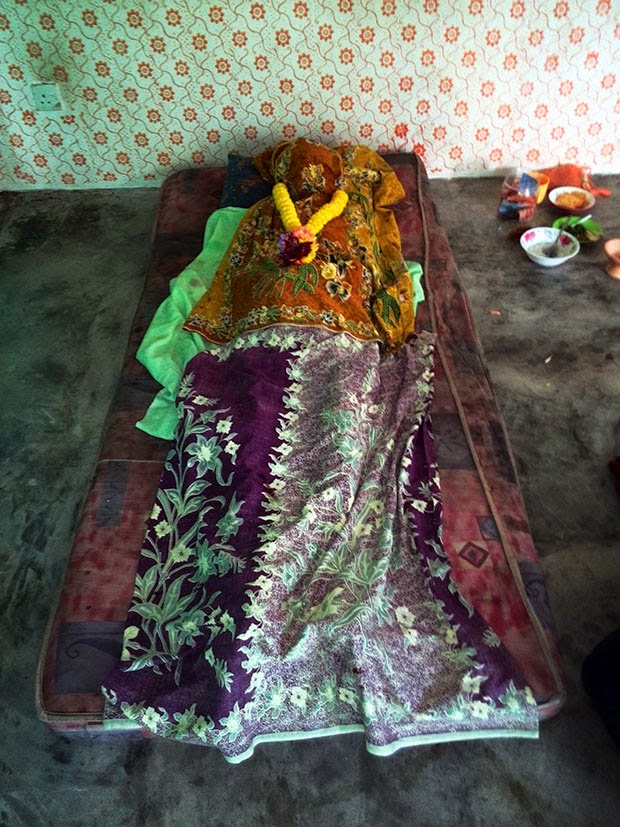
Bidar Chik was appointed Batin of Kampung Pertak in 1994, the year I took up residence
in the High Hut. Initially we had our differences - when he allowed loggers into the area -
but we became close allies during the campaign against the Selangor Dam a few years later. My parting gift to him was this garland.


PULAU BUAH, the Isle of Fruits, is the Temuan paradise, the Garden of Eden we knew as Home before the... what? The Fall? The Great Flood? Even Seri Pagi wasn't too sure what terrible crime we had committed as a species to have warranted banishment from Pulau Buah. Surely the gods would not introduce sexual reproduction to the human race only to punish us for it? (No one seemed to have given this any thought. Indah merely told me the tale she probably heard when her first period arrived: the one about Tuhan finding menstrual stains on the Stairway to Heaven and deciding to seal it forever to humanity.)
    
“Sometimes we can still visit Pulau Buah,” Seri Pagi said, “but only in dreams, or if we're very ill and in a sort of coma. In the old days, we had dukun (shamans) who were powerful enough, and pure enough, to travel there without losing their physical connection to the Earth. Nowadays, we only tell stories about Pulau Buah.”
   
Mak Minah said her great-grandmother used to travel to Pulau Buah in her dreams. “She told us there was a great tree in a beautiful clearing by a crystalline stream. The tree was laden with ripe rambutans (a hairy-skinned, succulent, juicy fruit) - only these were no ordinary rambutans, they were enormous! And best of all, she could reach up and pluck a fruit from the lowest branch without any effort. The spirit of the tree told her not to throw away the peel after she had eaten the fruit. Instead, she had to carefully place the peel on the ground below the branch where the fruit had been growing. One fruit was enough to satisfy her, it was so large and so delicious. The next time she returned to the spot, the same fruit was back on the branch, ready to be plucked and eaten!”
    
Nadi Empok & his wife Lumoh in 1994
Penengah admitted that he had tried to visit Pulau Buah in his youth, and failed. “Before you can proceed, you must go to the foot of Gunung Raja and wait for an invitation. If the guardian favors you, you will somehow find yourself going up the mountain. I've heard the old folks telling of signs and special spirit guides that can show you the path to Pulau Buah, which is not in this world. I didn't even get beyond the foot of Gunung Raja. If the guardian doesn't want you to enter the sacred realm, the mountain itself will move away, so that you find yourself somewhere else. 

Well, that's what happened. I was there with a few friends. We were certain it was Gunung Raja. Then there was heavy rain and strong winds and strange sounds that really frightened us. Of course, it could have been a tiger or leopard, but even if it was, you can bet it was no ordinary tiger or leopard. When the weather cleared, we realized we were nowhere near Gunung Raja. We turned around and somehow found our way back to the village. We were glad to be alive.”
    
Nadi Pak Empok may have been on that expedition. Or he may have made a separate attempt to scale Gunung Raja. He spoke reverently about the very special atmosphere that pervades the Royal Mountain, even around its base. The beautiful birds and plants he saw along the way, the mysterious cries of unknown creatures. “We heard the musical voices of maidens calling to us. It was hard not to obey their call, it was so seductive. But one of the group suddenly told us to flee for our lives, and we did. I don't know what would have become of us if we had tried to find the source of those haunting cries.”
    
Utat Merkol a year before he left for
Pulau Buah in 2007
Soon after the Selangor Dam project was announced, I found Utat lying feverish on a mat in Indah’s house. “I dreamt about Pulau Buah,” he whispered. “I was there, at the peak of Gunung Rajah, and I saw Mamak and Inak Bongsu.” I was all ears. Anoora’s uncle Utat rarely discussed his dreams, being an exceptionally private and shy man, but he revealed that he had twice been summoned to the Sacred Mountain by the Temuan’s tutelary gods - a signal honor for any Temuan.
    
“How did they appear to you, what did they look like?” I prompted Utat.
    
“They were absolutely splendid, more beautiful and much, much grander than kings and queens. They looked human, but in a more luminous, far nobler form.” (Lothlorien and the High Elves immediately came to my mind.)
    
“What did Mamak and Inak Bongsu have to say to you?”
    
Utat was silent for a moment. “They said they were very concerned about the destruction that is about to take place. The dam. It makes them angry and they want me to warn people that this desecration is loathsome to them. They have the capacity to destroy the dam, but they do not wish to harm anybody.”
    
“Well, are you going to tell the rest of the tribe?”
    
Utat shrugged and was silent. “People won’t believe me,” he finally said.
  
“WHEN SOMEONE DIES,” Penengah said, “their soul wanders around familiar places for a while before a longing to go home takes them towards Gunung Raja. After a while, they will find themselves at a fork in the trail. One path leads to Pulau Buah; the other... well, the other leads nowhere.”
    
How does one identify the correct path?
    
Penengah seemed reluctant to reveal the signs that would indicate the correct path. Then a gleam appeared in his eye and he whispered: “We don't usually talk about this, but I think you will understand why. For years people have tried to sway us from our beliefs. They wanted us to convert to Islam or Christianity or whatever. But our ancestors warned us about this. They told us there is a black dog guarding the path to Pulau Buah. If the soul is destined for Pulau Buah, the dog wags its tail and shows the way. But if the dog growls, it means the soul has accumulated too much sin (dosa).    
    
What happens if someone takes the wrong path?  
    
“They find the path easy going at first, very well maintained and attractive to behold. But at the end of the trail, they find themselves on an illusory bridge that goes nowhere.”
    
Can you describe what happens to someone who tries to cross the bridge?
   
“Well, they drop into a pit when the bridge collapses. A pit full of rats and cockroaches, creatures of the dark that devour anything that falls in.”
    
Sounds like hell to me. Is this the influence of Muslim and Christian eschatology on the Temuan belief system? Or is the Heaven-Earth-Hell configuration a common denominator of all human cosmogony?

Bidar (left) officiating at the engagement ceremony of Anoora's pretty niece Halus in 2010

ENGLISH TRANSLATION OF A LETTER FROM BIDAR CHIK (BATIN OF PERTAK) TO ABDULLAH AHMAD BADAWI (5TH PRIME MINISTER OF MALAYSIA)

Batin Bidar Chik
No. 1 Kg Pertak
Batu 8, Jalan Gap
44000 Kuala Kubu Baru
Ulu Selangor

13 April 2004
Y.A.B. Perdana Menteri Malaysia
Datuk Seri Abdullah Ahmad Badawi
Pusat Pentadbiran Kerajaan Malaysia
Putrajaya 62502

Sir:

Why do so many Orang Asli lack motivation?  Because we feel homeless in our own homeland.

1. We congratulate and welcome you as our new prime minister.  It is our hope that with a fresh beginning, a new era of justice and wise governance will dawn.  I am only the humble headman of a small village of Orang Asli from the Temuan tribe in Ulu Selangor, voicing my thoughts and feelings.  But I have faith that my voice will be heard by the Honourable Prime Minister.

2. The beauty of the Pertak Forest Reserve where our small village of 43 houses is located has attracted many visitors from far and near.  Now that the Selangor Dam is complete, even more people are coming here to fish from the artificial lake.  We are glad that people appreciate the beauty of our ancestral homeground, birthplace of the Temuan tribe, indeed, our “pusat negri.”

The High Hut at Lata Puntung where I lived from April 1994 till October 1999

3. When we were resettled by the dam project, the Jabatan Hal Ehwal Orang Asli (JHEOA) assured us that each family would be issued an individual grant for our new houses, along with some dusun land.  However, nothing was said about the 400 acres approved for gazetting in 1965 as Orang Asli Reserve Land.  After 39 years, the status of this land remains uncertain.  We would like this matter clarified in writing.

4. In February 2004, we were informed that our new houses stand on State land for which we have been granted a 99-year lease.  We received a letter from the Land Office asking us to pay an assessment of RM540 by 11 May, 2004, or our land and houses will be forfeit.

5. There are few families in Kg Pertak that can afford to pay this amount in three months, or even six.  I cannot imagine what will happen to my sister-in-law, a widow who receives a monthly cash subsidy of RM70 from the Welfare Department.  How will she pay the assessment? 

6. The JHEOA told us not to worry about it.  They said Splash Sdn Bhd, the dam operator, has offered to pay on our behalf.  As nothing is in writing we have only their verbal promise.  Nearly a year ago the JHEOA organised a 3-day workshop on Fraser’s Hill for a group of villagers.  Each participant will receive RM50, they said.  Those who went are still waiting to be paid.

Bidar Chik came into his own as tribal chief 
during the 1999 campaign against the Selangor Dam 
7. Our ancestors have dwelt here from the dawn of time.  Nobody knows how long the Temuan have been here, but it is safe to say we have been here for a thousand generations.  Now we are told the land is on a 99-year lease, and we must pay an annual rent to live here.  When my great-granddaughter’s children reach a ripe old age, the lease will expire, and the tribe’s future will be decided by the Land Office.  If they choose not to extend the lease, our community will die out, for the life and identity of the Orang Asli are tied to our ancestral lands.

8. The Jabatan Hal Ehwal Orang Asli has existed for 50 years since the Emergency.  Their duty is to look after Orang Asli interests, not to belittle us.  To be honest, we Orang Asli do not have much trust in the JHEOA.  They seem set on destroying our way of life and our beliefs.  In the past they have joined forces with loggers to exploit our forests and pollute our streams.  Now they have turned us into rent-paying tenants on land we have inhabited for thousands of years.  We are not happy about this.  The JHEOA have had 50 years in which to rob us of our dignity, pride, confidence, and self-reliance - not to mention the ground beneath our feet.  For Orang Asli, the Emergency is not over yet.

9. Honourable Prime Minister, we humbly request that you intervene to save us from the JHEOA, which treats Orang Asli like unwanted stepchildren.  They never listen to us and they do not understand or respect us.  They tell us to let loggers clear our beautiful jungle so we can cultivate cash crops.  In the 1960s we were told to plant rubber trees but when they matured there was no demand for latex.  Now they talk about oil palm, but we do not understand the business, and do not wish to be at the mercy of middlemen and unstable market prices.  Most importantly, the forest must be preserved, not only for Orang Asli, but for all who value God’s creation.

10. We would rather be given the Reserve Land promised us 39 years ago so we can hunt and harvest fruit as we have always done.  We can also start small-scale ecotourism-related projects that will preserve the forest, and that will give us a chance to be our own bosses.  Younger Orang Asli who wish to seek their fortune elsewhere are encouraged to do so.  But as long as we have our ancestral lands, they at least have something to return to.

11. We urge that you investigate the unresolved issue of the 400 acres approved for gazetting in 1965 as Orang Asli Reserve Land, and instruct the Land Office to issue a communal title deed.  This is surely not too much to ask, as our ancestors originally roamed the whole of Pahang, Selangor, and Negri Sembilan.  But without the sense of permanency granted by official recognition of our customary lands, our people will be in despair and lack direction.  Grant us the land our ancestors left us as their legacy, and free us from the heavy-handed control of the JHEOA.  This is how we can regain our self-esteem, our spirit of independence, and our ability to prosper from the fruits of our own initiative.

12. The rest of the nation won its independence from colonial rule 47 years ago.  We feel it is time we Orang Asli, too, are allowed to taste the dignity and joy of freedom. 

13. A copy of this letter will be handed to Persatuan Orang Asli Semenanjung Malaysia (POASM) to be shared with my fellow Batins.
Yours faithfully,


Bidar Chik
Batin Kg Pertak
Ulu Selangor


[First posted 6 June 2014, reposted 6 June 2019 & 9 June 2023]

Monday, June 1, 2026

GUARDIANS OF THE FOREST (documentary on the Temuan released in 2000)


Published on 14 Mar 2014

This film documents the plight of Malaysia's indigenous people, the Orang Asli, in their losing struggle to retain their traditional way of life in a rapidly developing nation. Pressures to renounce their beliefs, assimilate with Malay culture and make way for the modern world, are shredding the very fabric of Orang Asli life and culture.

We learn about the heartbreaking choices that a small community of Temuan Orang Asli face as they are about to be displaced by a giant dam project. The film also unveils chilling truths that speak to the decline of indigenous peoples all over the world.

Filmed in the lush Malaysian rainforest in the year 2000, this documentary provides a rare insight into a little-known community and introduces us to their haunting stories and songs.

Produced by Mary Maguire
Directed by Alan D'Cruz
Script by Antares & Rehman Rashid
Music by Akar Umbi
Narrated by Rehman Rashid
Featuring the voices of Huzir Sulaiman, Sandra Sodhy, Rafique Rashid & Jane D'Cruz
with a cameo appearance by Sherry Siebel

Executive Producer: Andrew Bird
Released & distributed by Verado Films, UK


[First posted 6 June 2014]


Monday, April 13, 2026

Winning Orang Asli Votes (updated)


Just before the by-election of April 2010 I received an email from the political secretary of one of the candidates asking me for suggestions on how to effectively campaign among the Orang Asli of Ulu Selangor. I was happy to provide an overview of how things stand with my indigenous kinfolk from the perspective of someone free of tribal imprints. The following is extracted from my email response...

Siama anak Penengah (died 2012)
Thanks for giving me the opportunity to delineate the key issues confronting the Orang Asli in general - and the Temuan community of Ulu Selangor in particular.

1. As with all indigenous peoples the most crucial issue is permanency of tenure on their ancestral lands. Without a sense of belonging to their tanah pesaka (customary lands), Orang Asli tend to become dispirited (and seek to numb themselves with spirits out of a bottle). An important case in point is Kampung Pertak, situated within a few kilometers of Gunung Rajah, their sacred mountain which they call Pusat Negeri. In February 1965 the Jabatan Hal Ehwal Orang Asli and the Selangor state government approved for gazetting as a permanent Orang Asli Reserve close to 300 hectares of forest reserve, stretching from Gunung Rajah to Sungai Luit which flows beside the present Kampung Pertak.

However, in 2004 the Land Office issued 99-year leases on an individual basis to the residents of Kg Pertak, effectively denying their claim to their tanah pesaka, and reducing their land holdings to a tiny fraction of what was promised them 45 years ago. [Dr Colin Nicholas of the Center for Orang Asli Concerns can supply you with the documentation for this.] Other Temuan settlements in Ulu Selangor are faced with different problems: those in Kg Tun Abdul Razak and Gerachi Jaya, for example, have been living in fear of being displaced by developers working in cahoots with the JHEOA and the Land Office. Kg Orang Asli Kolam Air, KKB, still has no electricity supply even though it is located less than half a kilometer from the nearest power line.

Amran @ Kuku
2. The feudalistic and patronizing attitude of the Jabatan Hal Ehwal Orang Asli (JHEOA) has effectively infantilized the Orang Asli, keeping them timid, intimidated and unsure of their rights. In Kg Pertak, for instance, the Batin doesn't have the authority to convene a majlis (village council) - only the JHEOA can call a meeting in the village. After more than half a century the JHEOA apparently has only three agendas: (i) forcing the Orang Asli to abandon their traditional ways by systematically destroying their forest habitat; (ii) cajoling them and offering them material incentives to embrace Islam; (iii) ensuring that the Orang Asli remain powerless and lacking in self-confidence so that the JHEOA can justify its continued existence.

What the Orang Asli urgently need are representatives in parliament and non-governmental agencies who can articulate their desires, bypassing the heavy-handed, short-sighted and self-serving JHEOA. Sincere and independent NGOs like COAC are underfunded and understaffed - but with regular funding and more staff they can do a far more effective job of bridging the gulf between the Orang Asli and the bureaucracy.

Koi
3. On several occasions I have helped Orang Asli widows, accident cases and the elderly to apply for financial support from the Welfare Department (Pejabat Kebajikan). In every instance I have been disgusted by the snail's pace at which the Welfare Dept staff operate. Sometimes it takes more than six months from the date of application for financial aid to be granted. Such a lackadaisical attitude cannot be tolerated as it can mean the difference between life and death for some Orang Asli.

What is urgently required is a special fund set up for the Orang Asli at the district level which can be used to provide immediate financial aid to those who cannot fend for themselves owing to unforeseen circumstances, e.g., accidents, ill health, old age, loss of family breadwinner. Red tape needs to be minimalized so the Orang Asli are not daunted by the process of requesting aid. This fund can also be utilized to help enterprising Orang Asli set up food stalls or build riverside chalets, so they can learn how to do business on a modest scale and remain their own bosses.


4. Before the construction of the Selangor Dam, a few Temuan from Kg Gerachi and Kg Pertak were earning good money working as river guides with whitewater rafting companies. Regular contact with tourists has made these Temuan conversant to a degree in English and their natural aptitude for the sport has given them a big boost in self-esteem. Unfortunately, the dam has severely impacted on the water level of the river, making whitewater rafting almost impossible. The Temuan river guides have repeatedly sought the cooperation of Splash Sdn Bhd (the dam operator) to release water every time they have rafting clients - but I'm told that Splash has simply ignored their petition. This is one instance where the JHEOA ought to take up their cause and negotiate with Splash, but the Orang Asli have long learnt not to bother asking for help from the JHEOA (whose officers tend to be malas and tidak peduli, unless there's money to be made, as in logging commissions).

Sibin Aus (died 2011)
5. After living among the Temuan since 1992, it has become obvious to me that the Orang Asli would swiftly regain their self-esteem if given the opportunity to excel in what they naturally do with ease, viz., "right-brained" activities like sports and the arts. I doubt the existing school curricula can encourage and foster such talents. What might be effective are informal programs to stimulate and inspire the youngsters on several fronts: (i) helping them access the Internet, thereby improving their language skills and exposing them to a far wider world of possibilities; (ii) providing them access to arts workshops (music, dance, acting, woodcarving, painting, and so on); and (iii) granting scholarships and sponsorships to Orang Asli kids who show promise in athletics and cultural activities.

A viable long-term project would be to fund individuals and NGOs who can set up regular learn-while-you-play programs in various villages to broaden the outlook and increase the knowledge pool among the youth (who tend to get into mischief when they are bored).

Apin
Recently I met a few Temuan in their mid-20s from Bukit Lanjan and other settlements around Selangor who impressed me with their excellent grasp of English and their facility with digital tech (they have their own websites and blogs and have been shooting and editing their own documentaries). At the same time these new generation Temuan displayed great pride in their own mythic traditions and have published books and comics in their own Temuan language.*

These are the way-showers and bridge-builders between the past and the future who will lead their people to a new era of self-respect and self-determination, free from the suffocating clutches of the JHEOA.

Antares
~^@^~

Note: Jabatan Hal Ehwal Orang Asli (JHEOA) was renamed Jabatan Kemajuan Orang Asli (JAKOA) in November 2010 - but apart from the change of logo, very little else has (except the disturbing fact that JAKOA appears to be working closely with Jakim to embed Muslim missionaries in every Orang Asli community).

*One of these Temuan youth, Shaq Koyok, has since made a dent in the art world and become a de facto cultural ambassador of the Orang Asli, receiving cultural awards and invitations to visit galleries and meet with other indigenous peoples around the world.

[First posted 29 January 2015, reposted 9 December 2019 & 18 October 2024]


Tuesday, February 10, 2026

'Merdeka' Means Having No Debts! (reprise)

First published in the Sunday Mail, 31 August 1997, in abridged form and subsequently included as a chapter in TANAH TUJUH ~ Close Encounters with the Temuan Mythos (Silverfishbooks, 2007)
Uman, Anoora's stepmother, in 2005

“UNFORTUNATELY, many of us still owe the Chinese towkays (Big Bosses) thousands of ringgit,” a Temuan elder admitted with a sardonic grin. “Every durian season we have to give them first option on our harvest.”

But how did this vicious cycle of hutang (indebtedness) begin?

“Well, no bank will loan us a cent, so we ask the Chinese towkays for help. When our sons and daughters get married, we need money to hold feasts. Sometimes we need a motorbike or a bushcutter. Usually it's just an accumulation of basic necessities like rice, cooking oil, cigarettes - which we buy on credit. If there's no durian season, hutang lah!”

We were sitting around my mother-in-law's shanty in Kampung Pertak, drinking sweet black tea. Some were chewing betelnut while others just chewed the fat. The fortieth anniversary of Merdeka was approaching. I asked Utat Merkol, who must have been about twenty when Malaya became independent, if he remembered the changing of the guards on 31 August 1957.

Utat Merkol in the late 1990s
He knit his already furrowed brow and slowly shook his head.

“Doesn't Merdeka have any significance at all for you?” I probed.

“Not really,” Utat replied. “In the days of Hukum Orang Putih (White Man Rule) we were treated quite well. Every month the government supplied us with rice, sugar, cooking oil and other necessities.”

His younger sister Indah piped in: “I remember that everything cost so much less!”

This triggered off animated talk about the bounty of nature in pre-Merdeka days. My sister-in-law Anggu recalled her father's stories of the days when one could just dip a basket in the stream and return with a fishy feast for the whole family.

From conversations I've had over the past few years with various Orang Asli, it's obvious that they don't have a clearly defined notion of nationhood as a political abstraction. In the old days they identified themselves along purely tribal lines. Intermarriage with other tribes or ethnic groups would occur from time to time, but the idea of being part of a larger Orang Asli community is a fairly recent one - and one that has been thrust on them by anthropologists and bureaucrats.

Lumoh & Awa playing the Buloh Limbong at a gig in 2009
Broadly speaking the Orang Asli simply think of themselves as Manusia - Human Beings. They know this much: their nenek-moyang (ancestors) have inhabited certain bioregions at least since the Great Flood (perhaps 13,000 years ago). And before that? Who knows? Their tutelary gods, Mamak and Inak Bongsu, often spoke of returning to a home “beyond Pulau Buah (the Isle of Fruits or Paradise), beyond Tanah Sejuk (The Cold Land), beyond the highest heavens.”

Wherever they came from must be very, very far away from Tanah Tujuh (the Seventh Land or Seventh Planet).

Utat and his elder brother Diap (who was probably the last Keeper of the Stories) had hinted once or twice of battles between gods, between planets and stars... cosmic events beyond their comprehension. The Temuan, who used to be classified Proto-Malay by anthropologists (these days the preferred academic description is “Austronesian”), share linguistic roots with Malay, Tagalog, and other “Austronesian” tongues - including dialects spoken among certain Northern Territory aboriginal tribes in Australia. Many basic words are borrowed from Sanskrit. Manusia, for example, is from Manu - Progenitor, Archetypal Father. When we hear the word pusat, we usually think of “headquarters” or “administrative centre.” But to the Temuan, pusat means “belly button” or “navel,” which is its original sense in Sanskrit. This demonstrates that they have an earthier, gutsier, more visceral apprehension of reality. We urbanites have become too intellectual, too head-centred.

Halus in 1999 (photo by Colin Nicholas/COAC)
So what could Merdeka (Independence) possibly mean to an Orang Asli?

Colonizers come and go, but the indigenous tribes have rolled with the punches, assimilating whatever they could from the invaders. They themselves might once have been “invaders,” migration patterns being what they are, due to the vagaries of climate and tectonic upheavals that created whole new mountain ranges and land mass link-ups. One generation arrives to replace the previous - and life goes on in Tanah Tujuh (the Seven-Storied Land or Seventh Planet). This physical world that we inhabit is merely one of the middle stories.

Now and again, certain individuals may experiment with new-fangled lifestyles, as in the legendary case of Si Tenggang, a Temuan boy who ran off to join a trading ship and eventually became captain of his own galleon (after marrying a Malay princess, the story goes). Alas, success went to his head and Tenggang refused to recognize and receive his aged parents in their loincloths and crude dugout canoe, when they rowed out to his ship, anchored in a bay near his home village.

Heartbroken and humiliated, Tenggang's parents cursed the day he was born. Before long, a violent storm capsized Tenggang's ship and his roomy cabins were transformed into the limestone outcrop now known as Batu Caves, For generations the Temuan regarded it as a sacred site - until the land was acquired and developed into a Hindu shrine and tourist attraction.

(Even the fable of Si Tenggang has been assimilated into mainstream Malay literature. The 1992 New Straits Times Annual, for instance, featured a story by Adibah Amin - called The Stony Penitence of Si Tenggang - in which Tenggang and his family were recast as Malays.)

As tribal entities, the Orang Asli feel magnetically bound to their familiar hunting grounds. When forcibly evicted from their ancestral lands, they tend to wither spiritually and acquire negative traits like alcoholism and apathy.

My adopted kinfolk have told me hair-raising tales of massacres inflicted on their tribe over the last few centuries. Pirates from nearby islands used to hunt the Orang Asli for sport. The ones they captured alive were sold into slavery. Some ended up in Batak cooking pots. The White Man came and put a stop to all this - not so much for altruistic reasons but because the pirates were a threat to his merchant ships.

But why did the Orang Asli offer no resistance? Surely they had hunters and warriors amongst them who could be pahlawan and wira (defenders and heroes)?


“We are not an aggressive people,” Mak Minah explained. “Even though we feel anger, humiliation, and acute distress, we try to endure whatever befalls us. We believe that Tuhan (God) loves and looks after all his children.”

In true stoical tradition, the Orang Asli have generally sought peaceful co-existence rather than armed conflict. Even after wave upon wave of migrants arrived and began staking claims on their ancestral lands, the Orang Asli were more inclined to show hospitality instead of hostility. However, as in the famous story of the Arab and his camel, they now find themselves crowded out of their own domicile by pendatang (newcomers) armed with “legal” documents. Some say the meek shall inherit the earth. But when? After the earth has been turned into an industrial wasteland, a virtual Neraka (Hell)? Would an Orang Asli be shouting “Merdeka” in Neraka?

Yam Kokok & Karim reroofing the Bamboo Palace (2008)
Merdeka, as a political concept, holds no emotive meaning for the Orang Asli. In their own eyes, they have always been free. Even when foreign invaders called them sakai (the equivalent of “nigger” or “slave”) and treated them no better than cattle, they remained free in spirit by retreating deeper into the mysterious jungle - and into their own myth-bound psyches.

And they shall always be free (though the left-brained among us may perceive their love of independence as “backwardness” or “obstinacy” or “unreliability” or “indiscipline” or “recalcitrance”). Whether it's Hukum Orang Putih (White Man Rule), Hukum Melayu (Malay Rule), or Hukum Hutang (Rule of Perpetual Debt) - you'll never catch an Orang Asli yelling, “Merdeka!”

Only those who lack the reality resort to shouting slogans.

[First posted 30 August 2010. Reposted 9 February 2020]

Monday, January 12, 2026

The Unwashed Dukun of Pertak

Sibin Aus in 2009 & several years later, perhaps 2014 (Photo by Antares)

ORANG ASLI FOLK MEDICINE - generically known as jampi - is feared and respected by most “modern” Malays - even regular mosque-goers who drive Proton Wiras and subscribe to the high-tech pseudo-mysticism of full-tilt industrialization. The Chinese have their own sinseh (traditional healers) or access to Thai witch-doctors. Working-class Indians continue to patronize roadside kuil (temples or shrines) for divine intercession, while the middle-class or westernized ones prefer to take their medical problems to private clinics and hospitals.  

Sibin Aus is the resident dukun (medicine man) of Kampung Orang Asli Pertak. He once told me that he studied the craft for three years in Pahang before establishing his own practice. Three years doesn't sound like a very long apprenticeship, especially for something as complicated as sorcery - but I felt it wasn't my place to probe further. The fact remains that Sibin is often sought out from afar for a bit of good, old-fashioned Orang Asli jampi. 

Recently, I was approached by a corporate-type Malay seeking a magical remedy for his wife's “feminist rebellion” against the patriarchal family order. He didn’t want “counseling” - he wanted the “real stuff” - so I pointed him in Sibin’s direction. After the man left, I was curious to know what the crafty old shaman had prescribed, and how much the bill was. Sibin told me many months later, when he began to accept me as a “colleague” of sorts, that he had given the afflicted husband some Pengasih Rindu (Lover's Yearning), a love potion concocted from tree roots. The bill came to exactly RM88. 

The High Hut in 1997 (photo by Ahmad Sabki)

SIBIN HAS an excellent singing voice and usually serves as the chief spirit-caller whenever a sawai (ritual healing) is convened. Nobody in the village seems to take Sibin too seriously, since he is invariably either completely inebriated or recovering from a monstrous hangover. The kids all call him Berk'ot - Smelly or Unwashed - and to Sibin's credit, he never seems to mind.

Awa Anak Lahai, Sibin's long-suffering-but-always-jolly wife, is also a much called-upon traditional healer and sawai singer. Awa likes operating as a trio, along with her inscrutable, feline-faced elder sister, Mak Nai and the celebrated Mak Minah (perhaps the first Orang Asli vocalist to appear on a nationwide live telecast). When they first asked me for a ride to the bus station, I asked them if they were off on a jaunt, and they said they were “on call.” Some poor soul in Rasa (a village about five miles south of Kuala Kubu Baru) had been cursed with an incurable disease, and in desperation a relative had come seeking help from the “Three Witches” of Pertak. I was amazed at the reach of their reputation, and thus was somewhat taken aback when Awa and Minah began coming to me for medical advice!

I realized it was Utat who had recommended my healing prowess to his kinfolk after I had successfully treated his leg sores. (I used a combination of pranic healing and antiseptic cream.) I have since been called upon to perform a few minor “miracles.” Mostly, I have fulfilled the role of resident psychologist, since the Orang Asli have yet to acquire the habit - or perhaps the technical vocabulary - of articulating their emotional tensions, which then manifest as pening (dizziness or headaches), demam (fever), or perut sakit (abdominal pains).

Side view of the High Hut (Ahmad Sabki)

The first time I actually witnessed jampi was when Daharom, the Indonesian caretaker of my former Magick River residence, appeared in the village, complaining of acute pains in his kidneys or liver. He asked if I knew of any dukun (shaman) in the area, and as we were directly in front of Sibin's house, I led him straight to it. Sibin, as usual, had a hangover - but was ready to be of service. I asked if I could stay and watch him in action, and the medicine man immediately agreed. 

Sibin's wife collected some embers from the kitchen fire for the kemenyan (incense), while he shuffled into the next room (I suspect, to revive himself with another shot of Old Man Brand Tonic Wine, the Orang Asli favorite when it comes to plonk). When he emerged, Awa had got the kemenyan going nicely, and the small, dark room was filled with the evocative fragrance of burning wood-resin. Sibin began muttering incantations - very rapidly and softly - before smudging himself and his patient with the incense. After a while, Sibin began feeling around Daharom's abdomen with his grubby, stubby fingers before bending down and licking, then sucking at a specific spot. This went on for several minutes. 

Finally, the witch-doctor let out a triumphant grunt and spat something into his hand, which he proceeded to show to Daharom and me. I saw several chipped pebbles in Sibin's open palm. He said he had removed the stones from Daharom's kidneys. As Sibin wasn't even wearing a shirt, he couldn't have had the pebbles up his sleeves. Of course, he could easily have hidden them under his tongue after he had taken a swig from his bottle of tonic wine. Then, again, he could just as easily have sucked the stony bits right out of Daharom's innards. Who am I to question the ways of jungle magic?   

For his stone-removal service, Sibin demanded only RM22 from Daharom, who complained that the fee was too high. After some haggling, Sibin accepted RM12 in payment. I never found out if Daharom's medical problem was satisfactorily resolved in the long term. If it was, then Sibin's RM22 fee was perhaps a great deal lower than what a western-style doctor might have charged. And if it wasn't... well, Daharom was certainly not the first person on Earth to lose a few bucks to a snake-oil salesman. At least, for his money, he had the dubious pleasure of getting his belly licked and sucked by a drunken and only slightly unwashed dukun. 

[Excerpt from TANAH TUJUH ~ Close Encounters with the Temuan Mythos, Silverfish Books, 2007]


Tuesday, September 2, 2025

Preface to TANAH TUJUH ~ Close Encounters with the Temuan Mythos (repost)


AT THE OUTSET I wish to declare that I am not an anthropologist.
 
I am, however, deeply interested in mythology. What fascinates me about the mythic tradition is that it has proven to be an effective way of preserving important archetypal images and ideas for thousands of years, merely through oral transmission down the generations. Like nursery rhymes imbibed in early childhood, a myth once heard is never forgotten, even if a few minor details get added or subtracted along the way.
 
Nadi Empok & his wife Lumoh in 1994
In this respect I perceive myths as organic time capsules of the tribal superconscious. More precisely they are a semiotic time-travel device: “reality spores” designed to survive aeons of incomprehension or indifference, only to germinate anew as soon as favorable conditions occur. To bring the stories back to life, you only have to add the water of empathy, of emotive resonance.

Of course, it helps greatly if you also have “genetic access” to the stories. For each story, like a life, has its own specific genealogy. But in the end, all stories can be traced to a single source - the Mother Lode of Stories - which I comprehend as the deep memory of the Earth herself.
     
MYTHOLOGY, folklore, and grandmothers' tales are by definition non-logical story forms, meaningless to the rational mind and subject to no “scientific proof.” Characters tend to appear and disappear without rhyme or reason, and their actions and reactions are generally an unfathomable mystery - until one adds the essential ingredient, subjectivity. The fact that “mystery” and “myth” both contain the key word my is highly instructive. One has to own them, take personal possession of these transpersonal, extra-dimensional truths, before they yield their secret kernel of meaning. More specifically, one has to incorporate the mythic system into one's vision quest, so that the sense of revelation which follows the sudden flash of insight becomes an intensely intimate experience. For whom does the bell toll, if not yourself?
 
Halus, Titit & Kusak in 1996

In attempting to piece together the few Temuan myth fragments that I chanced upon, I have had to apply a liberal amount of interpretative glue. It is certainly not my intention to present this as some sort of “definitive” Temuan gospel. The shreds of tribal lore that have survived, at least amongst the Temuan I know, are too tattered and incomplete to reconstitute into any meaningful whole - unless one matches them with myth fragments from other native traditions. But essentially I just want to share my own insights and opinions - and the exquisite tingle of quiet excitement that each discovery brought - with whomsoever may be interested.   
 
The gods and heroes of antiquity are, in truth, fragments of our own mystery, our own unfolding story in space and time. We need only take the initiative to reclaim them from the myopia of our throwaway consumer culture and the self-destructive forgetfulness of our times.


TANAH TUJUH ~ Close Encounters with the Temuan Mythos was published in 2007 by Silverfish Books. Now out of print!

The Antares Interview (by Tunku Halim)


[First posted 16 November 2017, reposted 26 September 2018 & 13 September 2020]

Monday, July 14, 2025

Notes from an exhibition of Orang Asli wood sculptures I co-curated in 2000


Introduction to Animism

“A myth is a projection of an aspect of a culture’s soul. In its complex but revealing symbolism, a myth is to a culture what a dream is to an individual.” ~ David Adams Leeming, A Dictionary of Creation Myths (1994)

Perumal by Jah Hut artist Hassan
What is animism all about? What exactly does a pagan believe? Animism derives from anima, the Latin word for soul. Orang Asli believe that the world was created when Universal Spirit – the One Primordial Soul (Tuhan) – split into many souls. These lesser souls or spirits began to explore different dimensional possibilities, each identifying a unique form to inhabit and, in the process, devolving from the subtle (halus) to the dense (kasar). Human beings (manusia) operate midway between these extremes – acting as conscious or unconscious intermediaries between the Seen and Unseen Realms, between the material and spiritual domains.

The animist views the landscape as the manifestation of Universal Spirit. However, certain forms – whether mineral, vegetable, tree, animal, bird, fish, river, or rock – are more aware of their spiritual pedigree and are thus considered sacred (keramat). Whilst others, turning their figurative backs on their divine source, constitute the malefic and ruffianly ranks of predatory ghosts, imps, and vampires (hantu, jin, langsuir).

Ebrahil by Jah Hut artist Mat Idris
Because the animist perspective is essentially multidimensional and holistic, time is experienced more as a spiral than as a linear progression. Unlike the modern outlook, there is no assumption that the new is inherently superior to the old, that the future is somehow more valuable than the past. To be called “primitive” is therefore quite meaningless to the Orang Asli, even though the obtuse offensiveness of such a label may be acutely felt – especially when they live in close proximity to other communities that have wholeheartedly embraced consumerism and all its attendant foibles.

Indeed, many Orang Asli elders are inclined towards the opinion that modern man has fallen from grace; that we now find ourselves collectively living in a paradise lost. Our remote ancestors, they say, lived in a far richer reality, with access to a much wider range of the electromagnetic spectrum. There are legends that speak of the spiral stairway between heaven and earth being shut down by the gods to stop humans from infecting other worlds with pestilential greed and ruthless ambition.

As with many other cosmologies – for instance the Mayan and the Hindu – the indigenous cultures view our much-vaunted Age of Reason and Scientific Materialism as a long, spooky trip through the Galactic Night (Kali yuga or the Nine Hells) before our re-emergence into a New Evolutionary Dawn wherein humanity shall once again live in cooperative harmony with Nature.

Jah Hut artistry on display

Orang Asli society, while mostly egalitarian, recognizes hierarchical status according to an individual’s mastery of knowledge (ilmu) – be it esoteric or exoteric. Traditionally the tribal chief (batin) was also a shaman who guided the community’s inner life; but in recent days the choice of a batin largely depends on the candidate’s ability to read and write and effectively function as an intermediary between community and state.

In animist cultures the shaman (bomoh, dukun, pawang) is a master of many arts, and all art derives from magical ritual. Ceremonial songs, weavings, dances, carvings and masks were originally a means to link up with the spirit realms – not ornaments for barter or sale in the market.

But aesthetic or magical values are not necessarily destroyed by commercial considerations. Almost all art today is influenced to a degree by economic factors. The test of good art is that it transcends the monetary value attached to it. That it retains the innocence and spontaneity of a creative act inspired by the unschooled imagination.

Good art stimulates not only the external senses but also the remembrance of other lives and other worlds. Good art reconnects us with our indigenous roots, our primeval selves. It feeds our yearning for the mysterious and the numinous.


ASLI ~ An Exhibition of Wood Sculptures from the Anthony Ratos Collection @ Galeri Petronas, April-May 2000

Curator’s Statement

“Indigenous art is essentially governed by religious beliefs and ceremonial rituals. For inspiration, the artist looks to his surroundings. His creation is not purely aesthetic. It is a greater expression of the living social reality in which he resides. Gods, spirits, landscapes, natural phenomena, animals, and even fellow human beings provide him with the material to invoke a world where the mundane meets the mystical, where the simple meets the complex. It is a world where art and artist merge as one.” ~ Anthony Ratos, The Orang Asli of Malaya (1999)

Mah Meri artist on Carey Island
ASLI brings to you a rich collection of wood carvings produced by members of the Jah Hut and Mah Meri tribes in response to the active encouragement of Anthony Ratos, former art teacher and deputy director of the Orang Asli Affairs, and a well-known promoter of their cultural traditions.

For Anthony Ratos, an initial encounter with Orang Asli at the tender age of 12 led to a lifelong love affair with these simple, fascinating, jungle folk. 

Indeed, the term “Orang Asli” was first used in 1952 by Ratos, in a thesis he wrote while at Kirkby Teachers’ College in Liverpool. As a teacher in Maxwell Secondary School, Kuala Lumpur, Mr Ratos coordinated a two-year field study of Orang Asli culture by the senior students, which yielded a book and an exhibition.

In 1958, while seconded to the Pahang Orang Asli Affairs Department, Anthony Ratos saw Batin Hitam, headman of the Jah Hut tribe, carving a wooden doll from pulai wood to replace his 5-year-old daughter’s broken plastic plaything. Batin Hitam was using a crude rattan-cutting knife with such obvious skill that Mr Ratos decided to provide him with proper carving tools and a commission to depict the tribal pantheon in wood. This, according to Anthony Ratos, was the genesis of the Jah Hut wood carving tradition.

In the course of his visits to the Mah Meri settlement on Carey Island, Mr Ratos persuaded a few villagers to try their hand at wood sculpture. The results were astounding. Within a year enough carvings had been produced by the Jah Hut and Mah Meri to merit an exhibition of 82 pieces at the National Art Gallery in Kuala Lumpur. This was followed by a second exhibition two years later. Since then Jah Hut and Mah Meri wood carvings have been exhibited in Germany, Australia, and India.

Mr Ratos himself is an avid collector of these spirit-charged wood sculptures and masks, and over the decades he has acquired nearly 600 exquisite examples of Orang Asli artistry.

The Anthony Ratos collection of Jah Hut and Mah Meri wood carvings is truly a national heritage of immeasurable worth. As we enter a new millennium, it is fitting that this unique artistic, cultural, and anthropological treasure be shared with the widest possible audience.

Antares
Exhibition Curator

The Anthony Ratos Collection

Who is Anthony Ratos?

Datuk Anthony Ratos
The son of a silent movie musician from Bombay who migrated to Kuala Lumpur, Anthony Ratos was born in Bukit Nanas on November 2nd, 1932. During the war years (1942-1945) young Ratos enjoyed fishing in the Gombak River to supplement the family’s meager diet. This was where he first met the Orang Asli, who gladly shared with him their fishing and foraging secrets.

In 1952, as a trainee teacher at Kirkby College, U.K., Anthony Ratos chose to write his thesis on the aboriginal peoples of Malaya. He described them as “Orang Asli” (original people). This was subsequently adopted as the generic term for all indigenous tribes in Peninsular Malaysia. His interest in and personal involvement with the Orang Asli did not end there. As an art teacher at Maxwell Secondary School, Kuala Lumpur, Ratos coordinated a two-year student project which yielded a book and a special exhibition on Orang Asli culture.

Genesis of a Wood Carving Tradition

A Jah Hut elder
From 1958 to 1963 Ratos served as deputy commissioner of Orang Asli Affairs in Pahang, where he discovered the latent wood carving skills of a few members of the Jah Hut tribe. Before long Ratos was encouraging members of the Mah Meri tribe on Carey Island to experiment with wood carving tools. The results were astonishing. And little wonder, as both tribes are said to originate from the Celebes Islands where totem-carving is an ancient tradition. The Mah Meri wood carving and ritual styles are, in fact, very similar to that of the Balinese.

Anthony Ratos kept buying finished wood sculptures from the Jah Hut. He offered his early collection for an exhibition at the National Art Gallery in 1960, followed by another two years later which showcased a few Mah Meri sculptures and masks. This is how the modern tradition of wood carving began among the Jah Hut and Mah Meri tribes.

Meanwhile, Ratos had become a successful entrepreneur, pioneering the latex glove industry in Malaysia and helping to establish a thriving medical franchise. A man of wide and varied interests, Anthony Ratos also collects peafowl and artifacts from little-known cultures. Over the decades he has written numerous newspaper articles and books on his lifelong love affair with the Orang Asli. Indeed, many of his weekends are still spent visiting Orang Asli friends in remote areas in his Frontera 4X4.

Mah Meri master wood carver
The Anthony Ratos Collection Seeks a Permanent Home

Today the Anthony Ratos collection of Jah Hut and Mah Meri sculptures and masks is worth literally millions. But its true worth as an artistic, cultural and anthropological legacy is immeasurable. 

Mr Ratos has indicated his desire to hand the entire collection to any institution that can guarantee future generations the opportunity to be acquainted with these superb examples of Orang Asli artistry and provide a decent, permanent home for them.

NOTE: One would think the National Art Gallery would be delighted to inherit the Anthony Ratos collection. The reality on the ground is disturbing indeed. Our cultural bureaucrats are extremely timid when it comes to embracing Orang Asli culture, mainly because it is rooted in what they consider paganism (which isn’t part of “Malay culture” in their books).

The next best solution, one would think, would be the new Orang Asli Museum (reportedly constructed at a staggering cost of RM33 million and officially opened in June 2000) located miles from the city center in Gombak, on the outskirts of Kuala Lumpur. On closer look, however, it soon becomes evident that the ones entrusted with the responsibility of documenting and preserving Orang Asli culture are, in fact, embarrassed by and often antagonistic to it. Which may explain why the museum is almost inaccessible to the casual visitor, located as it is in an area where public transport is scarce.

Sophisticated "primitivism"
In private conversation, Anthony Ratos expressed to me that he did not trust the Orang Asli Affairs Department (renamed Jabatan Kemajuan Orang Asli or JAKOA in 2010) because it is now run by bureaucrats with absolutely no interest in or passion for all things Orang Asli. Indeed, the fact the agency was renamed the Orang Asli Development Department suggests that the Malaysian government would like the Orang Asli to assimilate into mainstream Malay culture, thus strengthening the Malays’ claim to indigenousness.

Colin Nicholas, director of the Center for Orang Asli Concerns, once remarked to me that JAKOA shows scant interest in educating the Orang Asli about their own traditions. The fact that a librarian assigned to the Orang Asli museum (ironically renamed Museum JAKOA in 2013) was a school dropout who never studied beyond Primary Six vividly illustrates their cavalier attitude towards Orang Asli affairs.


A British tourist expresses disappointment
[Most of the photos were taken from Google Images. If you happen to know the photographers, kindly leave a comment here & I shall duly include credits. First posted 5 May 2014. reposted 1 July 2015]