Showing posts with label JHEOA. Show all posts

Tuesday, June 9, 2026

The Path to Pulau Buah ~ In Memory of Bidar Chik, Batin of Pertak (repost)


Batin Bidar Chik discussing the impending Selangor Dam project in his Kg Pertak residence (1999)

Bidar Chik, Batin (headman) of Pertak, breathed his last on 6 June 2014 around 10:30 a.m. I dedicate this chapter from TANAH TUJUH ~ Close Encounters with the Temuan Mythos to his fond memory.
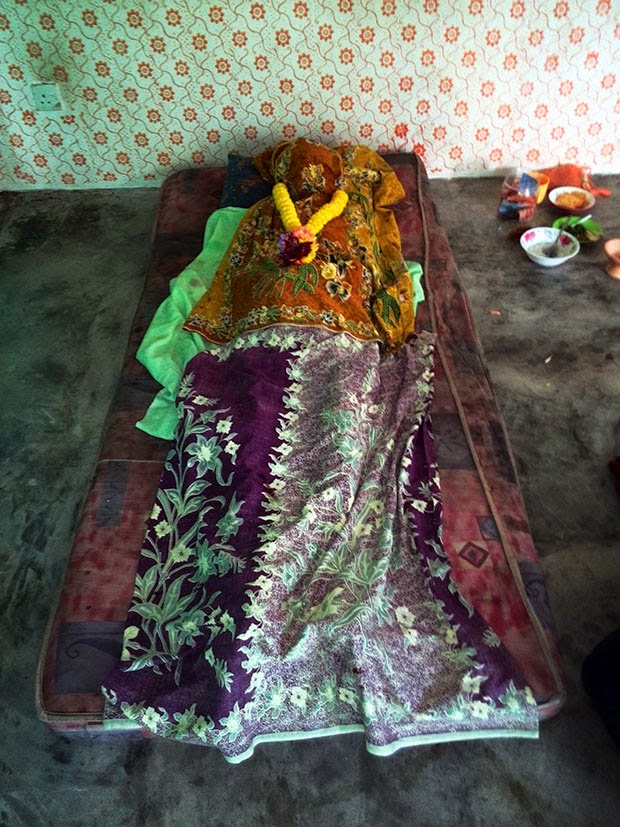
Bidar Chik was appointed Batin of Kampung Pertak in 1994, the year I took up residence
in the High Hut. Initially we had our differences - when he allowed loggers into the area -
but we became close allies during the campaign against the Selangor Dam a few years later. My parting gift to him was this garland.


PULAU BUAH, the Isle of Fruits, is the Temuan paradise, the Garden of Eden we knew as Home before the... what? The Fall? The Great Flood? Even Seri Pagi wasn't too sure what terrible crime we had committed as a species to have warranted banishment from Pulau Buah. Surely the gods would not introduce sexual reproduction to the human race only to punish us for it? (No one seemed to have given this any thought. Indah merely told me the tale she probably heard when her first period arrived: the one about Tuhan finding menstrual stains on the Stairway to Heaven and deciding to seal it forever to humanity.)
    
“Sometimes we can still visit Pulau Buah,” Seri Pagi said, “but only in dreams, or if we're very ill and in a sort of coma. In the old days, we had dukun (shamans) who were powerful enough, and pure enough, to travel there without losing their physical connection to the Earth. Nowadays, we only tell stories about Pulau Buah.”
   
Mak Minah said her great-grandmother used to travel to Pulau Buah in her dreams. “She told us there was a great tree in a beautiful clearing by a crystalline stream. The tree was laden with ripe rambutans (a hairy-skinned, succulent, juicy fruit) - only these were no ordinary rambutans, they were enormous! And best of all, she could reach up and pluck a fruit from the lowest branch without any effort. The spirit of the tree told her not to throw away the peel after she had eaten the fruit. Instead, she had to carefully place the peel on the ground below the branch where the fruit had been growing. One fruit was enough to satisfy her, it was so large and so delicious. The next time she returned to the spot, the same fruit was back on the branch, ready to be plucked and eaten!”
    
Nadi Empok & his wife Lumoh in 1994
Penengah admitted that he had tried to visit Pulau Buah in his youth, and failed. “Before you can proceed, you must go to the foot of Gunung Raja and wait for an invitation. If the guardian favors you, you will somehow find yourself going up the mountain. I've heard the old folks telling of signs and special spirit guides that can show you the path to Pulau Buah, which is not in this world. I didn't even get beyond the foot of Gunung Raja. If the guardian doesn't want you to enter the sacred realm, the mountain itself will move away, so that you find yourself somewhere else. 

Well, that's what happened. I was there with a few friends. We were certain it was Gunung Raja. Then there was heavy rain and strong winds and strange sounds that really frightened us. Of course, it could have been a tiger or leopard, but even if it was, you can bet it was no ordinary tiger or leopard. When the weather cleared, we realized we were nowhere near Gunung Raja. We turned around and somehow found our way back to the village. We were glad to be alive.”
    
Nadi Pak Empok may have been on that expedition. Or he may have made a separate attempt to scale Gunung Raja. He spoke reverently about the very special atmosphere that pervades the Royal Mountain, even around its base. The beautiful birds and plants he saw along the way, the mysterious cries of unknown creatures. “We heard the musical voices of maidens calling to us. It was hard not to obey their call, it was so seductive. But one of the group suddenly told us to flee for our lives, and we did. I don't know what would have become of us if we had tried to find the source of those haunting cries.”
    
Utat Merkol a year before he left for
Pulau Buah in 2007
Soon after the Selangor Dam project was announced, I found Utat lying feverish on a mat in Indah’s house. “I dreamt about Pulau Buah,” he whispered. “I was there, at the peak of Gunung Rajah, and I saw Mamak and Inak Bongsu.” I was all ears. Anoora’s uncle Utat rarely discussed his dreams, being an exceptionally private and shy man, but he revealed that he had twice been summoned to the Sacred Mountain by the Temuan’s tutelary gods - a signal honor for any Temuan.
    
“How did they appear to you, what did they look like?” I prompted Utat.
    
“They were absolutely splendid, more beautiful and much, much grander than kings and queens. They looked human, but in a more luminous, far nobler form.” (Lothlorien and the High Elves immediately came to my mind.)
    
“What did Mamak and Inak Bongsu have to say to you?”
    
Utat was silent for a moment. “They said they were very concerned about the destruction that is about to take place. The dam. It makes them angry and they want me to warn people that this desecration is loathsome to them. They have the capacity to destroy the dam, but they do not wish to harm anybody.”
    
“Well, are you going to tell the rest of the tribe?”
    
Utat shrugged and was silent. “People won’t believe me,” he finally said.
  
“WHEN SOMEONE DIES,” Penengah said, “their soul wanders around familiar places for a while before a longing to go home takes them towards Gunung Raja. After a while, they will find themselves at a fork in the trail. One path leads to Pulau Buah; the other... well, the other leads nowhere.”
    
How does one identify the correct path?
    
Penengah seemed reluctant to reveal the signs that would indicate the correct path. Then a gleam appeared in his eye and he whispered: “We don't usually talk about this, but I think you will understand why. For years people have tried to sway us from our beliefs. They wanted us to convert to Islam or Christianity or whatever. But our ancestors warned us about this. They told us there is a black dog guarding the path to Pulau Buah. If the soul is destined for Pulau Buah, the dog wags its tail and shows the way. But if the dog growls, it means the soul has accumulated too much sin (dosa).    
    
What happens if someone takes the wrong path?  
    
“They find the path easy going at first, very well maintained and attractive to behold. But at the end of the trail, they find themselves on an illusory bridge that goes nowhere.”
    
Can you describe what happens to someone who tries to cross the bridge?
   
“Well, they drop into a pit when the bridge collapses. A pit full of rats and cockroaches, creatures of the dark that devour anything that falls in.”
    
Sounds like hell to me. Is this the influence of Muslim and Christian eschatology on the Temuan belief system? Or is the Heaven-Earth-Hell configuration a common denominator of all human cosmogony?

Bidar (left) officiating at the engagement ceremony of Anoora's pretty niece Halus in 2010

ENGLISH TRANSLATION OF A LETTER FROM BIDAR CHIK (BATIN OF PERTAK) TO ABDULLAH AHMAD BADAWI (5TH PRIME MINISTER OF MALAYSIA)

Batin Bidar Chik
No. 1 Kg Pertak
Batu 8, Jalan Gap
44000 Kuala Kubu Baru
Ulu Selangor

13 April 2004
Y.A.B. Perdana Menteri Malaysia
Datuk Seri Abdullah Ahmad Badawi
Pusat Pentadbiran Kerajaan Malaysia
Putrajaya 62502

Sir:

Why do so many Orang Asli lack motivation?  Because we feel homeless in our own homeland.

1. We congratulate and welcome you as our new prime minister.  It is our hope that with a fresh beginning, a new era of justice and wise governance will dawn.  I am only the humble headman of a small village of Orang Asli from the Temuan tribe in Ulu Selangor, voicing my thoughts and feelings.  But I have faith that my voice will be heard by the Honourable Prime Minister.

2. The beauty of the Pertak Forest Reserve where our small village of 43 houses is located has attracted many visitors from far and near.  Now that the Selangor Dam is complete, even more people are coming here to fish from the artificial lake.  We are glad that people appreciate the beauty of our ancestral homeground, birthplace of the Temuan tribe, indeed, our “pusat negri.”

The High Hut at Lata Puntung where I lived from April 1994 till October 1999

3. When we were resettled by the dam project, the Jabatan Hal Ehwal Orang Asli (JHEOA) assured us that each family would be issued an individual grant for our new houses, along with some dusun land.  However, nothing was said about the 400 acres approved for gazetting in 1965 as Orang Asli Reserve Land.  After 39 years, the status of this land remains uncertain.  We would like this matter clarified in writing.

4. In February 2004, we were informed that our new houses stand on State land for which we have been granted a 99-year lease.  We received a letter from the Land Office asking us to pay an assessment of RM540 by 11 May, 2004, or our land and houses will be forfeit.

5. There are few families in Kg Pertak that can afford to pay this amount in three months, or even six.  I cannot imagine what will happen to my sister-in-law, a widow who receives a monthly cash subsidy of RM70 from the Welfare Department.  How will she pay the assessment? 

6. The JHEOA told us not to worry about it.  They said Splash Sdn Bhd, the dam operator, has offered to pay on our behalf.  As nothing is in writing we have only their verbal promise.  Nearly a year ago the JHEOA organised a 3-day workshop on Fraser’s Hill for a group of villagers.  Each participant will receive RM50, they said.  Those who went are still waiting to be paid.

Bidar Chik came into his own as tribal chief 
during the 1999 campaign against the Selangor Dam 
7. Our ancestors have dwelt here from the dawn of time.  Nobody knows how long the Temuan have been here, but it is safe to say we have been here for a thousand generations.  Now we are told the land is on a 99-year lease, and we must pay an annual rent to live here.  When my great-granddaughter’s children reach a ripe old age, the lease will expire, and the tribe’s future will be decided by the Land Office.  If they choose not to extend the lease, our community will die out, for the life and identity of the Orang Asli are tied to our ancestral lands.

8. The Jabatan Hal Ehwal Orang Asli has existed for 50 years since the Emergency.  Their duty is to look after Orang Asli interests, not to belittle us.  To be honest, we Orang Asli do not have much trust in the JHEOA.  They seem set on destroying our way of life and our beliefs.  In the past they have joined forces with loggers to exploit our forests and pollute our streams.  Now they have turned us into rent-paying tenants on land we have inhabited for thousands of years.  We are not happy about this.  The JHEOA have had 50 years in which to rob us of our dignity, pride, confidence, and self-reliance - not to mention the ground beneath our feet.  For Orang Asli, the Emergency is not over yet.

9. Honourable Prime Minister, we humbly request that you intervene to save us from the JHEOA, which treats Orang Asli like unwanted stepchildren.  They never listen to us and they do not understand or respect us.  They tell us to let loggers clear our beautiful jungle so we can cultivate cash crops.  In the 1960s we were told to plant rubber trees but when they matured there was no demand for latex.  Now they talk about oil palm, but we do not understand the business, and do not wish to be at the mercy of middlemen and unstable market prices.  Most importantly, the forest must be preserved, not only for Orang Asli, but for all who value God’s creation.

10. We would rather be given the Reserve Land promised us 39 years ago so we can hunt and harvest fruit as we have always done.  We can also start small-scale ecotourism-related projects that will preserve the forest, and that will give us a chance to be our own bosses.  Younger Orang Asli who wish to seek their fortune elsewhere are encouraged to do so.  But as long as we have our ancestral lands, they at least have something to return to.

11. We urge that you investigate the unresolved issue of the 400 acres approved for gazetting in 1965 as Orang Asli Reserve Land, and instruct the Land Office to issue a communal title deed.  This is surely not too much to ask, as our ancestors originally roamed the whole of Pahang, Selangor, and Negri Sembilan.  But without the sense of permanency granted by official recognition of our customary lands, our people will be in despair and lack direction.  Grant us the land our ancestors left us as their legacy, and free us from the heavy-handed control of the JHEOA.  This is how we can regain our self-esteem, our spirit of independence, and our ability to prosper from the fruits of our own initiative.

12. The rest of the nation won its independence from colonial rule 47 years ago.  We feel it is time we Orang Asli, too, are allowed to taste the dignity and joy of freedom. 

13. A copy of this letter will be handed to Persatuan Orang Asli Semenanjung Malaysia (POASM) to be shared with my fellow Batins.
Yours faithfully,


Bidar Chik
Batin Kg Pertak
Ulu Selangor


[First posted 6 June 2014, reposted 6 June 2019 & 9 June 2023]

Monday, April 13, 2026

Winning Orang Asli Votes (updated)


Just before the by-election of April 2010 I received an email from the political secretary of one of the candidates asking me for suggestions on how to effectively campaign among the Orang Asli of Ulu Selangor. I was happy to provide an overview of how things stand with my indigenous kinfolk from the perspective of someone free of tribal imprints. The following is extracted from my email response...

Siama anak Penengah (died 2012)
Thanks for giving me the opportunity to delineate the key issues confronting the Orang Asli in general - and the Temuan community of Ulu Selangor in particular.

1. As with all indigenous peoples the most crucial issue is permanency of tenure on their ancestral lands. Without a sense of belonging to their tanah pesaka (customary lands), Orang Asli tend to become dispirited (and seek to numb themselves with spirits out of a bottle). An important case in point is Kampung Pertak, situated within a few kilometers of Gunung Rajah, their sacred mountain which they call Pusat Negeri. In February 1965 the Jabatan Hal Ehwal Orang Asli and the Selangor state government approved for gazetting as a permanent Orang Asli Reserve close to 300 hectares of forest reserve, stretching from Gunung Rajah to Sungai Luit which flows beside the present Kampung Pertak.

However, in 2004 the Land Office issued 99-year leases on an individual basis to the residents of Kg Pertak, effectively denying their claim to their tanah pesaka, and reducing their land holdings to a tiny fraction of what was promised them 45 years ago. [Dr Colin Nicholas of the Center for Orang Asli Concerns can supply you with the documentation for this.] Other Temuan settlements in Ulu Selangor are faced with different problems: those in Kg Tun Abdul Razak and Gerachi Jaya, for example, have been living in fear of being displaced by developers working in cahoots with the JHEOA and the Land Office. Kg Orang Asli Kolam Air, KKB, still has no electricity supply even though it is located less than half a kilometer from the nearest power line.

Amran @ Kuku
2. The feudalistic and patronizing attitude of the Jabatan Hal Ehwal Orang Asli (JHEOA) has effectively infantilized the Orang Asli, keeping them timid, intimidated and unsure of their rights. In Kg Pertak, for instance, the Batin doesn't have the authority to convene a majlis (village council) - only the JHEOA can call a meeting in the village. After more than half a century the JHEOA apparently has only three agendas: (i) forcing the Orang Asli to abandon their traditional ways by systematically destroying their forest habitat; (ii) cajoling them and offering them material incentives to embrace Islam; (iii) ensuring that the Orang Asli remain powerless and lacking in self-confidence so that the JHEOA can justify its continued existence.

What the Orang Asli urgently need are representatives in parliament and non-governmental agencies who can articulate their desires, bypassing the heavy-handed, short-sighted and self-serving JHEOA. Sincere and independent NGOs like COAC are underfunded and understaffed - but with regular funding and more staff they can do a far more effective job of bridging the gulf between the Orang Asli and the bureaucracy.

Koi
3. On several occasions I have helped Orang Asli widows, accident cases and the elderly to apply for financial support from the Welfare Department (Pejabat Kebajikan). In every instance I have been disgusted by the snail's pace at which the Welfare Dept staff operate. Sometimes it takes more than six months from the date of application for financial aid to be granted. Such a lackadaisical attitude cannot be tolerated as it can mean the difference between life and death for some Orang Asli.

What is urgently required is a special fund set up for the Orang Asli at the district level which can be used to provide immediate financial aid to those who cannot fend for themselves owing to unforeseen circumstances, e.g., accidents, ill health, old age, loss of family breadwinner. Red tape needs to be minimalized so the Orang Asli are not daunted by the process of requesting aid. This fund can also be utilized to help enterprising Orang Asli set up food stalls or build riverside chalets, so they can learn how to do business on a modest scale and remain their own bosses.


4. Before the construction of the Selangor Dam, a few Temuan from Kg Gerachi and Kg Pertak were earning good money working as river guides with whitewater rafting companies. Regular contact with tourists has made these Temuan conversant to a degree in English and their natural aptitude for the sport has given them a big boost in self-esteem. Unfortunately, the dam has severely impacted on the water level of the river, making whitewater rafting almost impossible. The Temuan river guides have repeatedly sought the cooperation of Splash Sdn Bhd (the dam operator) to release water every time they have rafting clients - but I'm told that Splash has simply ignored their petition. This is one instance where the JHEOA ought to take up their cause and negotiate with Splash, but the Orang Asli have long learnt not to bother asking for help from the JHEOA (whose officers tend to be malas and tidak peduli, unless there's money to be made, as in logging commissions).

Sibin Aus (died 2011)
5. After living among the Temuan since 1992, it has become obvious to me that the Orang Asli would swiftly regain their self-esteem if given the opportunity to excel in what they naturally do with ease, viz., "right-brained" activities like sports and the arts. I doubt the existing school curricula can encourage and foster such talents. What might be effective are informal programs to stimulate and inspire the youngsters on several fronts: (i) helping them access the Internet, thereby improving their language skills and exposing them to a far wider world of possibilities; (ii) providing them access to arts workshops (music, dance, acting, woodcarving, painting, and so on); and (iii) granting scholarships and sponsorships to Orang Asli kids who show promise in athletics and cultural activities.

A viable long-term project would be to fund individuals and NGOs who can set up regular learn-while-you-play programs in various villages to broaden the outlook and increase the knowledge pool among the youth (who tend to get into mischief when they are bored).

Apin
Recently I met a few Temuan in their mid-20s from Bukit Lanjan and other settlements around Selangor who impressed me with their excellent grasp of English and their facility with digital tech (they have their own websites and blogs and have been shooting and editing their own documentaries). At the same time these new generation Temuan displayed great pride in their own mythic traditions and have published books and comics in their own Temuan language.*

These are the way-showers and bridge-builders between the past and the future who will lead their people to a new era of self-respect and self-determination, free from the suffocating clutches of the JHEOA.

Antares
~^@^~

Note: Jabatan Hal Ehwal Orang Asli (JHEOA) was renamed Jabatan Kemajuan Orang Asli (JAKOA) in November 2010 - but apart from the change of logo, very little else has (except the disturbing fact that JAKOA appears to be working closely with Jakim to embed Muslim missionaries in every Orang Asli community).

*One of these Temuan youth, Shaq Koyok, has since made a dent in the art world and become a de facto cultural ambassador of the Orang Asli, receiving cultural awards and invitations to visit galleries and meet with other indigenous peoples around the world.

[First posted 29 January 2015, reposted 9 December 2019 & 18 October 2024]


Sunday, March 30, 2025

The Fatal Curse of Tempurungism (reprise)


They say an idle mind is the devil’s workshop and this is especially evident in the case of Malaysian bureaucracy in general and the Jabatan Hal Ehwal Orang Asli in particular.

I have resided in and around Kampung Pertak since 1992. During this period I have witnessed how the Orang Asli Affairs Department favors diabolical initiatives that strengthen their psychological and political control over the Orang Asli - while creating opportunities for stuffing their own pockets.

Whether it be logging concessions, dam projects, turning ancestral lands into leasehold lots, or tarring roads that lead nowhere (except to environmental degradation), the JHEOA invariably finds a sneaky way to corrupt, oppress, intimidate, exploit and ultimately devour the Orang Asli.

Sagong Tasi of the Temuan tribe wins a landmark lawsuit (courtesy of Suaram)

The JHEOA ought to have been dismantled and abolished 20 years ago, following the surrender of the Malayan Communist Party in 1989. Instead, it became a tool to assimilate the Orang Asli into mainstream Malay culture - by pressuring them to embrace Islam and systematically pillaging their ancestral lands under the guise of kemajuan or “progress.”

Recently there has been talk of the JHEOA being “corporatized” into the Perbadanan Orang Asli (Orang Asli Corporation) using the Federal Land Development Authority (FELDA) as a model. Blurring the boundary between business and politics facilitates hanky-panky on a massive scale. As we have seen in the case of FELDA, feudal-style top-down management by aristocrat-politicians results in the ignorant peasantry being robbed totally blind without their knowledge. In most cases the public only finds out when it’s already too late because the thefts occur in remote rural areas.

Photo: Colin Nicholas/COAC

This, of course, has been UMNO’s modus operandi since the era of Mahathir and Daim. Leveraging on an atavistic appeal to bangsa and ugama to promote the fascistic notion of Ketuanan Melayu, UMNO warlords have siphoned off a great deal more than 30% of the nation’s wealth since the nefarious NEP was launched in 1970.

The JHEOA – like so many government agencies – has long served the UMNO agenda instead of the Orang Asli’s genuine interests. That’s nothing new. What has become alarmingly obvious is that they no longer bother concealing their narrow self-interests and their deeply ingrained racism.

Photo: Antares

During the Ulu Selangor by-election that ran from April 17-25, 2010, the JHEOA openly stage-managed the Barisan Nasional campaign in Orang Asli communities throughout the region. In one or two villages the Orang Asli batin (headman) called the police to prevent Pakatan Rakyat campaigners from entering their settlements.

In Kg Pertak the JHEOA facilitated the entry and encampment of dozens of UMNO campaign workers recruited from various ethno-fascist groups like Pekida and Perkasa. They were annoyed to find Pakatan Rakyat insignia proudly displayed in a couple of houses. What irked them even more was that a bunch of pro-Rakyat bloggers were comfortably embedded in Kg Pertak’s “diplomatic enclave.”

The JHEOA/UMNO faction reportedly handed RM7,000 in cash to one of the village security officers with instructions to distribute it amongst 70 registered voters as incentives to vote BN. I later heard complaints that the money never left the security officer’s pockets. This is how UMNO corrupts the Orang Asli via the JHEOA – by dragging them into the politics of greed, betrayal, and xenophobia.

Photo: Max Koh

On the eve of the by-election, the UMNO contingent instructed a few young Orang Asli to set up a roadblock at the entrance to the village. Later a skirmish broke out and one of the pro-Rakyat bloggers was assaulted by a Pekida thug. When the police arrived on the scene 30 minutes later, the UMNO thugs were nowhere to be seen. This small outbreak of violence was reported in Malaysiakini the next morning. In terms of negative publicity, JHEOA/UMNO came out with a black eye and began plotting revenge.

Xenophobia can also be called tempurungism – a regressive psychomental condition akin to acute jingoitis that commonly afflicts those who have never left the provincial and parochial confines of a monolingual, monocultural matrix. Those suffering from xenophobia have great difficulty accepting people with different linguistic and cultural imprints as close friends or family. They tend to label others as pendatang (immigrants), orang asing (outsiders), or Mat Salleh (Caucasians).

Working through a couple of Orang Asli agents, the JHEOA reactivated its xenophobic agenda by pressuring Asli families who had rented out their houses to “outsiders” to evict their tenants. The Asli were given to understand that the houses they were living in was government property – when in truth it was the dam developer that built the houses.

What the JHEOA had done in 2004 was to cheat the Orang Asli of their ancestral hunting grounds by issuing them 99-year leases instead of formally gazetting the whole area as a permanent Orang Asli Reserve (as promised in 1965). The Orang Asli have never seen a land grant in their life – nor have their ancestors. They don’t understand what a 99-year lease means – but they do know they have very little power over their own destinies as long as the JHEOA exists as an extension of UMNO.

[First posted 2 August 2010]

Friday, May 20, 2022

Flesh of the Ancestors (revisited)

On 17 March 2010, forty busloads of Orang Asli descended on Putrajaya to air their grievances directly to the prime minister. They were prevented by police from marching to the PM's office, but their strong showing and vigorous protest made the headlines in Malaysiakini. I am heartened to note that the worm has finally turned and that our indigenous tribes are no longer politically passive. As a tribute to their semangat (fighting spirit), I'm reposting this essay originally published here on 29 January 2007 and reposted 17 March 2010...


I can relate to the French painter Gauguin who took a libidinal shine to the native girls of Tahiti. There is something irresistible about bronze, rubbery, supple, brown skin - and the edenic innocence that flashes in their shy smiles. Pagan eyes that turn prudish at puberty, because their mothers keep yelling "Malu!" ("Shame!") when they skinny-dip with ripening bosoms and pubes. Contact with "civilization" taught them to feel ashamed of their own simplicity, made them into "primitives" living below the poverty line.

And yet, seeing a bunch of Orang Asli kids play like otters in the river is nothing less than a glimpse of paradise. You can't stay cynical or depressed in such an environment. The verdant landscape itself is balm for the eyes, as much as the sparkling waters are a treat for the senses.

The Orang Asli soul is bonded with the land, the living earth, nature itself. In mythic terms they regard their wild habitats as the petrified flesh of their ancestors.

Just as Native Americans once revered the buffalo as a benevolent manifestation of Wakan Tanka (Great Spirit), a parental sacrifice to feed the children, the Temuan view each species of flora and fauna as a gift from heaven, as food, medicine, friend, or shelter.

The younger ones have all but forgotten, born as they were into homes with TV sets bombarding all and sundry with images of a Brave New World, where ancient wisdom and traditional ways are dismissed as irrelevancies or mere superstition. But the older ones know there is no separation between the land and life itself.

To destroy nature is to murder the Life Force that sustains all existence - and therefore it is viewed as the ultimate wrongdoing, akin to forgetting one's roots and turning one's back on all that is considered divine.

Well, that's a very general overview of the Temuan mythos, which applies to just about every indigenous culture you can name - at least the ones that haven't been completely assimilated and subsumed by industrial society. However, admiring their resilience of spirit, their innocence, and their wealth of hand-me-down knowledge is one thing. Living with them at close quarters is quite another. They can certainly drive an essentially middle-class, former urbanite like myself round the bend with exasperation.

There seems to be a testosterone-related problem with the males: as soon as they turn 18, a sullen surliness bordering on xenophobia grips them. The modest wages they earn cutting grass on road verges or gathering bamboo for the Chinese towkays are mostly spent getting totally pissed at the local bar; and then they fall off their motorbikes and the rest of their hard-earned pay goes into repairing them. If they happen to be married with kids, their wives quickly turn into nags - because it's not uncommon that their husbands will stagger home late at night stinking of cheap plonk, without any food for the family. Apparently, this happens wherever indigenous "dreamtime" cultures collide with industrial "machinetime" societies. Anthropologists generally agree that the trauma of "culture shock" so disorientates the tribal folk they become dispirited - and therefore attempt to regain their spirits by imbibing vast amounts of the bottled variety.


But as long as our tribal folk have the forest to return to, they have a chance of eventually regaining their psychic equilibrium. My chief contractor on the Bamboo Palace project, Yam Kokok, really enjoyed the process of gathering about 3,000 bertam leaves to weave into roofing material for Anoora's hut. First he built a cozy lean-to while his wife began lining bamboo tubes with fragrant leaves, before stuffing them with rice to boil on a woodfire. The widow Lumoh had packed some salted fish and bottles of clear spring water. They were all set for a long day's work, cutting the thorny bertam leaves and carefully weaving them into attap. Yam Kokok's grandson and nephews all came along to help and I could see that the six days they spent "camping out" in the forest reminded them of the good old days - even though every evening I'd pick them up in my van and chauffeur them back to the village and some home comforts.

The forest is the Orang Asli's briar patch; their racial memory of being sustained by Mother Nature goes back thousands of generations. Chop down the trees and replant the land with cash crops like rubber and oil palm - and the Orang Asli become rootless, disconnected from their own past, insecure about their future and therefore apathetic.

True, some of the younger generation have adapted quite well to video games and factory jobs; a handful of Semai and Semelai have even made it all the way through university, and have become academics and doctors.

A year ago or so I was contacted by three enterprising young Temuans with university degrees. They told me they had stumbled upon my website back in 2003, but waited till they were fluent in English to send me an email! One of them, Shahar Koyok, is a fine arts graduate who's beginning to make his mark in the local art scene; another, Mor Ajani, graduated in multimedia design and maintains a Temuan blog. What deeply gratified me was their passionate interest and pride in their own mythic roots.

It's easy to demonize the Jabatan Hal Ehwal Orang Asli (Aboriginal Affairs Department) but it's really just a case of horribly misaligned worldviews. JHEOA officers, mostly urbanized Malays, scorn their own humble ancestry and sincerely believe they can persuade the Orang Asli to join the mainstream Malay community. Their strategy is two-pronged: first, systematically convert the jungle into plantations, so the Orang Asli can't hide in the past; and then convert these diehard animists into pious little Muslims.

I've long advocated that the JHEOA (instituted in 1954 during the Emergency years) be dismantled, as it serves little real purpose today except to breed the most loathsome varieties of bureaucratic ineptitude and corruption.

Think about it: how would you like being treated as a minor all your life and have some government agency manage your affairs as if you were severely retarded? If everybody else who enjoys Malaysian citizenship is free to live without an official guardian, why must our first peoples endure such an ignominy?

The argument that Orang Asli need a "protector" because they are still largely illiterate and can't cope with the demands of the modern world is a totally spurious one. First of all, after more than fifty years under the JHEOA's thumb, the Orang Asli have gained little ground in mastering left-brained activities like learning to manipulate alphanumeric symbols. The question is: why not capitalize on their strengths instead?

Most Orang Asli are physically agile, imaginative, fun-loving, and possess incredible stamina: in areas like sports and the arts, they would certainly be champs. Well, some descendants of African slaves in America have made their mark as athletes, musicians, actors, and dancers: would you think of Charlie Mingus, Michael Jordan, B.B. King, Eddie Murphy, Tina Turner, Ludacris, or Will and Jada Pinkett Smith as handicapped or backward?

What keeps the Orang Asli insulated from the outside world is the Jabatan Orang Asli's feudal mentality. That and the noxious effects of a patriarchal bias the Orang Asli got infected with along the way. Traditionally, the menfolk have been the hunters and womenfolk, the gatherers and nurturers.

In Kampung Pertak, there are quite a few unmarried mothers - girls of 17 who got knocked up after some smooth-talking fellow handed them a Guinness at an all-night wedding party. With so many kids bawling and crawling around the house, 12-year-old girls are often forced to look after their younger siblings while both parents are out working. By the time they reach 15 or 16, many end up as mothers themselves, which gives them little time or opportunity to grow mentally. So we have generation after generation of Orang Asli kids raised by completely ignorant mothers with little on their minds apart from neighborhood gossip and a bleak view of marital life.

All this would change if teenaged dating was accepted as something perfectly natural. When I first asked my mother-in-law if I could take Anoora down to town and buy her a meal, I was told we would have to be engaged before she would allow it. In other words, the relationship between men and women is always a sexual one; post-pubescent boys and girls simply cannot be friends and go out together. They end up getting married very young, prompted by hormonal surges, and never really have the chance to interact with a variety of friends, of different ages and genders, and therefore lack the means of acquiring communication skills and a broader perspective on things.

Most families in the past slept together in one large room with no partitions - or only very thin ones, at best. Obviously, sex was something carried out under cover of darkness, furtively, quietly (so as not to wake the kids), almost involuntarily - and never became an artform, or developed any degree of kinkiness, as it has in the cities.

I witnessed what happened when a young friend of mixed parentage from the big city started dating a village beauty from Pertak. On their very first secret rendezvous, she had asked if he was going to marry her (that's what he reported). Soon, the whole village was bristling with resentment at the urban Romeo. Even little children, no more than 8 or 9 years old, would taunt him as he drove past; the men in the village became more and more hostile, sabotaging his vehicle wherever he parked it, glaring at him with hands on their parangs. Posses of grandmothers and babes-in-arm would confront him at his rented lodgings in the village, demanding to know where he was hiding the girl. They gave him no peace until he buckled under the pressure and married the girl in a tribal ceremony.

Now the girl in question has had several lovers, and at 18 gave birth unexpectedly to a baby girl while trying to move her bowels, thinking it was one huge stomach upset she was experiencing. As to be expected, she's a lot more savvy and sophisticated than the other girls in the village. She could certainly learn to cope with life in the city, and has actually expressed a desire to someday get a job in KL.

Now, is there any correlation between an active sex life and intellectual curiosity? Remember that biblical myth about the forbidden fruit? Sex, drugs and rock'n'roll (or hip-hop or techno-rave, if you prefer) are definitely evolutionary triggers - that's why the patriarchy everywhere is so determined to outlaw them. What would happen to the Orang Asli if their youth got into sex, drugs and rock'n'roll in a big way?

Soon, they'd become pretty much the same as you and me, don't you think? And maybe that will prompt cityfolks to adopt more of the Orang Asli lifestyle - to reconnect with the earth, with Mother Nature, fresh air and sunshine. Sort of a cultural exchange: they become more experienced like us, and we become more innocent like them. Perhaps that's how things will ultimately balance out, and paradise will be regained on earth.

------
Recommended reading:

Proposed Orang Asli land policy: Planned poverty? [Aliran]

[First posted 24 May 2014]

Sunday, April 25, 2010

Thuggery on the eve of the by-election

We were at Pakatan Rakyat's closing ceramah at the KKB mini-stadium where at least 20,000 were gathered to mark the end of the intense campaign for the Ulu Selangor parliamentary seat. It was a heady, jubilant atmosphere charged with positive feelings about the outcome of this massively significant "referendum" on the nation's political future.

Because of the immense crowd, me and my friends opted to leave the stadium before Anwar had finished his fiery speech. When we got back to Kg Pertak, we were shocked to find the entrance blocked by a group of men who had parked a couple of motorbikes across the road.

A couple of Temuan youth had been assigned RELA T-shirts and flashlights and instructed to stop people from entering the village. A group of imported Umno heavies (some from Pekida it appears) stood around to provide additional muscle power.

They had no choice but to let me in since I live in Kg Pertak but friends in another car were prevented from entering. I got home and immediately informed Elizabeth Wong about the illegal blockade. Then I accompanied a few other friends back to the village entrance to persuade these idiots to stop their silly fascist game and let my overnighting guests through.

One of my friends started snapping photos of the situation and that riled up a white-haired guy wearing a silk batik shirt. He tried to punch him but his fist hit the camera instead.

Umno must be more desperate than ever to win this by-election if they can be bothered to encamp themselves in an Orang Asli village with no more than 62 registered voters.

What's utterly sickening is the vicious and violent energy Najib's goons have brought to Malaysian politics. Never have I witnessed such despicable strategies, born of abject fear of losing power.

All the more reason why voters in Ulu Selangor have little alternative but to whack BN good and proper at the polls. Let's give Zaid Ibrahim a whopping victory with at least a 3,000-vote majority!

EPILOG

Thanks to Elizabeth Wong's swift response, Umno's pathetic attempt to barricade the entrance to Kg Pertak was abandoned without a fight. Shortly after I posted the above report, Eli arrived at Kg Pertak escorted by three police cars and about 40 Pakatan Rakyat campaign staff. The Umno thugs disappeared into the darkness from which they had crawled out. Beautifully accomplished, Eli!

Wednesday, September 16, 2009

Investigate the Whistleblower, of course!

This is how I ended my post of 5 September:

I'm half expecting a visit from the Special Twig any moment now. Indeed, they might even assign an entire Branch to this case.

Prophetic words! Tuesday afternoon, 15 September, three Special Branch officers paid me a surprise visit. Somebody had lodged a police report against me, alleging that I was conspiring with environmental activists to block Umno's illegal roadworks project in Kg Pertak. Foreign interference, no less - since the police report stated that three "Mat Sallehs" had been harassing the excavator and tractor operators, demanding to see their permit.

Déjà vu. When loggers encroached in 1996 the same sort of shit had happened. The loggers, working through the Orang Asli Affairs Department (JHEOA) had persuaded the batin (headman) to put his signature to a petition for my eviction from Kg Pertak as I was deemed "a security threat." As a result the matter was raised at the Selangor state exco level and the Special Branch were instructed to investigate.

Fortunately, the SB in KKB appear to be fairly exemplary in that they dealt courteously and very reasonably with the situation. After interviewing me for about 20 minutes, the SB chief decided I was perfectly in my right to continue living in Kg Pertak. I remember him as an urbane, intelligent man who didn't resemble a cop at all.

Well, the three officers who dropped in on me were pleasant and attentive as I explained why those who love this area do not favor "the road to nowhere" (as ecowarrior Mary Maguire calls it). The most positive outcome of this incident was that I felt a certain rapport with these SB officers - they were entirely human and likeable. In fact, one of them had recently been transferred to KKB and he revealed that he occasionally plays guitar in a band.

If only the rest of the PDRM was as polite and professional as these three...

That was the good news. The bad news is that work started in earnest again early Monday morning. When I heard the heavy equipment going down the road I had assumed it was a JKR crew assigned to clear the fallen tree and reinforce the collapsed slope. It wasn't till the afternoon that I found out it was Mr Tan Mok Seng's workers again, eager to finish what they started and collect the balance of payment from YB Wong Koon Mun. As I suspected, some Umno members were behind the whole scheme to gain access to the goodies while justifying the environmentally ruinous project as "bringing development to the Orang Asli."

The Selangor state government, in effect, had been completely bypassed in the initiation of this ad hoc project, which threatens to seriously mar the peace and tranquility of this recovering forest - once regarded as sacred (hutan keramat) to the Temuan tribe since it lies within easy reach of Gunung Raja, the Temuan's pusat negri (spiritual umbilicus).

I guess old habits die hard. Read all about it here!

NEWSFLASH!
This morning (16 Sept) district councillor Chua Yee Ling showed up with Majlis Daerah Hulu Selangor enforcement officers and instructed the workers to stop work until they obtain a KM (Kebenaran Merancangan or Project Approval). Obviously, the federal government is channeling unknown amounts of money through its agents on the ground, facilitating all sorts of spurious "development projects" to maintain the corrupt status quo and show their utter contempt for the Pakatan Rakyat state government. After so many years under Mahathir and Khir Toyo, unaccountability and squandering of public funds to enrich cronies is the only modus operandi they understand.