Showing posts with label Temuan mythology. Show all posts

Tuesday, June 9, 2026

The Path to Pulau Buah ~ In Memory of Bidar Chik, Batin of Pertak (repost)


Batin Bidar Chik discussing the impending Selangor Dam project in his Kg Pertak residence (1999)

Bidar Chik, Batin (headman) of Pertak, breathed his last on 6 June 2014 around 10:30 a.m. I dedicate this chapter from TANAH TUJUH ~ Close Encounters with the Temuan Mythos to his fond memory.
Bidar Chik was appointed Batin of Kampung Pertak in 1994, the year I took up residence
in the High Hut. Initially we had our differences - when he allowed loggers into the area -
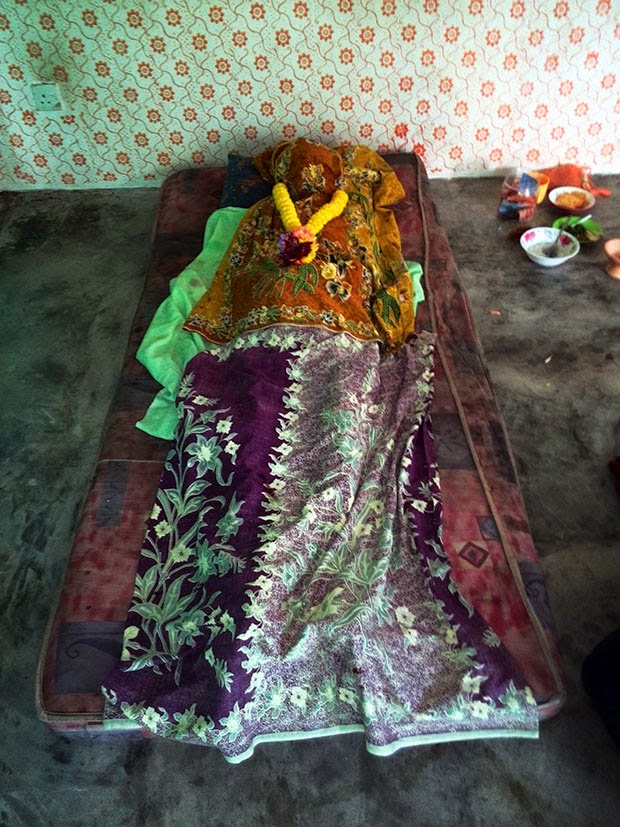
but we became close allies during the campaign against the Selangor Dam a few years later. My parting gift to him was this garland.


PULAU BUAH, the Isle of Fruits, is the Temuan paradise, the Garden of Eden we knew as Home before the... what? The Fall? The Great Flood? Even Seri Pagi wasn't too sure what terrible crime we had committed as a species to have warranted banishment from Pulau Buah. Surely the gods would not introduce sexual reproduction to the human race only to punish us for it? (No one seemed to have given this any thought. Indah merely told me the tale she probably heard when her first period arrived: the one about Tuhan finding menstrual stains on the Stairway to Heaven and deciding to seal it forever to humanity.)
    
“Sometimes we can still visit Pulau Buah,” Seri Pagi said, “but only in dreams, or if we're very ill and in a sort of coma. In the old days, we had dukun (shamans) who were powerful enough, and pure enough, to travel there without losing their physical connection to the Earth. Nowadays, we only tell stories about Pulau Buah.”
   
Mak Minah said her great-grandmother used to travel to Pulau Buah in her dreams. “She told us there was a great tree in a beautiful clearing by a crystalline stream. The tree was laden with ripe rambutans (a hairy-skinned, succulent, juicy fruit) - only these were no ordinary rambutans, they were enormous! And best of all, she could reach up and pluck a fruit from the lowest branch without any effort. The spirit of the tree told her not to throw away the peel after she had eaten the fruit. Instead, she had to carefully place the peel on the ground below the branch where the fruit had been growing. One fruit was enough to satisfy her, it was so large and so delicious. The next time she returned to the spot, the same fruit was back on the branch, ready to be plucked and eaten!”
    
Nadi Empok & his wife Lumoh in 1994
Penengah admitted that he had tried to visit Pulau Buah in his youth, and failed. “Before you can proceed, you must go to the foot of Gunung Raja and wait for an invitation. If the guardian favors you, you will somehow find yourself going up the mountain. I've heard the old folks telling of signs and special spirit guides that can show you the path to Pulau Buah, which is not in this world. I didn't even get beyond the foot of Gunung Raja. If the guardian doesn't want you to enter the sacred realm, the mountain itself will move away, so that you find yourself somewhere else. 

Well, that's what happened. I was there with a few friends. We were certain it was Gunung Raja. Then there was heavy rain and strong winds and strange sounds that really frightened us. Of course, it could have been a tiger or leopard, but even if it was, you can bet it was no ordinary tiger or leopard. When the weather cleared, we realized we were nowhere near Gunung Raja. We turned around and somehow found our way back to the village. We were glad to be alive.”
    
Nadi Pak Empok may have been on that expedition. Or he may have made a separate attempt to scale Gunung Raja. He spoke reverently about the very special atmosphere that pervades the Royal Mountain, even around its base. The beautiful birds and plants he saw along the way, the mysterious cries of unknown creatures. “We heard the musical voices of maidens calling to us. It was hard not to obey their call, it was so seductive. But one of the group suddenly told us to flee for our lives, and we did. I don't know what would have become of us if we had tried to find the source of those haunting cries.”
    
Utat Merkol a year before he left for
Pulau Buah in 2007
Soon after the Selangor Dam project was announced, I found Utat lying feverish on a mat in Indah’s house. “I dreamt about Pulau Buah,” he whispered. “I was there, at the peak of Gunung Rajah, and I saw Mamak and Inak Bongsu.” I was all ears. Anoora’s uncle Utat rarely discussed his dreams, being an exceptionally private and shy man, but he revealed that he had twice been summoned to the Sacred Mountain by the Temuan’s tutelary gods - a signal honor for any Temuan.
    
“How did they appear to you, what did they look like?” I prompted Utat.
    
“They were absolutely splendid, more beautiful and much, much grander than kings and queens. They looked human, but in a more luminous, far nobler form.” (Lothlorien and the High Elves immediately came to my mind.)
    
“What did Mamak and Inak Bongsu have to say to you?”
    
Utat was silent for a moment. “They said they were very concerned about the destruction that is about to take place. The dam. It makes them angry and they want me to warn people that this desecration is loathsome to them. They have the capacity to destroy the dam, but they do not wish to harm anybody.”
    
“Well, are you going to tell the rest of the tribe?”
    
Utat shrugged and was silent. “People won’t believe me,” he finally said.
  
“WHEN SOMEONE DIES,” Penengah said, “their soul wanders around familiar places for a while before a longing to go home takes them towards Gunung Raja. After a while, they will find themselves at a fork in the trail. One path leads to Pulau Buah; the other... well, the other leads nowhere.”
    
How does one identify the correct path?
    
Penengah seemed reluctant to reveal the signs that would indicate the correct path. Then a gleam appeared in his eye and he whispered: “We don't usually talk about this, but I think you will understand why. For years people have tried to sway us from our beliefs. They wanted us to convert to Islam or Christianity or whatever. But our ancestors warned us about this. They told us there is a black dog guarding the path to Pulau Buah. If the soul is destined for Pulau Buah, the dog wags its tail and shows the way. But if the dog growls, it means the soul has accumulated too much sin (dosa).    
    
What happens if someone takes the wrong path?  
    
“They find the path easy going at first, very well maintained and attractive to behold. But at the end of the trail, they find themselves on an illusory bridge that goes nowhere.”
    
Can you describe what happens to someone who tries to cross the bridge?
   
“Well, they drop into a pit when the bridge collapses. A pit full of rats and cockroaches, creatures of the dark that devour anything that falls in.”
    
Sounds like hell to me. Is this the influence of Muslim and Christian eschatology on the Temuan belief system? Or is the Heaven-Earth-Hell configuration a common denominator of all human cosmogony?

Bidar (left) officiating at the engagement ceremony of Anoora's pretty niece Halus in 2010

ENGLISH TRANSLATION OF A LETTER FROM BIDAR CHIK (BATIN OF PERTAK) TO ABDULLAH AHMAD BADAWI (5TH PRIME MINISTER OF MALAYSIA)

Batin Bidar Chik
No. 1 Kg Pertak
Batu 8, Jalan Gap
44000 Kuala Kubu Baru
Ulu Selangor

13 April 2004
Y.A.B. Perdana Menteri Malaysia
Datuk Seri Abdullah Ahmad Badawi
Pusat Pentadbiran Kerajaan Malaysia
Putrajaya 62502

Sir:

Why do so many Orang Asli lack motivation?  Because we feel homeless in our own homeland.

1. We congratulate and welcome you as our new prime minister.  It is our hope that with a fresh beginning, a new era of justice and wise governance will dawn.  I am only the humble headman of a small village of Orang Asli from the Temuan tribe in Ulu Selangor, voicing my thoughts and feelings.  But I have faith that my voice will be heard by the Honourable Prime Minister.

2. The beauty of the Pertak Forest Reserve where our small village of 43 houses is located has attracted many visitors from far and near.  Now that the Selangor Dam is complete, even more people are coming here to fish from the artificial lake.  We are glad that people appreciate the beauty of our ancestral homeground, birthplace of the Temuan tribe, indeed, our “pusat negri.”

The High Hut at Lata Puntung where I lived from April 1994 till October 1999

3. When we were resettled by the dam project, the Jabatan Hal Ehwal Orang Asli (JHEOA) assured us that each family would be issued an individual grant for our new houses, along with some dusun land.  However, nothing was said about the 400 acres approved for gazetting in 1965 as Orang Asli Reserve Land.  After 39 years, the status of this land remains uncertain.  We would like this matter clarified in writing.

4. In February 2004, we were informed that our new houses stand on State land for which we have been granted a 99-year lease.  We received a letter from the Land Office asking us to pay an assessment of RM540 by 11 May, 2004, or our land and houses will be forfeit.

5. There are few families in Kg Pertak that can afford to pay this amount in three months, or even six.  I cannot imagine what will happen to my sister-in-law, a widow who receives a monthly cash subsidy of RM70 from the Welfare Department.  How will she pay the assessment? 

6. The JHEOA told us not to worry about it.  They said Splash Sdn Bhd, the dam operator, has offered to pay on our behalf.  As nothing is in writing we have only their verbal promise.  Nearly a year ago the JHEOA organised a 3-day workshop on Fraser’s Hill for a group of villagers.  Each participant will receive RM50, they said.  Those who went are still waiting to be paid.

Bidar Chik came into his own as tribal chief 
during the 1999 campaign against the Selangor Dam 
7. Our ancestors have dwelt here from the dawn of time.  Nobody knows how long the Temuan have been here, but it is safe to say we have been here for a thousand generations.  Now we are told the land is on a 99-year lease, and we must pay an annual rent to live here.  When my great-granddaughter’s children reach a ripe old age, the lease will expire, and the tribe’s future will be decided by the Land Office.  If they choose not to extend the lease, our community will die out, for the life and identity of the Orang Asli are tied to our ancestral lands.

8. The Jabatan Hal Ehwal Orang Asli has existed for 50 years since the Emergency.  Their duty is to look after Orang Asli interests, not to belittle us.  To be honest, we Orang Asli do not have much trust in the JHEOA.  They seem set on destroying our way of life and our beliefs.  In the past they have joined forces with loggers to exploit our forests and pollute our streams.  Now they have turned us into rent-paying tenants on land we have inhabited for thousands of years.  We are not happy about this.  The JHEOA have had 50 years in which to rob us of our dignity, pride, confidence, and self-reliance - not to mention the ground beneath our feet.  For Orang Asli, the Emergency is not over yet.

9. Honourable Prime Minister, we humbly request that you intervene to save us from the JHEOA, which treats Orang Asli like unwanted stepchildren.  They never listen to us and they do not understand or respect us.  They tell us to let loggers clear our beautiful jungle so we can cultivate cash crops.  In the 1960s we were told to plant rubber trees but when they matured there was no demand for latex.  Now they talk about oil palm, but we do not understand the business, and do not wish to be at the mercy of middlemen and unstable market prices.  Most importantly, the forest must be preserved, not only for Orang Asli, but for all who value God’s creation.

10. We would rather be given the Reserve Land promised us 39 years ago so we can hunt and harvest fruit as we have always done.  We can also start small-scale ecotourism-related projects that will preserve the forest, and that will give us a chance to be our own bosses.  Younger Orang Asli who wish to seek their fortune elsewhere are encouraged to do so.  But as long as we have our ancestral lands, they at least have something to return to.

11. We urge that you investigate the unresolved issue of the 400 acres approved for gazetting in 1965 as Orang Asli Reserve Land, and instruct the Land Office to issue a communal title deed.  This is surely not too much to ask, as our ancestors originally roamed the whole of Pahang, Selangor, and Negri Sembilan.  But without the sense of permanency granted by official recognition of our customary lands, our people will be in despair and lack direction.  Grant us the land our ancestors left us as their legacy, and free us from the heavy-handed control of the JHEOA.  This is how we can regain our self-esteem, our spirit of independence, and our ability to prosper from the fruits of our own initiative.

12. The rest of the nation won its independence from colonial rule 47 years ago.  We feel it is time we Orang Asli, too, are allowed to taste the dignity and joy of freedom. 

13. A copy of this letter will be handed to Persatuan Orang Asli Semenanjung Malaysia (POASM) to be shared with my fellow Batins.
Yours faithfully,


Bidar Chik
Batin Kg Pertak
Ulu Selangor


[First posted 6 June 2014, reposted 6 June 2019 & 9 June 2023]

Friday, January 30, 2026

The A Bao A Qu Mystery Revisited

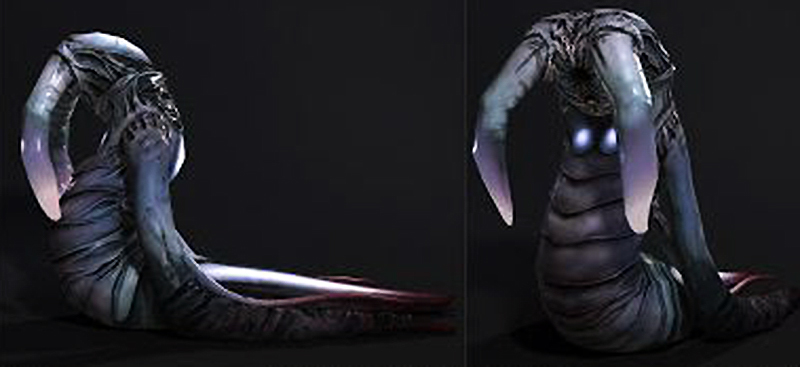
Fanciful depiction of the A Bao A Qu found on the internet

IN APRIL 1993 I received a strange request in the post. John Hagedorn - an American educationist-cum- percussionist then based in Alexandria, Egypt - wrote asking me to research the Malayan origins of the legend of "A Bao A Qu." Hagedorn's travel-writer colleague, Christopher Green, had unearthed this obscure tale from Jorge Luis Borges's 1967 Book of Imaginary Beings.

Borges claimed he had found the "A Bao A Qu" story in the appendix of C.C. Iturvuru's 1937 treatise, On Malay Witchcraft. I finally tracked down Borges's version of the "A Bao A Qu" story in the University of Malaya library - so I can vouch for the reliability of Green's succinct summary of this hoary tale:

To see the most lovely landscape in the world, a traveler must climb the Tower of Victory in Chitor

King Kumbhakaran
aka Rana Kumbha
[Green says he found on a map of India a town named Chitor. For what it's worth, there is indeed a town named Chittorgarh in Rajasthan province where the legendary warrior king Rana Kumbha constructed a Tower of Victory in 1448.]

A winding staircase gives access to the circular terrace on top, but only those who do not believe in the legend dare climb the tower.

On the stairway there has lived since the beginning of time a being sensitive to the many shades of the human soul known as A Bao A Qu. It sleeps until the approach of a traveler and some secret life within it begins to glow and its translucent body begins to stir.

As the traveler climbs the stairs, the being regains consciousness and follows at the traveler's heels, becoming more intense in bluish color and coming closer to perfection. But it achieves its ultimate form only at the topmost step, and only when the traveler is one who has already attained Nirvana, whose acts cast no shadows.

Otherwise, the being hesitates at the final step and suffers at its inability to achieve perfection

["Its moan is a barely audible sound, something like the rustling of silk."]

It tumbles to the first step as the traveler climbs down and collapses weary and shapeless, awaiting the approach of the next traveler.

In the course of the centuries, A Bao A Qu has reached the terrace only once.

For some reason I felt sure that C.C. Iturvuru (what an amazing name!) had heard the tale from an Orang Asli. The first person I asked happened to be Seri Pagi (though I only knew him as Pak Diap then). I gave him a simplified rendering of the A Bao A Qu legend and waited while the rusty gears of his memory whirred. His brow furrowed and then he broke into a broad grin, exclaiming in triumph: "Abang Aku! You mean Abang Aku!"

But of course. The way Orang Asli slur their vowels (especially in the states of Negri Sembilan and Pahang), Iturvuru might well have heard it as "A Bao A Qu." My Elder Brother, Abang Aku.*

I felt a jolt of electrifying knowledge. Diap said he remembered hearing a story similar to that when he was very young. It involved a spiral stairway connecting one dimension to another. A stairway once used by visiting or incarnating stargods. They say some got caught out by the calamitous closing of the interdimensional pathways. Once brilliant stars in their own universe, they fell to Earth and became ensnared in Time. Some of them ended up just like poor Abang Aku alias A Bao A Qu. A spirit fragment of cosmos caught in the gravity of human karma; a glorious starbeing lying inert at the bottom of the stairway to heaven, dependent on messy human destiny for its own fulfilment.

Only one other Elder seemed to have heard of Abang Aku. Village shaman Sudin Aus kept nodding sagely when I outlined the A Bao A Qu story to him. Then he smiled and said, “My Elder Brother is a reference to the Orang Asli. Our spirit will not be free until the younger races achieve nobility of purpose and purity of heart.”

Almost everyone, however, was familiar with the cryptic image of the long and winding stairway to the most wonderful view on Earth.

THE A BAO A QU MYTH evoked images of chakras - energy spirals operating on macro and micro levels - primordial forces attaining self-awareness, and nebulous notions of some deep alchemical mystery - an H.P. Lovecraftian vision of the strange, chthonic thoughtfields from which our familiar symbols sprout. 


“Abang Aku” brought to mind the Great Old Ones, ancient squid-like beings central to Lovecraft’s Chthulu tales. (It also brought to mind Gurdjieff's Kundabuffer. This peculiar word was coined in the 1920s by the Greek-Russian magician-philosopher, G.I. Gurdjieff, to explain some "tragic flaw" in Man's genetic program which condemns him to futile lifetimes of Sisyphean** struggle, forever slipping back into robotic animality just when he's on the threshold of illumination. 

Some believe that this "Kundabuffer Effect" was deliberately installed by a somewhat insecure Creator God (or gods), to retard the evolution of human intelligence and thereby perpetuate a harnessable labour force on Earth. The Tower of Babel story lends credence to this notion of an "Almighty Father-God" who, feeling threatened by his mortal creatures' overweening ambitions, confounds them with a babble of tongues. Another scenario describes how humanity had its original 12-strand DNA reduced to two, to confine our consciousness within the physical world.)

I sensed that the A Bao A Qu story offered a key insight into the magical teachings of the Ancients. At some remote point in the infinite spiral of existence, an aspect of Spirit found itself trapped in a Promethean*** nightmare loop of recurring time. Only a self-realized and karma-free human could release the A Bao A Qu from its eternal yearning for perfection.

Tower of Victory in Chittorgarh,
Rajasthan, India

The Tower of Victory. Victory over death? Despair? Futility? The magic column of ascension, located in Chitor. Chita? Chita, cita, cinta, citta. Sanskrit for a quality difficult to define: essentially, citta means mindstuff, consciousness.

Chita or cita is closely related to cinta, romantic love - desire, emotions, feelings, longing, love, aspiration. (It could also, by invoking homophonic licence, be a slurring of cherita - nowadays spelled cerita - which means "story.") In effect one might describe chita as a poetic symbol for the Imagination, the Desiring Mind. But this is assuming it is related to Chitor, the town named in the legend of A Bao A Qu. And I assume it is, because myth is meant to be a malleable, dreamlike substance. 

The test of myth-entering keys lies in their emotive resonance when struck. Substituting “Abang Aku” for “A Bao A Qu,” “Chita” and “cerita” for “Chitor,” and “you” for “the traveler” - what do we get? A metaphysical conundrum that echoes in some barely remembered attic of our unconscious. A vague feeling of déjà vu, of “When did I dream this dream?” 

Was I the intrepid traveler, the hero, the messiah, redeemer of gooey amorphous geeks? Or was I Abang Aku himself, waiting eon upon eon for humanity to attain Buddha and Christ consciousness? Who else would have “already attained Nirvana,” whose acts would “cast no shadows” - in other words, be completely free of karmic consequences. And who might this Exalted Being be - if not our own Noblest Aspect, the Omega point of our Adamic Alpha?

That's why Abang Aku reaches perfection only once. However, his dream body or holoform remains embedded in the mythic realm as a timely trigger, to awaken anyone who chances upon the legend to the nature of his or her true purpose on this Earth.


______________

*  A. Ghani Ismail, an ardent scholar of Malay esoteric lore, offers some information which sheds a whole different light on the A Bao A Qu legend. He suggests that the phrase in question is actually a slurring of “Ibu Aku” (“My Mother”), explaining that in pre-Islamic Malay shamanism, the gateway to other dimensions was via an inner journey through the spiral staircase of the etheric umbilical cord which reconnects us with our pre-birth experience of oneness with the Mother. By voyaging beyond the point of our own conception, we break through the veils of time and space and regain cosmic consciousness. I thought this variation on the theme warranted inclusion, at least as a footnote.

** Sisyphean: from Sisyphus, in Greek mythology a cruel and cunning king of Corinth, who was punished in Hades by being made to roll a heavy boulder up a steep hill. Every time he got to the summit, the boulder would roll back down the hill, and Sisyphus had to repeat the process over and over forever.

*** Promethean: from Prometheus, in Greek mythology a first-generation god (or Titan) of Fire and Intellect, who returned the gift of Fire to Mankind (which Zeus the second-generation Olympian had withheld) - and for that was chained to a rock and his liver devoured by an eagle every day. Every night, the liver would regenerate and Prometheus would come back to life, only to have the eagle eat his liver all over again, and so on, ad infinitum. (It's less gory, but a lot scarier, when you approach this mythic morsel as a giant metaphor for compulsory reincarnation: Prometheus is the Soul, the rock is the physical world, the liver represents a lifetime, and the eagle is the emblem of Higher Authority or Spiritual Law. As a symbol, the eagle is interchangeable with the Indonesian garuda, the Chinese phoenix, the Mexican quetzal, or the Russian firebird, which represents Eternal Return. And Prometheus, the Fire-Bringer, is often identified with Lucifer, the Light-Bringer.) From the 'Management' point of view, Prometheus is a subversive element -  but 'Labor' would see him as a cult hero, a freedom fighter, a System-bucking Little Red Robin Hood!

[This essay was originally included as a chapter in my book TANAH TUJUH ~ Close Encounters with the Temuan Mythos, published by Silverfish Books in 2007. First posted 15 October 2022. Reposted 24 October 2025]


Saturday, September 27, 2025

Mak Minah, Uncrowned Queen of the Temuan (repost)

"Minah Angong" by Andy Maguire (oil on fiberboard, 10" X 8")

Yes, I am pleased to tell you my story. But as I cannot write things down, I will ask my friend to help. He is among those who knew me well in my last years on this earth. I whisper these words in his mind’s ear, for he is still in the world of the living, while I am already back in the realm of spirit, and happily so.

Minah Angong's gravestone
My bones now lie buried on top of a hill overlooking the saddest sight you can imagine. Majestic hills stripped of trees, mountains blown up to make a dam. I may be dead but my spirit lives on in my songs, and in the sacred (and now badly scarred) landscape I love so dearly.  One day my songs will be heard and they will soften the hardened hearts of the greedy ones who destroy more than they construct. When men’s hearts heal, so will the land.

I was born in Pertak, Ulu Selangor, between two world wars, into the Temuan tribe. The identity card issued by the government says I arrived on September 14, 1930, and records my name at birth as Menah Anak Kuntom.  People knew me as Mak Minah because that was my stage name as lead singer with a band called Akar Umbi. Perhaps the most exciting moment of my life was when we performed before 42,000 people at the biggest stadium in Selangor. Afterwards, so many people came and congratulated me. I had a photograph taken with Sharifah Aini and Sahara Yaacob, who were also performing that night. We looked like three queens together!

Anyway, Menah or Minah makes little difference to me, since I can’t spell. Our names keep changing as we change. But once we write anything down, it becomes harder to change. Take my sister’s name: although we have the same father and mother, her name is recorded in her identity card as Indah Anak Merkol, after our  stepfather. My mother’s name was Beresih but all her children called her Mui, which is the Temuan word for Mak or Mother.

As a child I remember life was carefree and fun. Fish was abundant in the streams, and the forest supplied all our needs, except for luxuries like sugar, salt, and milled rice. Fresh meat was easily available as there were many animals that could be hunted or trapped.  We Orang Asli can eat anything, with or without legs or wings, as long as it’s not poisonous (we even know how to remove the poison from some wild plants so that they become edible). Apart from fish and wild boar, we also eat porcupines, pythons, leaf monkeys, deer, birds, and bamboo rats (whose flesh is very clean and sweet, as they feed only on bamboo shoots). These are all gifts of the Great Spirit That Dwells In Everything.

Mak Minah with younger sister Indah (1997) 

The only education I received was from my grandmother, who enjoyed telling us stories. She explained how human beings were seeded on Tanah Tujuh (which is what we call this physical world) by Mamak and Inak Bongsu, a brother and sister who survived the Great Flood by clinging to the top of a gaharu tree on Gunung Raja. 

My grandmother was full of wonderful tales about the beautiful elven races (Orang Halus) who left the planet for the higher heavens when the Difficult Times began. Some chose to remain, because they had grown to love the earth, but they gradually became invisible to human eyes.

Minah claimed she could summon the dragon,
totem of her tribal lineage (Peter Lau)
People ask me if Orang Asli have any religion. I always reply that we don’t need religion because our God is not separate from the everyday world in which we live. The Great Spirit That Dwells In Everything takes all forms and speaks to us as the song of the wind in the bamboo grove, or as the neverending gossip of the river. Sometimes it is the distant call of a mist-covered mountain. Other times, it is as close as a sleeping child breathing gently in its mother’s ear.

During my lifetime I saw how people became blinded by ambition and greed. They began to mine the earth for metals and log the forest for wood. With each passing year the land became hotter and the rivers became dirtier, so we could no longer drink the water without boiling it first.  With each passing year we had to walk farther and farther to find some bamboo or catch some fish because people would come into the forest and take out more than they needed. And with each passing year we saw more and more wilderness cleared so that towns could be built.

I enjoyed going to town where many things could be bought, but to do that we had to sell durians, petai, bamboo, cane (manao) and aromatic wood (gaharu) for cash. Yet I could never imagine myself living in a town where it’s always so noisy and hot. Like all Orang Asli, I dearly love the jungle which is our natural home and hunting ground. I would rather die than be forced to live in a town.

Japanese soldier in Malaya, 1942
When I was 12 the world turned upside down. Planes dropped bombs in the jungle to destroy bridges and railway tracks. We had to hide in caves on the slopes of mountains. For many years my family stayed hidden deep in the forest, for fear that we may be captured or killed by the invaders. During those war years we missed the taste of salt and sugar. We lived in the middle of the Malay Peninsula - far from the sea – and had grown accustomed to flavoring our food with salt bought from the Chinese merchants.  My mother taught me how to make cooking oil from the perah nut.

After the war life became even worse for us. The government put us all in detention camps, surrounded by barbed wire, and guarded by soldiers. They said it was to protect us from the communist guerrillas. Unused to suddenly being confined in a small space so close to town, many of our people became depressed, fell sick, and died. This is how I lost both my parents.

Sembo, Minah's favorite granddaughter
But I was already an attractive young woman with many admirers. My life stretched ahead of me like a newly laid road, and I had a taste for adventure. I found myself married to a man I hardly knew. At least he could take me away from the confines of the resettlement camp. We ran back to our beloved jungle and built a hut along the river, along with many others who could no longer bear living within a fence.

My first marriage was a tragedy. I was too young to be a dutiful mother. My children died of illness and my husband left me. For a while, I flirted with the idea of becoming a white man’s mistress. Then I met Angong who had recently become the Batin (headman) of Kampong Gerachi. He was a patient man with great wisdom. It was he who taught me the ceremonial songs passed down to him by his ancestors. Angong taught me to be proud of my noble naga (dragon) lineage. Not every family has an animal totem. Only those with some knowledge of jungle medicine (jampi) or who possess magical powers (dukun) have special allies in the animal kingdom. 

I bore Angong five children and greatly missed him when he returned to Pulau Buah, where souls go after they drop their physical bodies (which we call baju, or clothes). When my children grew up and started their own families, I moved to Kampong Pertak to live with my younger sister Indah and her husband Rasid. My elder brothers, Diap and Utat, lived nearby.  My eldest son, Ramsit, took over as Batin of Gerachi.

Minah Angong & Nai Anak Lahai with Akar Umbi lineup in August 1995

Mak Minah with Antares & Chandrabhanu
after performing 'Birthplace Reclaimed'
in 1993 (photo by Rafique Rashid)
It was fated that my life would begin to change in 1992. I met a few people from the big city who happened to be musicians. They heard me singing and decided to record my voice, adding musical instruments to give my traditional sawai (healing) songs a modern sound. The first song we created together was called Burung Meniyun. I was asked to sing it on stage during a performance by a famous dancer named Chandrabhanu who lived in Australia. I was surprised and touched that people in the big city would receive my humble song with such open hearts.  Never before had I sung for so many strangers in such a large hall! Chandrabhanu himself was quite a colorful character, dressed up as some kind of witch doctor with all sorts of strange objects dangling from his body. I found it exciting to meet so many new friends who were delighted to hear my ancient songs. 

It all happened so quickly. One moment I was just an Orang Asli widow gathering firewood and tapioca leaves in the forest and going fishing with my sister. Then suddenly I was on national TV singing for thousands of people in a huge stadium! I shall never forget the pleasure of hearing the loud applause and shaking hands with everybody afterwards. I felt proud to be able to please so many people with my simple songs. For once I could feel that no one was looking down on me, or ignoring me, for being an uneducated Orang Asli. 

Can you imagine how it feels to be recognized by someone in Ulu Langat who had seen my performance on TV?  When I went to the market in town, people came up to me and congratulated me on my performance. But back in Kampong Pertak, I was greeted with a mixture of wholehearted support and suspicion. Some whispered behind my back that I was soon going to be too sombong (proud) to be their friend. That really hurt my heart.

Minah performs at the first Rainforest World Music
Festival in Sarawak, August 1998 (Wayne Tarman)
I enjoy singing for people, and my late husband taught me that these songs handed down from our ancestors carry healing power. They are medicine songs. When I sing I can feel my spirit expand like a strong wind blowing through a tree. Naik angin, we call it.  Once I start I must carry on until the wind becomes a breeze and goes quietly on its way. If I don’t let the spirit wind flow (lepas angin) I can get very sick.

My first experience of flying was when Akar Umbi performed in Sarawak at the Rainforest World Music Festival. I had such a grand time and made even more friends. I returned to Sarawak with Akar Umbi the next year, for the last time. At the party after the close of the festival, my newfound friends sang me a rousing Iban farewell. My heart was light and heavy at the same time. Perhaps I knew this was our last meeting on this earth.

Photo by Roland Takeshi
Even as I felt the pleasure of being applauded, I could feel the pain of losing our past and future. The dam project would soon destroy Kampong Gerachi and its durian orchards. A man-made lake would fill the Selangor River Valley, drowning a once-beautiful forest, along with our ancestral graves. I could not imagine anyone so foolish as to declare war against the forces of nature.  Did they have no understanding of, or respect for, our deep love of the land? Were they totally unaware that destroying the land would mean the end of our livelihood and future?  We are the land. If the land dies, we die. 

My sister Indah and brothers Diap and Utat felt the same way that I did. We cherished our traditions and would never lose our heart connection to the land, even if we were offered vast amounts of money.  The Temuan tribe has lived here for many thousands of years; the hills and valleys and rivers are much, much older than that. Our fruit trees can live for over a hundred years and as long as we keep planting new ones, our great-great-grandchildren will never starve. But if they destroy the wilderness and put our people in housing estates and make us work in factories, our tribe will be disappear within a generation. Our nenek-moyang (ancestors) told us: “When Orang Asli are no longer visible on this earth, the sea will rise, the sky will fall, and everything will perish.”

Minah Angong by Antares (1999)

It all seemed hopeless. My own son, as headman, had signed an agreement with the dam builders and loggers, allowing the destruction to begin.  I tried to talk him out of it, but he silenced me, his own mother.  My sorrow ran deep.  Before it had even started the dam project had split our families apart. 

But there were thousands of voices raised against the dam, and I was glad that we had so many friends, people who knew the true value of the rainforest and fought hard to stop the destruction.  I was interviewed by many reporters and I told them how I felt about seeing our way of life being taken from us.  One reporter asked me: “Don’t you want to see your grandchildren getting a good education, which they can only get when development reaches the rural areas?” I replied: “All those who cut down the trees and make the hills bare, causing landslides and floods, aren’t they educated too? If that’s what being educated means, then we Orang Asli don’t want to be educated!” The reporter had nothing to say to that.

Minah gazes at the Indian Ocean at Batu Ferringhi, Penang, 1993 (photo: Rafique Rashid)

In a way, I’m glad I didn’t live to see the bulldozers and excavators arrive. Three weeks after I performed in Sarawak, I fell ill and surrendered my body to the earth. It has become part of the sacred landscape of my ancestors. But my spirit is reunited at last with the Great Spirit That Dwells In Everything and I am happy.

[Originally published in Off The Edge © Antares 2002, first posted 21 September 2014. Reposted 14 September 2016, 14 September 2017 & 24 September 2019]


Tuesday, September 2, 2025

Preface to TANAH TUJUH ~ Close Encounters with the Temuan Mythos (repost)


AT THE OUTSET I wish to declare that I am not an anthropologist.
 
I am, however, deeply interested in mythology. What fascinates me about the mythic tradition is that it has proven to be an effective way of preserving important archetypal images and ideas for thousands of years, merely through oral transmission down the generations. Like nursery rhymes imbibed in early childhood, a myth once heard is never forgotten, even if a few minor details get added or subtracted along the way.
 
Nadi Empok & his wife Lumoh in 1994
In this respect I perceive myths as organic time capsules of the tribal superconscious. More precisely they are a semiotic time-travel device: “reality spores” designed to survive aeons of incomprehension or indifference, only to germinate anew as soon as favorable conditions occur. To bring the stories back to life, you only have to add the water of empathy, of emotive resonance.

Of course, it helps greatly if you also have “genetic access” to the stories. For each story, like a life, has its own specific genealogy. But in the end, all stories can be traced to a single source - the Mother Lode of Stories - which I comprehend as the deep memory of the Earth herself.
     
MYTHOLOGY, folklore, and grandmothers' tales are by definition non-logical story forms, meaningless to the rational mind and subject to no “scientific proof.” Characters tend to appear and disappear without rhyme or reason, and their actions and reactions are generally an unfathomable mystery - until one adds the essential ingredient, subjectivity. The fact that “mystery” and “myth” both contain the key word my is highly instructive. One has to own them, take personal possession of these transpersonal, extra-dimensional truths, before they yield their secret kernel of meaning. More specifically, one has to incorporate the mythic system into one's vision quest, so that the sense of revelation which follows the sudden flash of insight becomes an intensely intimate experience. For whom does the bell toll, if not yourself?
 
Halus, Titit & Kusak in 1996

In attempting to piece together the few Temuan myth fragments that I chanced upon, I have had to apply a liberal amount of interpretative glue. It is certainly not my intention to present this as some sort of “definitive” Temuan gospel. The shreds of tribal lore that have survived, at least amongst the Temuan I know, are too tattered and incomplete to reconstitute into any meaningful whole - unless one matches them with myth fragments from other native traditions. But essentially I just want to share my own insights and opinions - and the exquisite tingle of quiet excitement that each discovery brought - with whomsoever may be interested.   
 
The gods and heroes of antiquity are, in truth, fragments of our own mystery, our own unfolding story in space and time. We need only take the initiative to reclaim them from the myopia of our throwaway consumer culture and the self-destructive forgetfulness of our times.


TANAH TUJUH ~ Close Encounters with the Temuan Mythos was published in 2007 by Silverfish Books. Now out of print!

The Antares Interview (by Tunku Halim)


[First posted 16 November 2017, reposted 26 September 2018 & 13 September 2020]

Tuesday, February 18, 2025

Song of the Dragon (revisited)

Adapted from an essay by Antares, published in Journal One, October 1996,
and later included as a chapter in
 
Tanah Tujuh ~ Close Encounters with the Temuan Mythos...

TWO DAYS AFTER the monstrous calamity at Pos Dipang on 29 August 1996, when almost an entire Orang Asli village was demolished by a tidal wave of mud and dead trees, a dramatic black-and-white photograph appeared in the Sunday Star.

It showed the “dragon's trail of destruction” down one slope of the Kinjang Range - like a huge rip in the fabric of reality exposing the raw elemental underside of nature. An awesome sight, not exactly beautiful, but inspiring speechless awe, and reminding us of the two faces of cosmic forces - the malefic as well as the benign.

The Orang Asli village of Pos Dipang was wiped out by a gigantic mudslide on 29 August 1996
Those who survived the murderous mudslide later murmured that the naga (dragon) must have been very angry. But what exactly do the Orang Asli mean when they speak of the dragon's wrath?

“YOU ought to know,” said the editor of a monthly magazine to which I had been contributing, when I dropped in on their office soon after the Pos Dipang disaster, “you've lived with Orang Asli for quite a few years.”

I thought it over for a moment. “It isn't so easy to explain these ideas in rational terms,” I began. “One has to have a fundamental connection with the pre-industrial mythologizing mind; you need to intuit your way around these “dreamtime” spaces. I happen to be very sympathetic to mythic awareness myself - but nowadays you don't find too many people with the necessary experience or exposure to thinking-feeling through free association. Our modern education system trains minds to analyze rather than synthesize, to criticize rather than empathize. It would probably come across as ancient superstition or new age nonsense.”

“I still think you're the right person to make an attempt,” the editor said with persuasive earnesty. I had to grin. Was this just her way of nudging me away from my metaphysical musings and coming back down to earth? I told her I'd give the question of dragons some thought, and left it at that. (It didn't strike me at the time that, by some strange coincidence, the company that published the magazine was called Nagamedia - and the managing editor happened to be called Ty Fong, which sounds remarkably like Typhon, another name for the Great World Snake!)

Typhon, the largest monster in Greek mythology, was perhaps inspired by
a planetary cataclysm that destroyed entire civilizations

Spontaneous painting by Alex Grey
at the 2011 Rainbow Serpent Festival
in Australia
The problem is: most of us were raised in an intellectual environment defined by linear semantic conventions and encouraged by “career” demands to specialize further and further - until all our knowledge has become fragmentary and compartmentalized. To be able to see beyond the veil of the visible, one needs to temporarily renounce intellectual materialism and embrace the mystical-poetical-spiritual essence of gnostic re-cognition.

You won't come anywhere near an understanding of the invisible cosmic forces underlying geophysical upheavals simply by analyzing mud samples in the laboratory. Even if only as an exercise, you still need to look at phenomena through the metaphoric monitor-screen of myth - just as you can only experience the full effect of 3D movies by wearing 3D spectacles.

The more thought I gave it, the more complex the subject became. There were so many overlapping dimensions around the subject of dragons, serpents, snakes - and rainbows. Yes, rainbows somehow belong in this extended family of archetypal symbols. Take for instance this highly evocative quote:

The rainbow as a snake is a recurrent image among many ethnic groups and nations. The Pomo and Kato tribes of California consider it to be an aquatic, horned snake that provokes floods and earthquakes. The rainbow is also identified as a water snake among the people of South America. The natives of the Amazon believe it represents a bridge between the Earth and the temples of the royal kingdom of heaven. (Alberto Ruz Buenfil, Rainbow Nation Without Borders)


I was pleased to find a compact but erudite “dragon” entry in the Britannica's Micropaedia which opened with this intriguing comment:

The belief in these creatures [dragons] apparently arose without the slightest knowledge on the part of the ancients of the gigantic, prehistoric, dragon-like reptiles [dinosaurs]. In Greece the word drakon, from which the English word was derived, was used originally for any large serpent, and the dragon of mythology, whatever shape it later assumed, remained essentially a snake.


Dragons. No matter where you travel on the surface of this planet, you will encounter a dragon or serpent or rainbow myth in some form. In China and Japan the emperors were said to have descended from the Dragon gods who came from the sky.

Kukulcan, Mayan version of the
Plumed Serpent
In Central America the most revered deific figure is called Kukulcan by the Maya and Quetzalcoatl by the Aztecs; he is represented as a Plumed Serpent, and has been linked to the Peruvian legends of Viracocha. (Thoth, a major Egyptian god, is also associated with the Serpent - as was his father, the Sumerian progenitor god Enki.) It's worth noting that the national emblem of Mexico is an eagle with a snake in its claws.

In India the Nagas are described as a race of demigods who emerged from the bottom of the sea and brought civilization to the aboriginal tribes. Yogis depict the Life Force, kundalini, as a serpent uncoiling up the spine when aroused. At the crown, the serpent reveals itself as the seven-headed cobra, symbol of mastery over the illusory realms of matter.

The Celts and Picts of pre-Norman Britain called their kings Dragons - Pendragon (meaning the Great Dragon) being the symbol of the Supreme Ruler of the British Isles. Uther Pendragon and his famous son Arthur were the last known historical personages to bear this exalted rank. And to this very day in Britain there are numerous Pendragon Societies dedicated to the resurgence of the Pendragon lineage, which they hope to see regain the throne of “New Jerusalem” from the usurpers, the secular House of Windsor. This momentous event will be heralded by the reappearance of the bardic archdruid Merlin (note the combination of Dragon/serpent and Merlin/hawk: Earth and Sky!)

Vindicta Pendragon 

However, the dragon/serpent motif acquired a totally negative connotation when the Hebrews invaded Canaan and enforced exclusive worship of their fiercely patriarchal god Yahweh. From this violent overthrow of the goddess-worshiping cultures associated with the Earth-loving serpent, grew the image of the dragon as an emblem of Evil, of the torrid temptations of carnal Nature.

In Europe, owing to the Judeo-Christian prejudice against the Earth-Mother-Goddess-Serpent aboriginal archetype, the dragon has been portrayed as the enemy: Nemesis, agent of Satan, Lucifer's earthly form, the Worm of Hades. Statues and paintings abound that show the Archangel Michael, and later St. George, slaying the dragon of pagan beliefs.

Unfortunately the same arid, patriarchal bias infected Islamic ideology, forcing goddess-worshipers to go underground, so to speak, and seek initiation into the ancient mysteries through dervish dancing and the private study of sacred geometry (wherein the feminine principle could be secretly revered in the form of arches, domes and spheres).

The accumulated effects of belligerent parochialism over the past five thousand years has also resulted in certain built-in behavioral traits amongst explorers, researchers, and academicians - a tendency to be invasive, divisive, possessive, and exploitative - which might explain why the proliferation of scientific and technology-using societies seems to have always been at the expense of Mother Nature.

Obviously, there is no simple straightforward way to discuss what the Dragon means to the Orang Asli - and to every tribal culture indigenous to planet Earth. The amount of available information on this mythical creature is actually quite staggering when one begins to research the subject seriously. Here's a random sample of interesting data involving the dragon/snake/rainbow motif:

• The dragon signifies royalty in a great diversity of cultures around the planet. In China and pre-Norman Britain, it was the national emblem (appearing in Wales as the griffin); while in Japan it was believed that the Emperor was descended from a race of flying dragons. Taoists regarded the dragon as one of the most important deified forces of nature.

• In Babylonian mythology the dragon Tiamat symbolized the watery goddess of Primordial Chaos, later subjugated by Marduk, a masculine deity of Law & Order & Civilization. Zecharia Sitchin, author of the controversial Earth Chronicles, has a radical interpretation of this myth. According to Sitchin, the ancients called all the planets “gods” - and “Marduk” was an invading celestial body, wandering in space after being flung off its original orbit by some stellar explosion. Marduk's satellites smashed into Tiamat, which broke in half from the impact, leaving a trail of icy debris that now forms the Asteroid Belt between Mars and Jupiter. The remaining portion of Tiamat was flung into a new orbit between Mars and Venus, where it became known as Ki or Ge or Gaia or Earth. Marduk, known to the Sumerians as Nibiru or the Planet of the Crossing, constitutes the twelfth planet in our solar system (including the Sun and Moon). Sitchin asserts that Nibiru is the home of the Sky Gods who created the human race. Those with access to arcane knowledge support this notion - but add that the Nibiruans couldn't have done it without a little help from the Sirians, their mentors!

• The feminine principle was revered by the Ophites whose sacred symbol was the Cosmic Snake coiled round the World Egg. This image also recurs in Egyptian and Greek mythology as the worm Ouroboros, the serpent swallowing its own tail - a powerful symbol of eternally regenerative cycles. Joseph Campbell, the pre-eminent mythical scholar, puts it succinctly in a famous televised conversation with journalist Bill Moyers: “The serpent sheds its skin to be born again, as the moon its shadow to be born again. They are equivalent symbols. Sometimes the serpent is represented as a circle eating its own tail. That's an image of life. Life sheds one generation after another, to be born again. The serpent represents immortal energy and consciousness engaged in the field of time, constantly throwing off death and being born again. There is something tremendously terrifying about life when you look at it that way. And so the serpent carries in itself the sense of both the fascination and the terror of life.”

• Amazonian natives revere the Anaconda - guardian spirit of their sacred river. Like the Orang Asli of Peninsular Malaysia, they perceive the snake/dragon as a celestial as well as terrestrial phenomenon. On earth the Anaconda lives as a giant freshwater python that guards the physical flow of life-energy-water. In the fourth-dimensional or astral zones, the Anaconda is magnified in scale into mythic proportions: a wind-raising, fire-belching, earth-shaking Elemental Force that could destroy all animal and human life if angered beyond certain established limits.

• I once heard an Orang Asli mother tell her child to avert her eyes whenever there was a vivid rainbow in the sky. She believed it was created by the Orang Halus (elves) as part of their sacred rituals, and that the rainbow was actually the invisible people's processional pathway to the heavenly realms. This is an idea echoed by many Native American tribes, who view the rainbow as symbolic of a dimension where Spirit and Matter are harmoniously wed.

The Temuan have great reverence for all hills and mountains and the rivers and streams that water them. In their creation stories, the dragon or naga plays a key role in preparing the Earth for human habitation. Fire Nagas are “technical supervisors” of events like the Big Bang wherein suns and planets are created. Water Nagas work with Nagas of the Air to cool down and mould the newborn world.

Quetzalcoatl-Kukulcan
by Genzoman
There are tales of an Aeon of Celestial Fire, followed by the Aeon of Great Cold and an Aeon of Universal Flood. When the waters finally receded, the Temuan's earliest ancestors were found clinging to a gaharu or eaglewood tree resting atop Gunung Raja (the Royal Mountain). The landscape that evolved around Gunung Raja is therefore keramat - conforming to a heavenly blueprint and lovingly guarded by their ancestral spirits. Every rock and boulder, every tree and shrub, every spring and tributary is a familiar aspect of their dreamscape which is animated by spirits fine and coarse. The physical world, which is really a shadow of the higher realms, is where humanity dwells, till such time as we prove ourselves worthy of permanent residence on Pulau Buah (the Isle of Fruits) - in other words, Paradise. Guardian spirits like the ular and naga (snake and dragon) are also being tested. They too can evolve to the higher worlds (there are seven levels on Tanah Tujuh, the living cosmos that is planet Earth). If the Naga's dwelling place in the upper reaches of the river is desecrated, it will get very angry and leave in a great huff, thundering and thrashing its tail on its way to the sea where it becomes a naga laut (nautical dragon). That's why it is dangerous to infuriate the Nagas - and every high mountain has its own Naga.

The Orang Asli also believe that they were placed on Earth as Guardians of the Rainforest. “If Tuhan (God) sees that the Orang Asli are no longer serving their sacred purpose,” said Utat, “the whole world will be turned upside down and humanity will perish. Those of us who have been true to our duties will find ourselves naked on Pulau Buah (in other words, stripped of earthly flesh and restored to the spiritual realms).”

Nadi Pak Empok told me he dreamt of the Naga once, back in 1990. The Naga asked him to visit a particular spot along the river three times in three weeks - but Nadi was too afraid to obey. One evening, he happened to be passing near the spot on his way home, when he was startled by a roaring noise -”like a helicopter landing on top of you.” Nadi hid behind a rock and nervously looked around. Suddenly the river exploded into shiny golden scales as a gigantic Naga raised its mighty antlered head from the water. It seemed to hang in the air for an eternity before diving back into the river and disappearing. Nadi's legs went limp and he had to recuperate for an hour before he could get up and walk home with a troubled heart. The headman of his village in Pertak had allowed loggers into the area, and the Penunggu (guardian spirit) was issuing the Temuan a warning through Nadi.

Hermes Trismegistos, whom the Greeks revered as the patron deity of science, philosophy and the healing arts, is usually shown carrying a caduceus - a winged staff with two snakes entwined along its length. This Hermetic wand of magickal power was chosen by the followers of Hippocrates as their guild emblem. Even today, the medical profession is symbolized by the caduceus of Hermes (an incarnation of Thoth, the Egyptian god of wisdom and general wizardry).

• In Bali the highest aspect of divinity is known as Tintya (inspired by the dancing form of Shiva-Natarajah). Tintya is often depicted in sacred paintings as an agile, elvish figure on a chakra (wheel of cosmic energy) - flanked by two dragons (one green, the other red) representing the ida and pingala - or the positive and negative poles of all energetic systems - and, by extension, the planet's electromagnetic field.

Now, this is truly significant. The green and the red, the positive and the negative, the yang and the yin, the male and the female, electricity and magnetism.... herein lies the most important clue to the grand mystery of the Dragon's Song.

Rainbow tube torus: shape of
the Earth's electromagnetic field
WHOLE SYSTEMS THINKER R. Buckminster Fuller was fond of teleologizing - which means, essentially, to derive elegant general principles from observing natural phenomena. When he declared that Unity was “plural at minimum two,” he had truly put his finger on the paradox of integrity as a complementary duality: radiation and gravity, outwardness and inwardness, convexity and concavity, electricity and magnetism, maleness and femaleness. However, Fuller was at pains to point out that complementary opposites were never intended to be in static 50-50 balance.

Indeed the laws of dynamic flux require that the Golden Mean be set at what is called the “phi ratio” - which has been approximated at 1.6180339 - a number that goes on forever. (The phi ratio is a sort of “golden mean proportion” or Fibonacci spiral formula that underlies all organic structures. It can be found in the relative bone-lengths of animal skeletons; in the design of plants; in the geometry of crystal formations; even entire constellations and galaxies.) This mysterious phi ratio determines that interactions between the “feminine” force of gravity and the “masculine” force of radiation are never “perfectly” symmetrical. Indeed the built-in asymmetry between bi-polar forces ensures that “true balance” is endlessly sought, so that yang and yin can intertransform, each into the other ad infinitum, ensuring thereby that the “status quo” never stays static for too long.

It would appear that Buckminster Fuller was restating in 20th century terminology what ancient wisdom was already fully cognizant of in mythic language. The serpent lays the egg that translates into the binary code of “1” and “0”: lingam and yoni, phallus and vulva. Line and curve, electricity and magnetism. Radiation (i.e. differentiation, dissipation, and disintegration) and Gravity (i.e. cohesion, compassion, and unconditional love). All phenomena in the waveform universe can be described by this classic Fullerism: Unity is plural at minimum two. (Fuller later revised this to “unity is plural at minimum sixfold” but let’s not get into multidimensionality at this juncture!)

How does this relate to geophysical upheavals, nightmarish distortions of the electromagnetic field that can annihilate whole cities in an instant? Flashfloods, earth tremors, tsunamis, landslides, volcanic eruptions, periodic shifts of tectonic plates, axial polarities, and visionary paradigms? Petulant dragons with whiplash tails? Waveform deformities, wormholes that can suck entire star systems into the antimatter universe? Where does myth end and science fantasy begin?

WHAT HAS BEEN dismissed as “fantasy” is in truth the Unseen beyond the Seen - electromagnetic quirks occurring above and below the range of human sensory perception. Do you regard the Earth as a living Goddess, the Abode of Beauty, a sacred sanctuary, a temple, a home? Or do you dismiss her as a dead hunk of rock, covered with psychedelic lichen and acrawl with contentious lice?

Do you have serious difficulty sensing the intimate intercorrelations between dragons, snakes, rainbows - and power spots, psychic centers, interdimensional portals, planetary chakras? In acupuncture, the physical body is perceived as a dense configuration of energy patternings emanating from subtle constellations of perfect principles. It is the meeting place of Spirit and Matter, a vibrant multidimensional field of vital possibilities.

Practitioners of acupuncture familiarize themselves with detailed mappings of the human bioenergetic hologram form - which can be manipulated in terms of flow with conductive needles inserted at particular internodes - just as the planet's etheric body can be adjusted geomantically with crystals, dolmens, monoliths, stone circles, obelisks, and pyramids. Geomancy - the study of geodetic flowlines, the movement of wind and water (fengshui) - entails a thorough knowledge of major and minor “dragons' paths” or leylines.


Ancient power spots like Machu Picchu, Silbury Hill, Stonehenge, Iona, Uluru, Sacsahuaman, Teotihuacan, Tiahuanacu, Giza, Avebury, Chichén Itzá, Mount Ararat, Gunung Agung, Mount Shasta, Mount Fuji, Mount Meru, Gunung Raja and other earth-sun-moon-star temples were invariably sited at strategic intersections of dragons' paths.

Men-an-tol (Martin Gray)
Among indigenous tribes, all shamanic rituals are actually “geomantic” in function: realignments of chakras on individual and collective levels, etheric manipulations of weather conditions through the devas of wind, water and geomagnetic harmony, healing through invocation of the Earth's compassionate gravitational field, the Mother Goddess Force. (Drunvalo Melchizedek - alchemist, hermeticist and founder of the Flower of Life “portable” mystery school - informs us that there are at least 83,000 sacred sites guarded by indigenous tribes, strategically located around the Earth.)

Why have we forgotten this invaluable heritage? How did industrial societies fall so far from a wholesome, organic relationship with natural forces, with the electromagnetic Dream Body of the Earth Goddess? Any civilization that was aware of the cosmic patterns of energy flow would certainly not be committing covert genocide against its aboriginal tribes, and overt ecocide against Mother Earth, on the horrendous scale we see all around us.

The answer lies in the written records of what we call history: in the last 5,000 years or so since the sudden advent and swift adoption of alphanumeric symbols, oral traditions have been supplanted by the scriptural text, the Book. Although written language has proven to be an efficient tool for mass communication (and mind control), it has also propelled us towards more precise but narrower modes of perception and thinking. What we gained in specificity, we lost in the ability to apprehend generalities. We ended up not seeing the forest for the trees, and then seeing only the “merchantable biomass.” Business-as-usual is no way to experience and reconnect with the cosmomythological context that forms an eternal background to our frenzied preoccupation with clock time.

Which explains why the Chief Minister of Perak wasted no time in denying that logging had anything to do with the Pos Dipang catastrophe. He reasoned that since there was no sign of recent clear-felling on the hillslopes (“They stopped logging ten years ago!”), the blame must fall on the rain. It's all the weather's fault, in other words. But are we looking to blame anyone? We're on this planet to learn certain codes of ethics and aesthetics. Not to consume ourselves in puerile games of economics, politics, and ideological oneupmanship.

But let's be honest about it. A 360-year-old hardwood has a root system that could easily reach a depth of 120 feet; add the intricate root intertwinings with neighboring trees, and you can assume a subterranean spread of half-an-acre. If you chainsaw a jungle giant off at the stump, the root system remains firm for at least three or four years, then it may start withering and rotting for another five or six years before a mighty downpour washes it all down, together with a massive portion of the hillslope. Multiply this effect by 3,000 trees - and you get the Pos Dipang scenario. Don't blame it on the rain... or the terrain! Blame it, if you must, on the scarcity conditioning and competitiveness (read FEAR & GREED) that has made us blind to the beauty, the divinity, and the truth of the Seen - as well as the Unseen realms.

Postscript: Two years after this essay was published, anthropologist Jeremy Narby published his seminal work, The Cosmic Serpent: DNA and the Origins of Knowledge, in which he interprets his own ayahuasca initiations with Asháninka shamans from the Peruvian Amazon. Narby's profound insight into the connection between serpents, dragons, rainbows and the helical structure of DNA molecules constitutes a significant breakthrough in building a bridge between mystical visions and scientific investigation. Through Jeremy Narby's conscientious research, the cosmological and ontological meaning of the serpent coiled around the world egg has finally been revealed as symbolizing the genesis of Life itself.

[First posted 26 January 2012, reposted 27 October 2016, 24 October 2021 & 24 January 2022]