Showing posts with label Ubud. Show all posts

Thursday, June 26, 2025

KEMBALI KE BALI ~ RETURN TO BALI (reprise)

Finally I did it! I returned to the magickal Island of Bali after an absence of 26 years. It was only 5 days this time. In 1981 I was there for 5 weeks, and each day was a Technicolor dream overflowing with adventure, romance, and delicious sensations. I'm gathering my thoughts and feelings so I can write in greater detail about the invigoration and inspiration I felt - but, meanwhile, I'll share some photos I took with my dinky digital camera (a Sony Cybershot, believe it or not!)...

In Bali you'll always find a majestic old tree beside every temple. This magnificent green sanctuary that had shaped itself into a perfect archway was spotted on my way to Ubud, just outside Batubulan (what a romantic name, Moonstone!).

On both sides of the road leading to Ubud you'll find the finest artisans in Asia, a rich legacy of the Majapahit Empire which produced stonemasons comparable to those that built Angkor Wat, Khajuraho, and Tiahuanaco.
A colossal statue, presumably of Rama, greets every visitor to Ubud
Painters, painters everywhere in Ubud; modern as well as traditional
Mask-makers too!
Member of the Balinese Royal Household at the Royal Temple in Ubud
Five minutes outside the bustling tourist hub
that Ubud has become, soothing sounds of running water
and ducks romping in lush paddy-fields
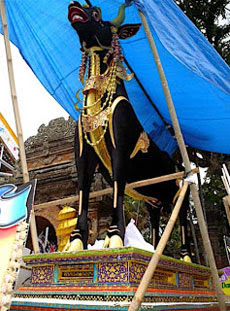
Ceremonial cow presides over ritual cremation of Balinese royalty
Women in Bentuyong, near Ubud, so alike the Orang Asli among whom I live
Hokkien chef in Ubud with two of his Balinese angel waitresses
Daily offerings to the Unseen Beings are an integral part of Balinese culture

PART TWO

[Originally published 12 September 2007. Reposted 4 July 2013]


Friday, December 13, 2024

KEMBALI KE BALI (Part One of a 4-part pictorial essay,)

In Bali you'll always find a majestic old tree beside every temple.
This magnificent green sanctuary that had shaped itself into a perfect archway
was spotted on my way to Ubud, just outside Batubulan 
(what a romantic name, Moonstone!)

On both sides of the road leading to Ubud you'll find the finest artisans in Asia,
a rich legacy of the Majapahit Empire which produced stonemasons 
comparable to those that built Angkor Wat, Khajuraho, and Tiahuanaco

A colossal statue, presumably of Rama, greets every visitor to Ubud

Painters, painters everywhere in Ubud; modern as well as traditional

Mask-makers too!

Member of the Balinese Royal Household at the Royal Temple in Ubud

Right: Ceremonial cow presides over ritual cremation of Balinese royalty.

Left: Five minutes outside the bustling tourist hub that Ubud has become, soothing sounds of running water and ducks romping in lush paddy-fields.

Women in Bentuyong, near Ubud, so alike the Orang Asli among whom I live

Hokkien chef in Ubud with two of his Balinese angel waitresses

Daily offerings to the Unseen Beings are an integral part of Balinese culture

I returned in 2007 to the magickal Island of Bali after an absence of 26 years (and for the third time in October 2010 for the Ninth Gate Activation of the 11:11 Doorway but that was an entirely different experience). 

In 2007 it was for only five days. But in 1981 I was there for all of five weeks, and each day was a Technicolor dream overflowing with adventure, romance, and delicious sensations. I'm gathering my thoughts and feelings so I can write in greater detail about the delicious invigoration and inspiration I felt. Meanwhile, I'll share some photos I took with my humble digital camera - a Sony Cybershot I bought in New York City in August 2004 and which has served me well for so many years.


[Originally posted 12 September 2007. Reposted 16 April 2014, 20 June 2020 & 20 February 2021]

Sunday, September 16, 2007

KEMBALI KE BALI (Part Four)

Views from Bukit Jambul, en route to Besakih where the Mother Temple is located.
Bali's biggest temple at Besakih was acrawl with pilgrims when I arrived,
so I chatted with a couple of luminously beautiful vendors and rode off into the sunset.

I GOT AS FAR AS the side entrance to Tirta Empul hotsprings but decided to give it a miss. Too many day-trippers there, it felt like Batu Caves. I figured, the hot springs may be “holy” but, heck, all springs are – and I don’t like humans building a fence (and bureaucracy) around them and charging admission for Nature’s gift of healing.

Fifteen minutes later I was feeling exhilarated as the road’s gradient subtly began to increase and I knew I was heading into the highlands. Guess my lungs have acquired a taste for crisp mountain air from fifteen years of living at the foot of the Titiwangsa Range. Stopped to buy half a kilo of heavenly marquisas (“the famous Indonesian passion fruit”) and snapped this portrait of a fresh-faced highland girl (I was charmed by the way the fruits were displayed in elegant pyramids).

Village girl at fruit stall 20 minutes from Gunung Batur
As my 5-day tour of Bali progressed I became acutely aware of the fractal nature of reality. My handy desktop dictionary puts it this way: “Fractals are useful in modeling structures (such as eroded coastlines or snowflakes) in which similar patterns recur at progressively smaller scales, and in describing partly random or chaotic phenomena such as crystal growth, fluid turbulence, and galaxy formation.” The key phrase in this instance is “similar patterns.” The holographic architecture of Creation is fractal, and this is hinted at in the Hermetic notion of “as above, so below” (more accurately rendered as “as within, so without”) which suggests that Nature works through repetitive geometric patterns, on micro as well as macro levels.

The volcanic Gunung Batur, reminiscent of Mount Doom in Mordor, its western slope still black, barren and baking hot, while its eastern slope facing Batur Lake is starting to green out beautifully.


Just as you will meet Wayans, Mades, Nyomans, and Ketuts in every family wherever you go in Bali, the same rule applies to cultural forms and human behavior. Put another way: one fruit stall (like a fresh-faced, smiling village girl) is pretty much the same as another, with minor variations that allow for a degree of diversity – yet, in essence, it is a repeat pattern of a particular motif which generates a dynamic interplay between uniqueness and universality.

The fractal principle holds true whether in the case of homestays, bakso stands, pirate DVD outlets, surfer beaches, winding mountain roads, dusty and noisy urban streets, night markets, or busloads of daytrippers. However, on an island the size of Bali, the micro- and macrocosmic dance is clearly visible – just as it’s easier to understand the behavior of a small group of individuals rather than that of a mass of faceless statistics.

When one begins to notice the fractal forms at the core of all structures, whether man-made or natural, the effect is somewhat psychotropic. Sensory impressions begin to interlock like pieces of an immense, multi-dimensional jigsaw and the concept of morphogenetic fields suddenly becomes a vivid reality.

You could say the web of life that has been there all the while spontaneously comes into sharp focus, and it seems totally incredible that you never noticed it before. Indeed, this sort of epiphany is akin to the enhanced perception triggered by consciousness-altering substances like psilocybin or lysergic acid diethylamide.

In Bali, the boundary between the secular and the spiritual is blurry to the extreme. Science can be found living happily next door to mysticism. Indeed, I know of no other place where simplicity and sophistication get along so well.

The friendliness and warmth of people you encounter wherever you go is offset - and complemented - by the savvy and sophistication of the Balinese mind.

A pair of mammoths guard the 372 steps leading to the royal pura of Gunung Kawi
By corraling the hedonistic budget tourists in the Kuta-Legian area near the airport, the Balinese have successfully found a way to capture a staggering amount of foreign revenue without getting overly contaminated by it.

The entire world is drawn to the ultimate theme park that is Bali – and the locals who work in tourism have swiftly learnt how to keep the vacationers coming back year after year and bringing along more friends.

In Bali you don’t get the sense of pseudo-morality and fuddy-duddy judgmentalism that puts a damper on folks having fun any way they want – young Aussies who blow their wad going from beach to beach in quest of the ultimate wave, consuming beer by the crate in the process, are as welcome as earnest ethnomusicologists, culture vultures, or the rich and retired. Wherever I stopped for coffee or a bakso fix, some old chap would question why I was traveling solo instead of with a nice chewet (Balinese for "girl"; boys are called chowok). "Don't be putting ideas in my head," I'd quip and this would generate a fair bit of mirth and merriment. How refreshingly unprudish the Balinese are!


You feel welcome in Bali, regardless of your holiday budget. And the range of options is vast – you can spend anything from 30,000 to 3,000,000 rupiahs on a night’s accommodation. Chances are you’ll have a great time either way.

How did the Balinese accomplish this extraordinary feat of embracing modernity with a broad grin while retaining traditions that sustain social cohesiveness? Perhaps a significant clue can be found in the nature and personality of their prime deity, an emanation of Shiva-Natarajah they call Tintya, usually portrayed as an agile and elvish figure – sometimes painted with energy bolts shooting from every joint, often supported on a spinning chakra (disc or wheel), but invariably dancing the cosmic dance of primordial energy.

Studying images of Tintya through modern eyes, one might be tempted to speculate that the supreme deity of the Balinese was modeled after a visiting ET!

Consider the descriptive names the Balinese have for Tintya: he’s also known as Sangyang Widi (The Wise One), Sangyang Licin (The Elusive One), and Sangyang Tunggal (The Absolute One). Interestingly, Tintya represents the Supreme Embodiment and Manifestation of Life Itself in its unfathomable entirety and infinite diversity. Tintya is revered in Bali above the trinity of the exoteric Hindu pantheon, viz., Brahma, Vishnu, and Shiva.

Exploring the outskirts of Ubud on my motorbike, I stopped by another sacred fig tree and entered the small pura beside it. The stone walls and floor of the pura were green with ancient slime and the place looked fairly unvisited. Then I spotted an incongruously modern steel ladder bolted to the central candi (or shrine). Ascending the ladder between a pair of guardian dragons carved in stone, I came face to face with a Tintya icon, freshly gilded and radiant in the bright sunshine.

This was truly an unexpected epiphany which triggered a flood of long-buried genetic memories, too complex and mysterious to elaborate upon in a blogpost. Someday I may find a way to express these antediluvian flashbacks in words. But for now, suffice to say that I remembered the origins of the gods and the beginnings of religious indoctrination on this exquisite (and soon, soon to be liberated) holographic planet.
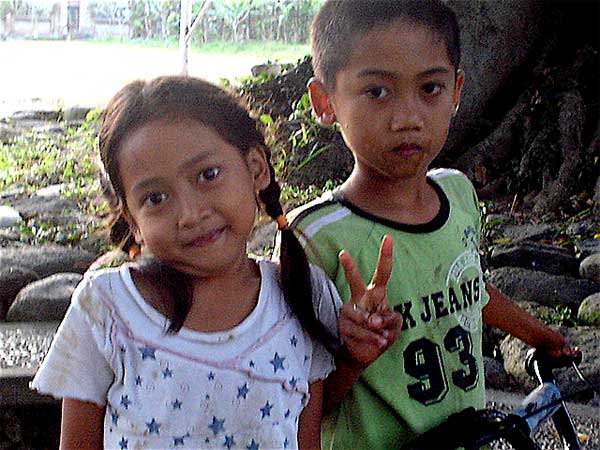
Terima kasih, Bali. I thank you with all my heart for staying true to yourself.
Text & photos © Antares


Friday, September 14, 2007

KEMBALI KE BALI (Part Three)

Inspiring view from a fancy resort about 20 minutes from Ubud. Lodgings range from USD175-400 a night. I paid 50,000 rupiah (about RM18) at Dewi Antara Homestay (no great views but it had a hot and cold shower and I slept extremely well).

THE BALINESE are apparently governed by a strong sense of cosmic order, devolving from the adoration of monarchs who were once worshiped as deities in human form. Their belief in the Law of Karma seems to fortify them against hubristic notions of upward mobility; in Bali you can be a rich tourist without paranoid expectations that the poor folk catering to your whims are just waiting for their chance to rip you off, pick your pocket or mug you in a dark alley.

70% of the craftsmen and business operators in Bali originate from Java.
This young man spends his days patiently pointillizing wooden turtles.
I was never, for an instant, nervous about anyone pinching my bag or making off with my rented bike. Even the few beggars I encountered in Ubud weren’t at all pushy, and were happy to accept a 500-rupiah (less than 20 sen) donation.


My second visit to Bali confirmed beyond any doubt that Ubud – and its verdant environs of well-tended paddies – is where I could easily establish a home away from home. One can “kontrak” or rent a cozy house set amidst the most inspiring landscapes for between RM300-500 a month; count on paying at least RM750 (that’s about 2 million rupiah!) for a luxury villa. Indeed, my Bali vacation has been a powerful incentive for me to become grotesquely rich (as I fully deserve to be).

Understandably - considering Bali’s immense popularity as a tourist destination (it has successfully retained its reputation as “the world’s most beautiful island” for decades) - I was initially anxious that I might find the place overrun by busloads of budget airline tour groups (Malaysians and Taiwanese are notorious for traveling in large, noisy platoons). As it turned out, the only horribly congested areas were the Kuta-Legian “drunken surfer” strip – and two or three shopping streets in Ubud. Everywhere else I ventured, Bali looked its remarkable, unflappable self.

I stayed only one night in Kuta, in a quiet guesthouse just off the busy commercial hub, and did a wee bit of shopping (nylon hammock, music DVDs, a cool shirt). Bumped into a lovelorn Irish gypsy named Eva and dispensed a bit of free advice. Rented a motorbike the next morning - cheap at 40,000 rupiah (about RM15) a day - and off I rode, feeling freer and easier than I have in years. Getting in and out Kuta, though, is quite a feat as the streets are a veritable maze, dusty and dense with traffic. You can’t rely on maps in Bali. Just stop and ask every 10 minutes. You’ll find that everybody is happy to point you in the right direction with a genuine smile.

One of the greatest joys in life is to ride a motorbike through open country without the impediment of a ridiculous crash helmet. True, Bali has been coerced by the diabolical forces of globalization into making crash helmets compulsory - but the rule is rarely enforced, especially outside the crowded urban areas, and this is one sure gauge of a nation that hasn't signed a contract with Dr Mephistopheles!

In Ubud I was surprised to hear somebody call my name. I turned around and caught sight of Andrew Sia’s beaming face. Did a quick U-turn and caught up with him down the road. Andrew (from The Star) was chauffeuring his mum around. He suggested I check out the sacred spring at Tirta Empul, Tampaksiring.


At Gunung Kawi, the royal pura (temple) and amphitheatre  carved out of granite are worth a visit.
11th century meditation cave at Gunung Kawi.
Met another Malaysian, oddly enough also from The Star, at Gunung Kawi. Zafarul was honeymooning with his new bride, Nazmi. He promised to pop me an email. Still waiting, Zafarul!

Private shower at Gunung Kawi - for me the most mystical moment of my brief sojourn there!


[To be continued...]
Text & photos © Antares


KEMBALI KE BALI (Part Two of a 4-part pictorial essay)


Barong, king of spirits, getting ready for the grand cremation of Bali's Queen Mother.
More preparations in Ubud for the Royal Cremation.

WHY ON EARTH did it take me 26 years to return to Bali? My first visit in 1981 stretched over 5 weeks and every day was a Technicolor dream filled with adventure, romance, inspiring vistas, and delicious sensations.

Perhaps the high point of that earlier trip was my encounter with the Bird and the Bearcat in a tourist restaurant on Lovina Beach. I found myself seated opposite two friendly young women who looked Scandinavian. As we chatted over coffee after dinner, somebody shouted: “Wow! Look at the full moon!” So we decided to take a stroll on the beach to revel in the silvery moonshine. Somehow I found myself standing beside the Bird on the surf’s edge. It was a moment of perfect ease and deep tranquility.

Without a word spoken our lips and souls connected.

Bird spoke briefly to Bearcat (her favorite traveling companion and childhood friend of ten years) and jumped on the back of my rented motorbike. We rode off to my humble lodgings and, with only a few coconut palms as our witnesses, I married Agnete "Bird" Holbak under a cloudless Balinese sky. Our honeymoon lasted less than a week before Helle the Bearcat turned up at our charming guesthouse on the outskirts of Ubud. “Your birthday is tomorrow,” Bearcat reminded Bird, “and I can’t let you celebrate without me!” So the three of us saw the Bird turn 21 in Ubud and thereafter, we decided to save money by sharing a room – the Bird and I in one bed, Bearcat in the other. And I thought such things only happen in the movies…

My Danish viking angels flew off to tour Malaysia’s peninsular east coast as planned while I stayed on in Bali another few days. They had my address in KL and promised to reconnect at the end of their journey. As it turned out I decided to cut short my Bali trip so that I could meet up with my dad at Changi Airport, Singapore. He was on his way to Melbourne for heart bypass surgery, accompanied by my mum and sis. The operation, performed by Dr Vincent Chang (the acclaimed heart surgeon who was senselessly murdered a few years later by a Malaysian thug), was successful beyond all expectations. My dad lived another 23 years and died of bronchial congestion in October 2004 at the ripe old age of 88.

Bird and Bearcat did show up at my doorstep in KL and we enjoyed a bonus vacation on Pangkor. I subsequently visited the Bird in Copenhagen a couple of times; and in 1987 Bird, Bearcat and I enjoyed a 10-day reunion in Phuket as the six-legged monster of Laem Promthep.

Stone monkey guards a wayside shrine.
In any case that 1981 holiday in Bali permanently changed my outlook on life, gave it an earth-centered spiritual grounding. The very next year I discovered the enchanting location I now call home. It was the closest I could get to living in paradise without leaving Malaysia. My nearest neighbors are now the Orang Asli who are in many ways like the Balinese – although they sadly lack the aesthetic sense, the unforced graciousness, and the rich tradition of skilled craftsmanship that characterize the Balinese.

Dead trees transformed into magnificent works of art.
Wherever you turn in Bali, you'll see skilled artisans hard at work - and there are expert woodcarvers, stone sculptors, metalworkers, and glassblowers to be found in large numbers, especially in the Gianyar province, where the cultural hub of Ubud is located.

Undoubtedly the people of Bali are an integral part of the island’s irresistible allure. Three million people – give or take twenty thousand tourists at any given time – crowded together on an island no bigger than the state of Selangor. A strong sense of hierarchy and tradition underpins all of Balinese social life - legacy of an era when Hinduism (along with the caste system) arrived on the island with refugees from the shrinking Majapahit empire.

Apart from the aristocracy - and it’s not unusual to meet a few “Anak Agungs” just as “Tengkus” aren’t uncommon in Malaysia, since Royalty everywhere has a penchant for polygamy - Balinese families classify themselves as Brahmanas (priests and scholars), Ksatriyas (warriors), Vaesyas (artisans, farmers, merchants), or Sudras (laborers).

I doubt that the demarcations between the castes are as rigid today as they once might have been, and intermarriage across caste lines must be fairly common these days. Balinese are named according to their status within each family. Every first-born has Wayan as a first name; second-born, Made; third-born, Nyoman; and fourth-born, Ketut.

What about the fifth-, sixth-, and seventh-born?

“The parents are free to name these children whatever they like,” I was informed by a lovely she-male named Nyoman Ayu (left) who took a shine to me.

Striking architectural and cosmological similarities abound amongst the monument-building cultures found along the Asia-Pacific Rim, leading one to speculate on Bali’s ancient links, via the Indian, with the Cambodian, Incan, and Mayan civilizations.

The Pleiadian influence reveals itself in the symbolism of the sacred bull (Alcyone, the brightest star in the Pleiades, is also known as Eta Tauri, and happens to be part of the Taurus constellation). Interestingly, the Pleiades features prominently in the starlore of almost every culture found south of the Equator; while, in the northern hemisphere, the predominant influences are Sirius and Orion. Energetically speaking, one may regard the Pleiades as a "feminine" or magnetic influence and civilizations in the southern hemisphere tend to be more mystical. Whereas the "masculine" or electrical influence of Sirius and Orion tends to inspire civilizations that are more technologically inclined.

[To be continued...]
Text & photos © Antares