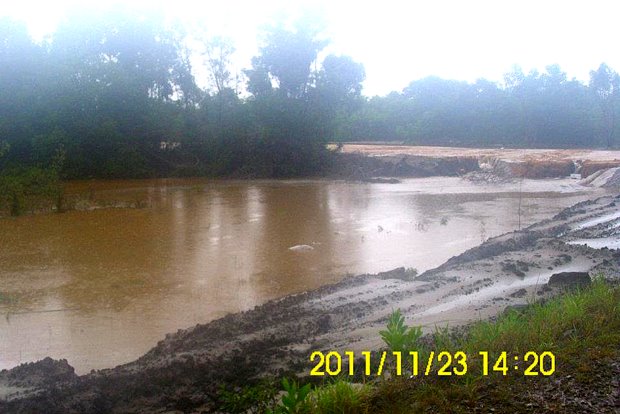
Serious flooding during the recent monsoon season in the immediate vicinity of the
nearly-completed Lynas rare earth refinery in Gebeng, Pahang
Key contractor pulled out of Lynas plant due to safety concerns, says NYT
By Shannon Teoh | The Malaysian Insider February 01, 2012
KUALA LUMPUR, Feb 1 – A Dutch chemical firm refused to supply crucial resins for Lynas Corp’s controversial RM2.5 billion rare earth plant in Kuantan due to safety concerns, according to the New York Times.
The influential newspaper cited engineers working for the Australian miner at the Gebeng industrial zone site and internal company e-mails as saying that AkzoNobel withdrew after it was told that the fibreglass liners using its resin would be installed in concrete-walled tanks that have a problem with rising dampness in the floors and cracks in the walls.
Proposed Lynas rare earth refinery flooded
on 13 January 2012 (courtesy of SMSL)
“AkzoNobel had been in discussions about the problem of rising dampness, but only became aware of the cracks this autumn,” the daily reported.
The resins were to be used to glue together dozens of fibreglass liners for concrete-walled tanks the size of double-decker buses where hundreds of tons of rare earths with low levels of radiation will be mixed with extremely corrosive acids at more than 93 degrees Celcius.
The company had said early last year it would supply chemicals for the Lynas project, which has raised fears of radiation pollution among local residents and environmentalists, only if it were certain that it would be safe.
LAMP waste water discharge point flooded in December 2011 after two days of heavy rain (SMSL)
In a report last June, the NYT had said that there were critical flaws in the design of the refinery, including the installation of the watertight fibreglass liners.
It said that memos showed Lynas pressed a Malaysian contractor, Cradotex, to proceed with the installation of watertight fibreglass liners designed for the containment tanks without fixing the moisture problem and with limited fixes to the walls.
“These issues have the potential to cause the plant’s critical failure in operation,” Peter Wan, the general manager of Cradotex, said in a June 20 memo obtained by the newspaper.
“More critically, the toxic, corrosive and radioactive nature of the materials being leached in these tanks, should they leak, will most definitely create a contamination issue."
CAIRO — Seven years later, it remains conventional wisdom here that Osama bin Laden and Al Qaeda could not have been solely responsible for the attacks of Sept. 11, 2001, and that the United States and Israel had to have been involved in their planning, if not their execution, too.
Many in Cairo see the attacks as part of an anti-Muslim plot.
This is not the conclusion of a scientific survey, but it is what routinely comes up in conversations around the region — in a shopping mall in Dubai, in a park in Algiers, in a cafe in Riyadh and all over Cairo.
“Look, I don’t believe what your governments and press say. It just can’t be true,” said Ahmed Issab, 26, a Syrian engineer who lives and works in the United Arab Emirates. “Why would they tell the truth? I think the U.S. organized this so that they had an excuse to invade Iraq for the oil.”
It is easy for Americans to dismiss such thinking as bizarre. But that would miss a point that people in this part of the world think Western leaders, especially in Washington, need to understand: That such ideas persist represents the first failure in the fight against terrorism — the inability to convince people here that the United States is, indeed, waging a campaign against terrorism, not a crusade against Muslims.
“The United States should be concerned because in order to tell people that there is a real evil, they too have to believe it in order to help you,” said Mushairy al-Thaidy, a columnist in the Saudi-owned regional newspaper Asharq al Awsat. “Otherwise, it will diminish your ability to fight terrorism. It is not the kind of battle you can fight on your own; it is a collective battle.”
There were many reasons people here said they believed that the attacks of 9/11 were part of a conspiracy against Muslims. Some had nothing to do with Western actions, and some had everything to do with Western policies.
Again and again, people said they simply did not believe that a group of Arabs — like themselves — could possibly have waged such a successful operation against a superpower like the United States. But they also said that Washington’s post-9/11 foreign policy proved that the United States and Israel were behind the attacks, especially with the invasion of Iraq.
“Maybe people who executed the operation were Arabs, but the brains? No way,” said Mohammed Ibrahim, 36, a clothing-store owner in the Bulaq neighborhood of Cairo. “It was organized by other people, the United States or the Israelis.”
The rumors that spread shortly after 9/11 have been passed on so often that people no longer know where or when they first heard them. At this point, they have heard them so often, even on television, that they think they must be true.
First among these is that Jews did not go to work at the World Trade Center on that day. Asked how Jews might have been notified to stay home, or how they kept it a secret from co-workers, people here wave off the questions because they clash with their bedrock conviction that Jews are behind many of their troubles and that Western Jews will go to any length to protect Israel.
“Why is it that on 9/11, the Jews didn’t go to work in the building,” said Ahmed Saied, 25, who works in Cairo as a driver for a lawyer. “Everybody knows this. I saw it on TV, and a lot of people talk about this.”
Zein al-Abdin, 42, an electrician, who was drinking tea and chain-smoking cheap Cleopatra cigarettes in Al Shahat, a cafe in Bulaq, grew more and more animated as he laid out his thinking about what happened on Sept. 11.
“What matters is we think it was an attack against Arabs,” he said of the passenger planes crashing into American targets. “Why is it that they never caught him, bin Laden? How can they not know where he is when they know everything? They don’t catch him because he hasn’t done it. What happened in Iraq confirms that it has nothing to do with bin Laden or Qaeda. They went against Arabs and against Islam to serve Israel, that’s why.”
There is a reason so many people here talk with casual certainty — and no embarrassment — about the United States attacking itself to have a reason to go after Arabs and help Israel. It is a reflection of how they view government leaders, not just in Washington, but here in Egypt and throughout the Middle East. They do not believe them. The state-owned media are also distrusted. Therefore, they think that if the government is insisting that bin Laden was behind it, he must not have been.
“Mubarak says whatever the Americans want him to say, and he’s lying for them, of course,” Mr. Ibrahim said of Hosni Mubarak, Egypt’s president.
Americans might better understand the region, experts here said, if they simply listen to what people are saying — and try to understand why — rather than taking offense. The broad view here is that even before Sept. 11, the United States was not a fair broker in the Arab-Israeli conflict, and that it then capitalized on the attacks to buttress Israel and undermine the Muslim Arab world.
The single greatest proof, in most people’s eyes, was the invasion of Iraq. Trying to convince people here that it was not a quest for oil or a war on Muslims is like convincing many Americans that it was, and that the 9/11 attacks were the first step.
“It is the result of widespread mistrust, and the belief among Arabs and Muslims that the United States has a prejudice against them,” said Wahid Abdel Meguid, deputy director of the government-financed Al Ahram Center for Political and Strategic Studies, the nation’s premier research center. “So they never think the United States is well intentioned, and they always feel that whatever it does has something behind it.”
Hisham Abbas, 22, studies tourism at Cairo University and hopes one day to work with foreigners for a living. But he does not give it a second thought when asked about Sept. 11. He said it made no sense at all that Mr. bin Laden could have carried out such an attack from Afghanistan. And like everyone else interviewed, he saw the events of the last seven years as proof positive that it was all a United States plan to go after Muslims.
“There are Arabs who hate America, a lot of them, but this is too much,” Mr. Abbas said as he fidgeted with his cellphone. “And look at what happened after this — the Americans invaded two Muslim countries. They used 9/11 as an excuse and went to Iraq. They killed Saddam, tortured people. How can you trust them?”