Friday, March 23, 2012

Artistic Freedom and Zenos Frudakis

"Freedom" by Zenos Frudakis
Size: 20 feet long x 8 feet high
Medium: Bronze
Location: GSK World Headquarters, 16th and Vine Streets, Philadelphia, PA

Zenos’ statement about his vision of the sculpture

Zenos Frudakis
I wanted to create a sculpture almost anyone, regardless of their background, could look at and instantly recognize that it is about the idea of struggling to break free. This sculpture is about the struggle for achievement of freedom through the creative process.

Although for me, this feeling sprang from a particular personal situation, I was conscious that it was a universal desire with almost everyone; that need to escape from some situation – be it an internal struggle or an adversarial circumstance, and to be free from it.

I began this work in a very traditional sculptural manner by creating a small model in clay called a macquette. The purpose of beginning in this manner is to capture the large action and major proportions of the figure within the overall design without any details to detract from the big idea. Another reason for not having details and for working on a small model only a few inches in height is that the small armature within it, holding the clay, is more easily manipulated, allowing for much greater flexibility in developing a concept. For example, an arm, a leg or a head can be pushed around without any concern for obliterating details, such as a nose or a finger.

The macquette is the original mass of clay where a concept is born and from which it grows and develops. This was important later when I enlarged the sculpture from several inches long to 20 feet long, and I retained in the larger work a sense that all the conceptual material, its forms, focus and development sprang from this rough idea. The work metamorphosized, in the way that we do.

Although there are four figures represented, the work is really one figure moving from left to right. The composition develops from left to right beginning with a kind of mummy/death like captive figure locked into its background. In the second frame, the figure, reminiscent of Michaelangelo’s Rebellious Slave, begins to stir and struggle to escape. The figure in the third frame has torn himself from the wall that held him captive and is stepping out, reaching for freedom. In the fourth frame, the figure is entirely free, victorious, arms outstretched, completely away from the wall and from the grave space he left behind. He evokes an escape from his own mortality.


IN FOND MEMORIAM

MY BELOVED MOTHER 
WHO WOULD HAVE TURNED 94 TODAY


A MUSICAL MONUMENT TO NAPOLEON HILL

NAPOLEON HILL (26 October 1883 ~ 8 November 1970)


In the early 1970s I picked up a paperback copy of Think & Grow Rich by Napoleon Hill and found it a great deal more readable than I had expected. This inspired me to investigate other American “success gurus” like Og Mandino and W. Clement Stone. I found their advice generally useful - but like all good advice, one has to follow it religiously, and I’ve never been a religious type. I also have an innate aversion to rightwing ideology - and all "successful" people tend to become rightwingers, because one must ferociously protect whatever one has acquired by fair means or foul.

Forty years later I find myself catching a preview of Napoleon Hill The Musical - scripted, produced and directed by my old theatre colleague JD Menon. Truth be told I only knew JD when he was in his early 20s, helping friends with various aspects of stagecraft and acquiring hands-on experience in showbiz. From time to time I’d bump into JD at arty events and exchange namecards – but I really had no idea what sort of work he’d been doing all these decades because I dropped out of the theatre scene in 1992. After that I kept in touch by doing the occasional theatre review – but I don’t recall catching any production by JD Menon.

Love, Sex, Desire, Romance, Hope, Faith, Enthusiasm and Napoleon Hill (Vishnu Rajendran Amboo)

So I was pleasantly surprised by what the man had accomplished the first time I visited Napoleon Hill The Musical at Matic. It’s akin to lunacy to embark on an original musical in this country – unless you happen to be married to a billionaire or have the benefit of a visionary corporate sponsor. To begin with there are so many elements one has to get right – apart from a solid libretto, a memorable music score, and an immensely talented cast (not to mention a competent and dedicated tech crew).

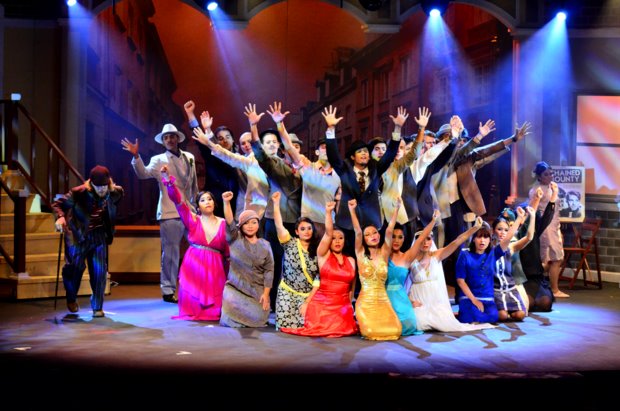
Although the pacing wasn’t quite snappy enough and a large portion of the cast appeared to be newcomers to the stage, their combined energy and enthusiasm were tangible and infectious. The camaraderie and joie de vivre I felt after the preview made me nostalgic for the “roar of greasepaint and the smell of the crowd” (as Anthony Newley once put it). And that’s ultimately what showbiz is all about – having a wonderful time while working off your excess fat.

Musical director Jeevz Menon
What impressed me most were the beautifully crafted songs and vibrant musical settings – a collaborative effort led by musical director Jeevz Menon (JD’s nephew and Berklee alumnus), songwriters Brittany Mahrer and Chris Murphy, with lyrical inputs from playwright-director JD Menon himself.

The vocals were pre-recorded with professional talents from various countries - and during the preview the lip-sync worked so smoothly I didn’t even notice the singing wasn’t live. Subsequently I caught the show on its final night and it was then I understood why the vocal amplification improved so dramatically whenever the actors burst into song. Apparently, only a couple of the performers had the necessary voice training to sing live; the others had to lip-sync it. Even so, the small orchestra performed exceedingly well; indeed, they were a major incentive for me to sit through the whole show a second time.

Haris Hadra as Napoleon Hill (photo: Vishnu Rajendran Amboo)

Well, the core of a musical is the music – and based on what I heard, Napoleon Hill The Musical has a lot going for it, even if none of the songs stood out as instant hits (like “Maria” from West Side Story, “On The Street Where You Live” from My Fair Lady, or “Do-Re-Mi” from The Sound of Music). But who knows – given a few more hearings, we might find ourselves humming a number like “Persona” or “What Do I Do With A Dreamer?” from Napoleon Hill The Musical. At any rate, the music was a savvy and sophisticated mix of styles ranging from rhythm-&-blues, soul, bebop, country-&-western, ragtime, jazz, emo and gospel - with a couple of anthems and marches thrown in for good measure.

People who enjoy musicals are those who appreciate a bit of song-and-dance – so choreography is also a vital element. I’d say that the dance numbers in Napoleon Hill The Musical passed muster, but fell short of being absolutely stunning. The four choreographers involved had to work with a diverse cast of amateurs and professionals - which, naturally, limited the sort of moves they could incorporate, although one member of the cast (Klethi Raphael) was extremely acrobatic, being a practitioner of capoeira.

Set and costume designs were competently executed, though I felt the director opted to play it safe with a conservative approach. There are many ways to costume a cast and construct a set and, ultimately, it’s a question of taste – so let’s say I found nothing distracting or incongruous in these departments. The lighting was effective without being intrusive; that means it was, for the most part, excellent.

Napoleon Hill: dogged by failure, haunted
by demons
(Vishnu Rajendran Amboo)
As for the acting, what I liked about this production was that there were no prima donnas amongst the cast – even among the key players – so the ensemble feeling was strong. Haris Hadra, as Napoleon Hill, cut an affable and likeable figure – heroic in his physical presence, yet humble and vulnerably human in his demeanor.

He was ably supported by Natalie Heng (who played Hill’s first wife Florence); Russ Natasha (second wife Rosa Lee); and Katarazyna Gabriel (third wife Annie Lou as well as Martha his stepmother).

Thomas Pang’s portrayal of Andrew Carnegie was precise, polished and very professional; while Russ Natasha’s slinky, sultry portrayal of the opportunistic femme fatale Rosa Lee was archetypal. Donna Lynn was immensely watchable as “Sex” (though she could have turned up the mojo a tad more); Noor Farzianna Hassaan was entirely lovable as “Love” and Anuja Chandran was pretty enticing as “Greed.” Geoff A. Feyaerts turned in a highly animated portrayal of “Fear” and Gonzalo Morquecho Rey played “Revenge” with exquisite flair and flamboyance.

The vivacious Russ Natasha as Rosa Lee
(Vishnu Rajendran Amboo)
What tickled me was Kasyfillah Kamain’s “Anger” – a perfect parody of Umno’s infamous paid rowdies down to his red headband and bullyboy postures. Aemma Ellysa Isa’s adolescent swagger as the young Napoleon Hill was both amusing and charming, even if her performance verged dangerously close to overacting at times.

As Napoleon Hill’s alter ego, Marvin Wong turned in a confident and elegant performance, while Dayton Lim’s characterization of Hill’s father, James, was empathetic, even if a wee bit wooden.

Overall, on second appraisal, Napoleon Hill The Musical struck me as a very promising first version. Given the opportunity to tighten a couple of scenes further and restage it on a more lavish scale with more heavy-duty talent - the RM300,000 budget is approximately one-hundredth of what I imagine it would cost to produce such a show on Broadway - there’s a fairly good chance JD Menon will realize his dream, which is to take Napoleon Hill The Musical on a world tour.

Young Napoleon working in a coal mine for $1 a day (photo: Vishnu Rajendran Amboo)

Why not? Three years ago an Australian-Indian musical extravaganza called The Merchants of Bollywood managed to take the world by storm – successfully touring Asia, Africa, Europe, America and the UK. It was as slick and glitzy as any musical spectacle that’s ever come out of Broadway or the West End – and it flaunted a heady Indian aroma with spectacular dances and costumes. The beautiful and talented Carol Furtada, who played Ayesha Merchant, was catapulted to international acclaim.

Original musicals, like durian trees, take a long time to bear fruit. Often, it takes several versions before the final product strikes the right chord with a mass audience and takes off, eventually joining the ranks of immortal hits like The Fantasticks or Les Misérables.

Playwright-producer-
director JD Menon
 

(Munira Abdul Ghani/NST)
JD Menon is fully entitled to his dreams – and it would appear that in bringing Napoleon Hill The Musical to fruition, JD has closely emulated the subject of his musical, overcoming a myriad of obstacles that would daunt anyone but the most audacious. Indeed, by populating his dramatization of Napoleon Hill’s life with a whole gamut of Emotions – negative and positive – he has drawn on a trusted technique in Greek theatre wherein the actors depict qualities such as Courage, Loyalty, Jealousy, Cowardice, Nobility and Hope. It was an inspired move, to say the least, and it would work even better if JD were to more vividly define and refine these characters – without lengthening an already long story.  

Malaysia has yet to take her artists, writers and performers seriously – and this neglect puts us at a vast cultural disadvantage when it comes to achieving world-class standards, especially in exportable media such as literature, films, theatrical productions, and so on. I believe we do have the talent – but for decades our cultural institutions appear to have been the refuge of deadwood bureaucrats, time-servers and brainless, myopic bigots whose idea of culture extends no further than insipid paintings of coconut palm sunsets, neo-romantic waterfalls and spiritless silat performances.

The fact that Napoleon Hill The Musical has seen the light of day at all is largely due to the visionary optimism of Christina Chia, chairman of Napoleon Hill Associates in Malaysia, who bravely underwrote the production so that its world premiere would coincide with the Napoleon Hill International Conference held on March 14-15 at the KL Convention Center, featuring Deepak Chopra as the main attraction.

Andrew Carnegie, steel
magnate and philanthrophist
Napoleon Hill struggled for 29 years before hitting the jackpot with Think & Grow Rich, which has sold over 100 million copies since its publication in 1937. Hill was inspired as a young journalist by his meeting with Andrew Carnegie, who challenged him to take on the task of interviewing more than 500 successful individuals and formulating some practical advice by which others might realize their own dreams.

In his single-minded pursuit of fulfilling his mission, Napoleon Hill neglected his domestic duties and, unsurprisingly, lost his family when his long-suffering wife Florence filed for a divorce, taking with her their three children. The vacuum in Hill’s love life was quickly filled by Rosa Lee, a social climber who later wrote a manual on how to snare a rich man – and then all but bankrupted Hill when she divorced him.

One might ask why Napoleon Hill deserves to be the subject of a musical. Well, why not? In 1991 I saw a brilliant musical in Melbourne called I Am Work – inspired by the life and times of Essington Lewis – Napoleon Hill’s contemporary and head honcho of BHP, the Australian steel giant. I was gobsmacked by the creative stagecraft that went into the dramatization of John O’Donoghue’s 2-act play with a cast of 6 men and 2 women. Even though it was a celebration of sorts of the life of a hard-headed industrialist, the musical qualified as high art.

Song-and-dance and a cast of nearly 60 (photo: Vishnu Rajendran Amboo)

In ancient times, epic poetry and murals were inspired by the battle exploits of victorious kings and emperors. Today's colossal overachievers devote their native genius and superhuman stamina to financial wars fought in corporate boardrooms.

Napoleon Hill is undoubtedly a luminary of the first magnitude among American success coaches in the tradition of Wallace Wattles, whose 1910 book, The Science of Getting Rich, inspired Rhonda Byrne’s best-selling 2006 DVD and book, The Secret. Everybody yearns for a taste of this elusive thing called Success.

W. Clement Stone: rags-to-riches,
inspired by Napoleon Hill
Napoleon Hill cleverly titled his book Think & Grow Rich – knowing full well that money, power and sex carry universal appeal. Without money, you can forget about power. Money and power are reputedly the strongest aphrodisiacs known to man.

The theory goes: if you can accumulate enough material wealth, influence and power are within easy reach; and with unlimited money and power, who can stop you from fucking up the whole world? Does that constitute Success?

Imagine getting paid $1.5 million a year as CEO of a toxic and polluting industry… how would you feel if a bunch of semi-illiterates in loin cloths decide to erect a barricade around your operations, claiming that you’re poisoning their rivers and destroying their miserable livelihoods? Would you suffer an attack of conscience and a sudden change of heart? Would you hand in your resignation and apologize profusely to those negatively impacted by your actions; and then do whatever you can to alleviate their suffering?

Shining Example of Success?
(Vishnu Rajendran Amboo)
Hosni Mubarak, Muammar Gaddafi, Dick Cheney, Ban Ki-Moon and Robert B. Zoellick are names you might find listed in the Who’s Who of World Affairs. These are men who have attained the very pinnacle of worldly power and riches – beyond the wildest dreams of their own former classmates. Are they not shining examples of worldly success?

Yet, having read Napoleon Hill’s book (among many other positive-mental-attitude manuals), I can attest that these self-help books never set specific goals for anybody – they merely offer practical tips on how to attain them.

And every one of them emphasizes the absolute necessity for us to anchor ourselves to an unshakeable spiritual foundation. Not only that, all these success gurus preach the same ultimate message: nobody can be considered truly wealthy or successful who isn’t at the same time compassionate, generous, and of the utmost integrity.

All previous models of success were founded on the erroneous notion that we are isolated individuals competing with one another to become King or Queen of the Mountain. Recent revelations in quantum physics suggest that each of us is an integral aspect of everyone and everything else in a holographic, multidimensional universe. As such, it's absurd to continue playing zero-sum games of win-lose. Win-win is the new evolutionary program.

The American Dream that became a Global Nightmare (photo: Vishnu Rajendran Amboo)

So long as there is a single homeless and hungry person on earth, nobody can be considered rich. True success must be something all of life can rejoice in – not just an elite cabal of criminals and sociopaths.

Chew on that, please, then act decisively to right all wrongs. Success, to me, is when heaven reigns on earth!


Antares  
23 March 2012

Wednesday, March 21, 2012

Star Commander Lee Ahau Ben turns Sweet Sixteen!

Lee Ahau Ben, 13 days after he landed on 21 March 1996.
16 years later, he still believes Mickey Mouse is God.

Anoora was the most excited one of all at Ahau's party.
Mary couldn't persuade Ahau to participate in the cake cutting ritual.
Neither could Anoora get him away from his Nemo DVD.
Don't BUG me... it's my birthday!

Aunt Rodi got Ahau a beautiful coverlet with a religious motif.
Mugging for the camera with his Daddy...
Okay, Daddy, that's enough...
All this unsolicited attention is giving me a headache.
So just bugger off, all right? I'm busy cultivating some acne.

That's better. Pimples don't show up in sepia.


HAPPY 16TH SOLAR ORBIT,
AHAU BEN!

Sunday, March 18, 2012

"$1.2 billion a week, squandered by folks with 1950s mindsets using 1970s technology... all in the name of National Security!"


A former CIA agent blows the whistle on the "national security" scam...

"They're only movers and shakers as long as YOU LET THEM BE movers and shakers." ~ Robert D. Steele

"Don't try to heal a broken system. Create a new system that replaces it." ~ Buckminster Fuller

[From a friend's facebook wall]

Wednesday, March 14, 2012

The Incomparable Nurul Izzah Anwar Speaks...


First time I shook her hand was in 1998, shortly after a commando team broke rudely into Anwar Ibrahim's Damansara Heights residence and bundled him off to jail as "a threat to national security." Nurul Izzah was only 18 years old then, but she was composed and confident as she greeted the throngs of well-wishers passing through their home to lend moral support.

Nurul Izzah's illustrious father, Anwar Ibrahim, was indeed a very serious threat - not to the nation but to the corrupt, hypocritical and tyrannical Umno regime established by the megalomaniacal and Machiavellian Mahathir Mohamad - who, in his 22-year term, almost single-handedly obliterated the horizon of decency and morally contaminated every public institution in the country - from the police force and the judiciary right down to our universities, civil service, and even the religious agencies.

Almost 14 years later, little has changed in Malaysia. The evil legacy left behind by Mahathir still plagues the nation. And Nurul Izzah's father is still the icon of political reform, as the Opposition Leader poised to become Malaysia's 7th prime minister if we can somehow overcome BN's fraudulent election system and knock them off their high horses.

At only 31, Nurul Izzah Anwar is already a seasoned campaigner. Everyone I know admires her courage, intelligence, composure - and, most of all, her compassionate, down-to-earth political stance. Of course, her striking beauty is a fantastic bonus. We dream of the day when we can watch our prime minister address the nation with sheer adoration and open-hearted admiration.

It's high time Malaysia gets a leader who deserves a standing ovation whenever she opens her mouth.

EVERY FACE TELLS A STORY


Mysterious lineage, possibly descended from one of the Great Khans; may also have genetic links to ancient shamanic bloodlines. Independent-minded and strong-willed, thrives on controversy and breaking social taboos. Ambitious and fashion-conscious, fond of luxury and an extravagant lifestyle. Passionate and romantic, with a protective veneer of cynicism and pragmatism. Adventurous spirit, assertive and self-confident, with a weakness for high-profile alpha males, especially the rich and famous. Emotionally wounded, fatally attracted to experiences of betrayal, sorrow, disappointment and tragedy.


Domineering spirit, drawn to wealth and power, and willing to do whatever it takes to achieve her ambitions. Inclined towards superstition and a belief in magical talismans; gracious and charming to anyone who can serve her purposes, but cold and spiteful towards those who do not fawn over or lavish her with flattery. Tendency to be ruthless and vindictive when thwarted.


Born into wealth and inherited power, self-assured about his social status and ability to command. Emotionally vulnerable but groomed for high office, hence skilful at camouflaging his feelings and maintaining a stiff (albeit pink) upper lip. Unresolved issues with father and mother: tends to defer to authoritarian father figures, while attracted to strong, domineering females. Inclined towards sensuality and sexual decadence, but acutely conscious of reputation and therefore constantly burdened with feelings of guilt. Able to detach completely from his emotions and thus capable of insensitivity and cruel, unfeeling behavior.


An explosive combination of personalities: when fire and ice come together, it can get really steamy. Steam, as we know, can be harnessed to power mighty engines - but if unreleased can produce calamitous effects.

[First published 10 October 2008]

Tuesday, March 13, 2012

The Astrology of 2012 and December 21st ~ Craig Howell


Big movements are afoot in the heavens as the planets jostle into position, signifying no less than the birth of a new consciousness. But with birth sometimes comes painful transitions until mother and child are resting in each others arms. The beginning of this goes back to the “Harmonic Convergence” of the ‘80s, but the most recent turn of events is showing a ratcheting up of the energy to the point where something’s got to give, as they say.

In June of 2011 there began a series of hard aspects between Uranus and Pluto, sometimes forming Grand Crosses with other planets in the Cardinal Signs. Uranus is the planet of independence and revolution and by that time last year it was in full swing with the “Arab Spring” and the “Occupy” movement not far behind. Pluto deals with old energy that needs shifting and in this case, in Capricorn, old structures that have been mainstays of society that need an overhaul. All astrologers agree that when planetary energies push against each other such as these, the friction and pressure create something like a world seismic event that lasts for a long time. It’s like an earthquake that has been building over years, starts swarming and then releases the pressure in various eruptions.

When other planets join in and form a cross in the sky, it intensifies this pattern. Cardinal signs (Aries, Libra, Capricorn, Cancer) show that the effects of this transition will be temporary, yet fraught with emergencies, creating issues or problems that require immediate solutions. It also shows that although there will be wasted energy spinning wheels, there will ultimately be growth and change for the better. Hard aspects will come to a conclusion in 2016, but it doesn’t mean that we’re done. It’s going to take a while to straighten everything back out. As one channeler expressed about this transition, “we are waist-deep” into it. We are in a major transition.

It’s time for “business as usual” to change, whether you want to or not. The Universe doesn’t ask if you are ready. This will turn the tables on the Plutonian power brokers if they are using their energy to control and manipulate the masses, because the masses just woke up and they are not going to lie down and play the game anymore. This is the beginning of the end for old political, financial, cultural and even religious structures (especially male-dominated types) that have run their course and are no longer assisting our evolution. This is the general climate at this time.

Now it is 2012 and everyone is wondering what’s going to happen when we get to the date of December 21, 2012. As an astrologer, there are indeed real physical alignments of planets around that date, but are of a more subtle nature. There is still Uranus and Pluto pounding it out along with the Sun and Moon, showing a minor flare up, but there is another configuration that begins at this date and continues for a short time. This is called a Yod, or the “Finger of God.”

Although this sounds ominous, it is actually symbolic of a time when a clear choice must be made as to where or how to proceed. With that choice a new destiny is born. It shows that we are at a crossroads, everyone knows it, and in fact may have even felt this for a long time, but now the realization that we can not go on like this has arrived. On December 21st, this may be but an inner knowing among us, but by late March, 2013, we will see what our choices have brought us. This configuration is helped along by having Pluto and Saturn sharing each other’s ruler. Pluto in Capricorn is saying tear down the old systems. Saturn in Scorpio is saying reuse and retool what is worth saving into something that works for us now. Because Jupiter is the trigger for this transit, it may be that people will be assessing their belief in their own abilities to accomplish a major shift (both inner and outer) and checking their personal spiritual beliefs. Maybe because Jupiter is in Gemini (and retrograde) people will be talking a lot about this to each other as well, attempting to process this and gauge other’s experiences of this at the moment. Then we will see what we have manifested in March, 2013.


Along the way there will be more exposing and reversal of power structures that do not serve our spiritual growth at this time. This may create some emergency situations that must be dealt with. It will also be a challenge to us to take back our power individually; to be accountable for our decisions and for the circumstances we find ourselves in. This may be felt as just a nudge now, but a more visceral effect will show around April of 2014, especially for the United States, as Jupiter moves into Cancer and triggers the Uranus /Pluto formation all over again.

This year Neptune moves into its home sign of Pisces. I believe it will be seen on one level as personal and group spiritual involvement and, on another level, as a social concern for the underprivileged or disenfranchised, where people are volunteering and sacrificing to help others in need. But there is more.

Because this involves Neptune, one must tread carefully so as to be able to get a constant reality check. This position will open people more to the spiritual realms, but also become the gateway for delusions, illusion and fantasy. Although we will be learning to be our own spiritual guide by connecting through our heart and soul, there will still be many searching for that one who they can follow, the one who they believe can save them and save the world.

Neptune tries to get us to live in higher consciousness while living in a lower vibrational third dimensional world, which provides some conflict for most humans, to say the least. Neptune seeks perfection in an imperfect world by any means possible, hence the negative reaction in striving to feel Nirvana through drugs or any escapist tendency instead of going within to align with their higher awareness. With Neptune, the “real” world weighs heavy on the soul.


As far as 2012 goes, this could mean that there is so much belief from so many that a particular event can occur, this event—or series of events—begins to manifest. Whether it is a manifestation of fear or of love is up to us. It comes down to the question, “How do you envision your future?” It may be the beginning of a time when we really start seeing our own thoughts and feelings manifest in our lives very clearly. Those that do not understand this may be creating more negativity for themselves and, only seeing this, they may believe it to be their reality—a never ending circle. This may be what people have predicted as a shift or separation in reality, which could be very confusing if you’re not prepared for it.

The greater effect for the United States will come around 2014-2024, as planets make harsh exact aspects to planets in the United States chart. This will shift the country in a deep and long lasting way. After this transit the USA will never be the same. This sounds dire, but it is actually going to bring a breath of fresh air after the power struggles are over between those who don’t want change and those who do.

My take on the big picture is that Neptune in Pisces is the last gasp of the Piscean Age with all the attending irrational fears, hypersensitivity and emotional hysteria until it goes into Aries (2026) about the same time as Pluto goes into Aquarius in 2024. Then we will see the real beginning of the Aquarian Age where people have a greater understanding of the spiritual energetic principles that create our existence and a tolerance for the beliefs and lifestyles of others.
Craig Howell has been a published writer since 1993 when he created and published his holistic/metaphysical monthly publication, The Wheel. He has since created four books: A Flower Unfolds (spiritual giftbook), Through the Eyes of Kwan Yin (Q&A with a Kwan Yin channel), Spiritual Teachings for Young Souls (basic teachings for teen empowerment) and 2012 Messages. He has contributed to many publications online and in print, most recently in Dell Horoscope Magazine.


[Brought to my attention by Olivia de Haulleville]


Latest music video from Hugo Farrant (the most erudite rapper on earth!)


Mash-up video for Hugo & Treats "1 1 2 3 5 Let It Reign"

Lyrics written and performed by Hugo
Music blended by Treats
Vox recorded, mixed and mastered at Squid Studios by Frank Pearce
Uploaded on YouTube 10 March 2012


Available for download here! ... or for listening here... connect on facebook here!
Connect with Treats here.

HOW I MET HUGO FARRANT

Sunday, March 11, 2012

Censorship & the performing arts in Malaysia: a case study


THE B*LTIM*RE W*LTZ OPENS IN KL!
Antares mulls over the far-reaching effects of censorship

Paula Vogel
This was supposed to be a straightforward review of a not-so-straightforward play, The Baltimore Waltz by the award-winning playwright Paula Vogel, directed by Rey Buono and produced by the Instant Café Theatre. However, external circumstances sometimes intrude and irrevocably alter the course originally intended.

The play was very nearly cancelled. Indeed, one day before opening night, The Baltimore Waltz was banned by DBKL (Dewan Bandaraya Kuala Lumpur aka City Hall) which issues public performance licences for all shows staged in the Federal Territory. DBKL have thus far been, to their credit, fairly cooperative, easygoing and mature about this ruling - until the recent flap over The Vagina Monologues (which saw a very successful initial run, only to have its application for an extension rejected).

Producer Adeline Tan and artistic director Jo Kukathas filed an urgent appeal with DBKL and, after agreeing to extensive cuts, were given permission to stage the play as scheduled. This, in itself, is reason to celebrate: firstly, the never-say-die feistiness of ICT and the cast of The Baltimore Waltz, which saved the show; and secondly, the fact that the show did go on indicates that the people who work at DBKL aren’t TOTALLY unreasonable and are, to a certain extent, still open to a little give-and-take. After all, a tremendous amount of energy, time, money, and talent goes into a theatrical production of this caliber – and it only takes one “TAK BOLEH!” to see everything go down the drain. Theatregoers will be condemned to a boring plastic future of uncontroversial plays and harmless frolic – because potential sponsors will inevitably balk at any material that extends the frontiers of artistic expression.

Rey Buono
This is a good time for all of us, whether or not directly involved in the performing and cinematic arts, to reassess how we really feel about being told what we can and cannot see and hear on stage or on the screen. Who decides and why? Censorship, no matter what the excuse, ultimately serves only to retard us mentally and culturally infantilize us. This may suit you fine if you happen to be in business or the bureaucracy – after all, a bunch of docile, overgrown kids are easy to keep in line with candy and canes (or bread and circuses).

Malaysia’s censorship laws, like our notorious Internal Security Act, are a legacy of the British administration. Archaic, irrelevant and unnecessary though they be, these laws are a convenient foil against any attempt to change the status quo or overthrow the ruling regime through nonviolent means. I’d like to quote extensively from my review of Chin San Sooi’s heavily censored play, Morning In Night, published in the New Sunday Times of August 24, 1986:

Freedom of expression isn’t something one can take for granted. Even in merry England, the necessity of getting official sanction for all plays was a centuries-old thorn in the side of the theatre community – until 1967 or thereabouts when Kenneth Tynan led a successful campaign to abolish the all-powerful rôle of the Lord Chamberlain in granting public performance permits.


Robert Walpole (1676 ~ 1745) 


The history of secular censorship in the English theatre goes back to a Playhouse Bill proposed by Robert Walpole in 1737. As First Lord of the Treasury and Chancellor of the Exchequer, Walpole was in a highly favorable position to amass great personal wealth through corruption; he was, in fact, unofficially England’s first Prime Minister and not without his critics, who often resorted to the symbolic weapon of the stage to lampoon his inflated political ambitions. Walpole’s Playhouse Bill passed into law and all scripts were subjected to the Lord Chamberlain’s scrutiny; the Lord Chamberlainship, naturally, was an office appointed by the Lord Chancellor of the Exchequer. The fact that it took the English 230 years to rid themselves of this particular nuisance shows how difficult it is to unmake unnecessary laws.


I hear voices piping up: “But, but… there HAS TO BE some form of control over artistic output or the whole nation will be plunged into chaos!” Well, let’s remind ourselves that originally all artistic expression was regarded as the chief means by which Divine Intelligence (or the Collective Psyche) revealed itself to mankind. If we’re going to run around hysterically plugging up these channels of intercommunication just because some of them threaten our narrow understanding of life, would that not precipitate our worst fears and bring about a monopoly of the Truth wielded by vested interests? Humans, in their faithlessness and folly, love to make laws, which the smarter ones break. Wise is he who knows how to unmake laws.

So much for censorship. I don’t have anything positive to say about any form of censorship – and don’t give me that cynical crap about “multiracial, multicultural sensitivities.” The only chance we have to resolve any human conflict is through honest, uncensored communication; and the best people to attempt this task are our writers, thinkers, and performers – not bureaucrats and politicians!

How about the play itself? I didn’t care too much for Paula Vogel’s writing, although I think the play is an instructive study for aspiring playwrights in its clever use of cinematic devices, literary allusions and cultural clichés. Vogel’s insights and responses are circumscribed by the intellectual materialism of her academic background. Her script, which humanizes the experience of being gay and dying of AIDS, may evoke sympathy for AIDS sufferers in particular and homosexuals in general - but her typically American (Hollywood?) sentimentality about death and dying came across as trite. I’d have been a great deal more intrigued if she had at least alluded to the possibility that the HIV virus was a top-secret population-culling project of the WHO that went awry. Fortunately Vogel managed to poke some timely fun at Big Medicine, pharmaceutical companies and their professional quackery and chicanery.

Ghafir Akbar
Despite the initially amusing, then annoying, surgical excisions - goodhumoredly captioned with slide announcements like: “UNACCEPTABLE DIALOGUE REMOVED” or “UNACCEPTABLE REMOVAL OF CLOTHING REMOVED” - the play was elegant and sophisticated, and might well have marked a new level of artistic achievement in KL theatre. Rey Buono showed himself once again to be an imaginative, intelligent, and inspired theatre director who combines craftsmanlike competence with poetic passion.

Rohaizad Suaidi
The cast deserves a tremendous round of applause for the superhuman effort they put into entertaining their audiences, in the face of the dreadful uncertainties and bureaucratic stress they were all subjected to. Rohaizad Suaidi was credible and animated as Carl; Ghafir Akbar was remarkably versatile with his multiple quick-change characterizations; and Joanna Bessey was simply lovable as Anna. Theirs were technically challenging rôles – especially Ghafir’s – and I felt they could have fine-tuned their characterizations a great deal better without the help of DBKL’s censorship board. As things turned out, it was like going to the cinema and seeing a goondu’s hand blocking the projector every time an “objectionable” scene came up. Unwittingly, DBKL (as the symbol of official repression) became the fourth member of the cast and their performance was, frankly speaking, shameful.

Joanna Bessey
Malaysians are generally a patient lot but are we prepared to put up with mediocrity forever? Because that’s what censorship ultimately breeds. I certainly hope not. It’s like granting the butler the power to stop you from leaving home if he felt you weren’t “suitably” dressed. Or allowing the security guards to decide what books to order for the library and what books to burn.

An advanced culture loves and accepts diversity in all things and allows free exchange of ideas. It doesn’t stifle artistic expression and suppress truthspeaking theatre. Seems like we’re a little backward when it comes to cultural maturity.

[First published in kakiseni.com in June 2003]

Friday, March 9, 2012

GODDESS ROCK


I love the way it glistens.


[Forwarded by my daughter Belle]

Tuesday, March 6, 2012

Opposition to Lynas escalates on all fronts...

Anti-Lynas Himpunan Hijau 2.0 in Kuantan, Pahang, 26 February 2012 (photo: Malaysiakini)

PETALING JAYA: The Anti-Nuclear Alliance of Western Australia (ANAWA) has revealed that Lynas Corporation Ltd was supposed to build its plant in Western Australia and not Malaysia.

According to ANAWA, Lynas’ 14-year-old blueprint indicated that the Australian mining giant had orginally planned to build its processing plant in Meenar a decade ago. But until today there had been no signs of any development on the intended site.

ANAWA spokesperson Marcus Atkinson told FMT that the orginal approvals were given by the Environmental Protection Authority (EPA) for Lynas to ship rare earth to buyers and confirmed that he had viewed these relevant documents firsthand.

Under pressure: Nick Curtis, Lynas CEO (TMI)
However, he said that Lynas had since made numerous alterations to its operations to the point that its rare earth refinery had now landed in Malaysia.

“Instead of transporting processed rare earth, it is now shipping a concentrate which contains thorium and other radioactive material with more heavy metals,” he told FMT.

Atkinson admitted that they had been more focused on Lynas’ operations in Australia until the uproar in Malaysia reached their ears and they realised that Lynas’ had made “massive” changes to its plans.

“Now it involves Malaysia and our moral responsibility,” he said. “This is a complete change to the original project hence why we are urging the EPA to review Lynas’ approvals.”

ANAWA and Australia’s Environmental Defenders Office (EDO) lodged a referral with the EPA this morning calling on the latter to reopen the project and revisit Lynas’ “outdated” approvals.

Atkinson had yesterday raised deep concerns over the amount of radioactive material being transported from Mount Weld to Fremantle Port for export and called for stronger regulations to be put in place to ease the fears of the surrounding community.

He had also drawn attention to the fact that Lynas had sparked off Malaysia’s largest environmental campaign with its RM2.5 billion Lynas Advanced Materials Plant (LAMP) in Gebeng, Kuantan.

The nationwide Himpunan Hijau 2.0 rally held on March 26 saw more than 15,000 people gathering to demand that Lynas be ousted from Kuantan.

Less stringent laws

Atkinson added that ANAWA and EDO strongly believed that Lynas had chosen to move its operations to Malaysia because of the heavy metals and radioactive waste involved in the processing.

“We believe Lynas picked Malaysia to save money and enable it to operate under less stringent laws,” he stated.


“The biggest concerns about the processing are the storage and waste management issues which are made more difficult in Gebeng which we understand to be wetlands.”

Asked if Lynas would be allowed to operate in the same manner and with the same liberty in Western Australia as in Gebeng, Atkinson firmly replied in the negative. “There is no way it could operate the way it is in Malaysia over here,” he said. “Australia’s laws are much more stringent.”

Atkinson issued a further call for the International Atomic Energy Agency (IAEA) to be scrutinised for downplaying the levels of radioactivity soon to be produced by Lynas’ operations.

“Just because the radioactive elements fall below the IAEA’s levels it doesn’t mean that the products don’t contain any radioactivity,” he pointed out.

EDO and its lawyers would also be issuing a letter to Lynas today urging it to stop any plans for the exportation of rare earth until the EPA reached a decision following the referral submission.

The EPA was expected to revert to ANAWA and EDO within 28 days on whether it would reopen the case or if Lynas’ current approvals were good enough.

“If they refuse to review the project then we will file a court case against it,” Atkinson promised.

Lynas’ letter of undertaking

Poet Laureate Samad Said (second from left)
at Himpunan Hijau 2.0
Meanwhile in another development, International Trade and Industry Minister Mustapa Mohamed said today that Lynas had given the government a letter of undertaking to send its rare earth processing residue abroad if it cannot find a suitable waste disposal site in Malaysia.

The Star Online reported Mustapa as saying that the move was taken as an assurance to the people’s psychological and emotional safety.

“Even though the government is satisfied there will be no radioactive residue produced during the plant’s operation, we have ordered Lynas to guarantee and plan the provision of a permanent waste disposal facility far from human population as recommended by the International Atomic Energy Agency.

“Failing which, Lynas has already expressed willingness to take the residue out of Malaysia,” he said in a joint statement with Pahang Menteri Besar Adnan Yaakob in Kuantan.

The report also quoted the minister as saying that the Western Australia Resources Minister Norman Moore had confirmed on Feb 29 that the rare earth’s radiation level was very low. “The fact is, the rare earth does not need to be controlled by Australia because it is not dangerous but in Malaysia, AELB is overseeing the project after considering the public’s opinion,” he added.

Mustapa said the government was urging Lynas to take extra care for the sake of the people, and not because of “threats by Himpunan Hijau” which had said it would hold another anti-Lynas rally if the government refuse to shut down the project.


Interviews following ANAWA/EDO submission of appeal to WA EPA today (audio recording)