Showing posts with label Deepak Chopra. Show all posts

Monday, March 30, 2020

Deepak Chopra ~ The Future of Leadership (repost)

Commencement speech by Deepak Chopra delivered at Hartwick College's
2013 graduation ceremony

Today as you celebrate this major milestone in your life and commence a new stage of your life journey, I ask you to reflect on the gift of life itself. And life, in essence, is nothing but awareness. Furthermore human life, considered the pinnacle of biological evolution, is not just awareness, but self-awareness. Amongst creatures on this planet, we human beings are not only aware; we have the capacity to be aware that we are aware, to be conscious of our consciousness. In that self-awareness lies our potential and power to direct our own future evolution and the future evolution of civilization.

Biological evolution has been summed up in the phrase of "survival of the fittest", but with overpopulation and overconsumption of resources, the future belongs to "survival of the wisest". It is imperative for the future of humanity that wisdom becomes the new criterion for sustainable life on this planet. And wisdom is that knowledge that nurtures life in all its dimensions not only for us but also for the generations that follow us.

Today's age is frequently referred to as the Information Age. The hallmarks of this age are the gifts of science and technology that have created the miracles of molecular medicine, real-time imaging of cellular function, instant accessibility of global knowledge, and social networks. Yet despite this emerging global brain, paradoxically we are beset with the same scourges of war and terrorism, radical poverty in 50% of the world’s population, irreversible climate change, along with deepening social and economic injustice! Furthermore, humanity suffers from massive malnutrition in which half the world suffers from hunger and the other half from obesity leading to inflammatory disorders, increasing the risk of chronic illnesses including many types of cancer and cardiovascular diseases while the hungry die from compromised immune function and infectious diseases. The information revolution has not led to the wisdom needed to solve our world crisis in health and well-being.

If ever humanity had the power of mass self-extinction on planet earth, it is today. And if it happens will be because we allowed our emotional and spiritual evolution to be outpaced by the evolution of our science and technology. Nuclear proliferation, biological warfare, eco destruction, the extinction of species and the poisoning of our atmosphere, our rivers and waters and the very food that sustains our life and all life loom before us as imminent threats. But just as in other critical phases of transformation, while there is disaster looming on one hand, there is on the other hand the potential to create a radical reorganization into something much greater than was conceived of before.

Today, I ask you my young friends, you who are the future hope of humanity, you who are the future leaders of the world; today, I ask you what Mahatma Gandhi once asked, "Can you be the change you want to see in the world?"

In fact, there can be no social or world transformation unless there is your own inner transformation. Today, I ask you to face a fundamental truth. Today, I ask you to consider that there is no ‘you’ that is separate from the world. The gift of life, your own self-consciousness is your key to inner transformation and wisdom, and that in turn is how you will transform the world. Today, I ask you to acknowledge that you are the world and that your transformation of consciousness will be the future of the word. This self-transformation is the wisdom for our planet’s survival.

As I enter the autumn of my life and you the springtime of yours, I want to leave you with seven skills in self-awareness that I have learned and that I hope will serve you well no matter what profession you choose, or where your life and destiny take you.

Skill # 1 Become the best listener you can be. Learn to listen with the instruments of the body, the feelings of the heart, the logic of the mind and the stillness of your soul. As you listen deeply, reflect on the following questions: What am I observing? What am I feeling? What is the need of the moment? What is the best way to fulfill this need?

Skill#2 Bond emotionally with friends, family, professional colleagues and those you interact with daily. Understand that each of us is part of a web of relationships that is nurtured through love, kindness, compassion, empathy and joy. Emotional bonds create effective teamwork where nothing is impossible because you have a shared vision for service, contribution and success and because you complement each other’s talents and strengths.

Skill # 3 Expand your awareness by knowing that all human beings have a hierarchy of needs that start with survival and safety and progressively expand through stages that include love and belonging, true self esteem, success as in the progressive realization of worthy goals, creative expression, higher consciousness and self-actualization. As you expand your awareness learn to harness your spiritual gifts that come in the form of the powers of intention, intuition, creativity, imagination & conscious choice making.

Skill #4 Remember the importance of action. Learn to be action oriented and know that there is no power higher than love in action. Remember that love without action is meaningless and action without love is irrelevant.

Skill# 5 Assume responsibility for your own well being in all its various facets. Your well being encompasses every aspect of your life - your career, your social interactions, your personal relationships, your community and your financial success. Take time to rest and play, to be with your family and friends, to exercise and nourish your body with healthy food.

Skill# 6 Empower yourself with true self-esteem. Learn to be independent of the good and bad opinion of others. Recognize the power of presence. Do not allow yourself to be distracted. Know your life purpose and the contribution you want to make to society.

Skill # 7 Know your true self. Your true self is not your self-image that is dependent on the labels you and others have given yourself. Your true self is the innermost core of your being that is beyond all labels, definitions & limitations. All the wisdom traditions tell us that the human spirit is a field of infinite possibilities, a field of infinite creativity love compassion joy and profound equanimity. Know you can only give to the world that which you possess in that innermost core of your being. Remember that you will create peace only when you are peaceful and create a loving world only when you have learned to love.

I entreat you to not lose your idealism with the passage of years. That idealism is connected to your knowingness of the good that can be created and the power to manifest it. In you lies the potential for a more peaceful, just, sustainable, healthier and happier world. Remember that the goal of all other goals is to be happy. I am reminded today of an assignment that John Lennon was given by his elementary school teacher when he was seven years old. He and his classmates were asked to write a short description of whom they wanted to be when they grew up. John Lennon wrote down that he wanted to be always happy. When his teacher complained that John did not understand the assignment, John's mother told him to tell the teacher that he did not understand life.

But what do we really know about happiness? Recently there has been a lot of research on the dynamics of happiness. Most people think that if they are successful in achieving their goals or have good relationships or if they are healthy, they will be happy. In fact it is the other way around. If you are happy person you are likely to have healthy habits, and nurturing relationships and great success in life. Social scientists describe what they describe the Happiness formula: H=S+C+V

H stands for happiness

S stands for set point in the brain

C stands for conditions of living

V stands for voluntary choices

“S” stands for the set point in the brain and refers to our mechanisms of perception. We all have a semi-fixed place on the happiness spectrum based on our outlook on life. Happier people see the opportunities, where unhappy people see problems. The set point for happiness can be upregulated, or shifted toward greater happiness, through self-reflection on limiting beliefs. The set point determines 50% of our happiness experience on a daily bases. The ‘C’ in the formula is the conditions of living and refers mainly to material success and personal wealth. It determines about 12% of your daily happiness experience. If you win the lottery you will be extremely happy for a few months, but after one year you will return to your set point. Voluntary choices represents choices that we make on a daily bases. Choices for personal pleasure bring transient happiness, while selfless choices bring inner fulfillment through purpose and meaning, e.g. by making other people happy meaningful relationships bring more permanent happiness. So to be happy it’s fine to have material comforts around you, but that will only account for 12% of your happiness. To really be happy you need to expand awareness and overcome your self-limiting beliefs and then choose selfless actions, or ways to be of service to others. This leads to true and lasting happiness and wisdom.

Finally today, more than any other day, remember to be grateful. Gratitude opens the door to abundance consciousness. Express your gratitude today particularly to your parents, teachers and fellow students, all who have helped bring you to this threshold of life.

You are now ready to embark on the hero's journey, the hero’s quest. Good luck and God speed.

June 2013

[First posted 1 June 2013]

Friday, March 23, 2012

A MUSICAL MONUMENT TO NAPOLEON HILL

NAPOLEON HILL (26 October 1883 ~ 8 November 1970)


In the early 1970s I picked up a paperback copy of Think & Grow Rich by Napoleon Hill and found it a great deal more readable than I had expected. This inspired me to investigate other American “success gurus” like Og Mandino and W. Clement Stone. I found their advice generally useful - but like all good advice, one has to follow it religiously, and I’ve never been a religious type. I also have an innate aversion to rightwing ideology - and all "successful" people tend to become rightwingers, because one must ferociously protect whatever one has acquired by fair means or foul.

Forty years later I find myself catching a preview of Napoleon Hill The Musical - scripted, produced and directed by my old theatre colleague JD Menon. Truth be told I only knew JD when he was in his early 20s, helping friends with various aspects of stagecraft and acquiring hands-on experience in showbiz. From time to time I’d bump into JD at arty events and exchange namecards – but I really had no idea what sort of work he’d been doing all these decades because I dropped out of the theatre scene in 1992. After that I kept in touch by doing the occasional theatre review – but I don’t recall catching any production by JD Menon.

Love, Sex, Desire, Romance, Hope, Faith, Enthusiasm and Napoleon Hill (Vishnu Rajendran Amboo)

So I was pleasantly surprised by what the man had accomplished the first time I visited Napoleon Hill The Musical at Matic. It’s akin to lunacy to embark on an original musical in this country – unless you happen to be married to a billionaire or have the benefit of a visionary corporate sponsor. To begin with there are so many elements one has to get right – apart from a solid libretto, a memorable music score, and an immensely talented cast (not to mention a competent and dedicated tech crew).

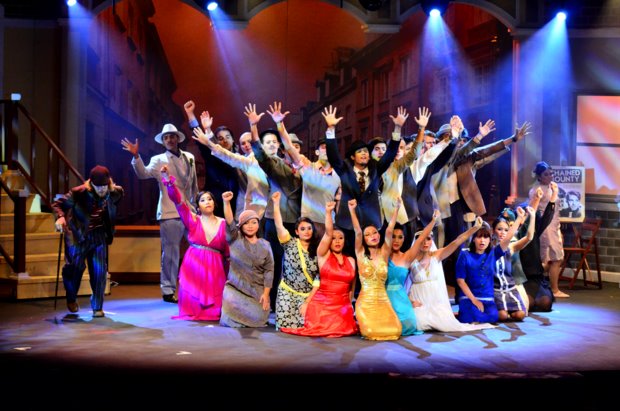
Although the pacing wasn’t quite snappy enough and a large portion of the cast appeared to be newcomers to the stage, their combined energy and enthusiasm were tangible and infectious. The camaraderie and joie de vivre I felt after the preview made me nostalgic for the “roar of greasepaint and the smell of the crowd” (as Anthony Newley once put it). And that’s ultimately what showbiz is all about – having a wonderful time while working off your excess fat.

Musical director Jeevz Menon
What impressed me most were the beautifully crafted songs and vibrant musical settings – a collaborative effort led by musical director Jeevz Menon (JD’s nephew and Berklee alumnus), songwriters Brittany Mahrer and Chris Murphy, with lyrical inputs from playwright-director JD Menon himself.

The vocals were pre-recorded with professional talents from various countries - and during the preview the lip-sync worked so smoothly I didn’t even notice the singing wasn’t live. Subsequently I caught the show on its final night and it was then I understood why the vocal amplification improved so dramatically whenever the actors burst into song. Apparently, only a couple of the performers had the necessary voice training to sing live; the others had to lip-sync it. Even so, the small orchestra performed exceedingly well; indeed, they were a major incentive for me to sit through the whole show a second time.

Haris Hadra as Napoleon Hill (photo: Vishnu Rajendran Amboo)

Well, the core of a musical is the music – and based on what I heard, Napoleon Hill The Musical has a lot going for it, even if none of the songs stood out as instant hits (like “Maria” from West Side Story, “On The Street Where You Live” from My Fair Lady, or “Do-Re-Mi” from The Sound of Music). But who knows – given a few more hearings, we might find ourselves humming a number like “Persona” or “What Do I Do With A Dreamer?” from Napoleon Hill The Musical. At any rate, the music was a savvy and sophisticated mix of styles ranging from rhythm-&-blues, soul, bebop, country-&-western, ragtime, jazz, emo and gospel - with a couple of anthems and marches thrown in for good measure.

People who enjoy musicals are those who appreciate a bit of song-and-dance – so choreography is also a vital element. I’d say that the dance numbers in Napoleon Hill The Musical passed muster, but fell short of being absolutely stunning. The four choreographers involved had to work with a diverse cast of amateurs and professionals - which, naturally, limited the sort of moves they could incorporate, although one member of the cast (Klethi Raphael) was extremely acrobatic, being a practitioner of capoeira.

Set and costume designs were competently executed, though I felt the director opted to play it safe with a conservative approach. There are many ways to costume a cast and construct a set and, ultimately, it’s a question of taste – so let’s say I found nothing distracting or incongruous in these departments. The lighting was effective without being intrusive; that means it was, for the most part, excellent.

Napoleon Hill: dogged by failure, haunted
by demons
(Vishnu Rajendran Amboo)
As for the acting, what I liked about this production was that there were no prima donnas amongst the cast – even among the key players – so the ensemble feeling was strong. Haris Hadra, as Napoleon Hill, cut an affable and likeable figure – heroic in his physical presence, yet humble and vulnerably human in his demeanor.

He was ably supported by Natalie Heng (who played Hill’s first wife Florence); Russ Natasha (second wife Rosa Lee); and Katarazyna Gabriel (third wife Annie Lou as well as Martha his stepmother).

Thomas Pang’s portrayal of Andrew Carnegie was precise, polished and very professional; while Russ Natasha’s slinky, sultry portrayal of the opportunistic femme fatale Rosa Lee was archetypal. Donna Lynn was immensely watchable as “Sex” (though she could have turned up the mojo a tad more); Noor Farzianna Hassaan was entirely lovable as “Love” and Anuja Chandran was pretty enticing as “Greed.” Geoff A. Feyaerts turned in a highly animated portrayal of “Fear” and Gonzalo Morquecho Rey played “Revenge” with exquisite flair and flamboyance.

The vivacious Russ Natasha as Rosa Lee
(Vishnu Rajendran Amboo)
What tickled me was Kasyfillah Kamain’s “Anger” – a perfect parody of Umno’s infamous paid rowdies down to his red headband and bullyboy postures. Aemma Ellysa Isa’s adolescent swagger as the young Napoleon Hill was both amusing and charming, even if her performance verged dangerously close to overacting at times.

As Napoleon Hill’s alter ego, Marvin Wong turned in a confident and elegant performance, while Dayton Lim’s characterization of Hill’s father, James, was empathetic, even if a wee bit wooden.

Overall, on second appraisal, Napoleon Hill The Musical struck me as a very promising first version. Given the opportunity to tighten a couple of scenes further and restage it on a more lavish scale with more heavy-duty talent - the RM300,000 budget is approximately one-hundredth of what I imagine it would cost to produce such a show on Broadway - there’s a fairly good chance JD Menon will realize his dream, which is to take Napoleon Hill The Musical on a world tour.

Young Napoleon working in a coal mine for $1 a day (photo: Vishnu Rajendran Amboo)

Why not? Three years ago an Australian-Indian musical extravaganza called The Merchants of Bollywood managed to take the world by storm – successfully touring Asia, Africa, Europe, America and the UK. It was as slick and glitzy as any musical spectacle that’s ever come out of Broadway or the West End – and it flaunted a heady Indian aroma with spectacular dances and costumes. The beautiful and talented Carol Furtada, who played Ayesha Merchant, was catapulted to international acclaim.

Original musicals, like durian trees, take a long time to bear fruit. Often, it takes several versions before the final product strikes the right chord with a mass audience and takes off, eventually joining the ranks of immortal hits like The Fantasticks or Les Misérables.

Playwright-producer-
director JD Menon
 

(Munira Abdul Ghani/NST)
JD Menon is fully entitled to his dreams – and it would appear that in bringing Napoleon Hill The Musical to fruition, JD has closely emulated the subject of his musical, overcoming a myriad of obstacles that would daunt anyone but the most audacious. Indeed, by populating his dramatization of Napoleon Hill’s life with a whole gamut of Emotions – negative and positive – he has drawn on a trusted technique in Greek theatre wherein the actors depict qualities such as Courage, Loyalty, Jealousy, Cowardice, Nobility and Hope. It was an inspired move, to say the least, and it would work even better if JD were to more vividly define and refine these characters – without lengthening an already long story.  

Malaysia has yet to take her artists, writers and performers seriously – and this neglect puts us at a vast cultural disadvantage when it comes to achieving world-class standards, especially in exportable media such as literature, films, theatrical productions, and so on. I believe we do have the talent – but for decades our cultural institutions appear to have been the refuge of deadwood bureaucrats, time-servers and brainless, myopic bigots whose idea of culture extends no further than insipid paintings of coconut palm sunsets, neo-romantic waterfalls and spiritless silat performances.

The fact that Napoleon Hill The Musical has seen the light of day at all is largely due to the visionary optimism of Christina Chia, chairman of Napoleon Hill Associates in Malaysia, who bravely underwrote the production so that its world premiere would coincide with the Napoleon Hill International Conference held on March 14-15 at the KL Convention Center, featuring Deepak Chopra as the main attraction.

Andrew Carnegie, steel
magnate and philanthrophist
Napoleon Hill struggled for 29 years before hitting the jackpot with Think & Grow Rich, which has sold over 100 million copies since its publication in 1937. Hill was inspired as a young journalist by his meeting with Andrew Carnegie, who challenged him to take on the task of interviewing more than 500 successful individuals and formulating some practical advice by which others might realize their own dreams.

In his single-minded pursuit of fulfilling his mission, Napoleon Hill neglected his domestic duties and, unsurprisingly, lost his family when his long-suffering wife Florence filed for a divorce, taking with her their three children. The vacuum in Hill’s love life was quickly filled by Rosa Lee, a social climber who later wrote a manual on how to snare a rich man – and then all but bankrupted Hill when she divorced him.

One might ask why Napoleon Hill deserves to be the subject of a musical. Well, why not? In 1991 I saw a brilliant musical in Melbourne called I Am Work – inspired by the life and times of Essington Lewis – Napoleon Hill’s contemporary and head honcho of BHP, the Australian steel giant. I was gobsmacked by the creative stagecraft that went into the dramatization of John O’Donoghue’s 2-act play with a cast of 6 men and 2 women. Even though it was a celebration of sorts of the life of a hard-headed industrialist, the musical qualified as high art.

Song-and-dance and a cast of nearly 60 (photo: Vishnu Rajendran Amboo)

In ancient times, epic poetry and murals were inspired by the battle exploits of victorious kings and emperors. Today's colossal overachievers devote their native genius and superhuman stamina to financial wars fought in corporate boardrooms.

Napoleon Hill is undoubtedly a luminary of the first magnitude among American success coaches in the tradition of Wallace Wattles, whose 1910 book, The Science of Getting Rich, inspired Rhonda Byrne’s best-selling 2006 DVD and book, The Secret. Everybody yearns for a taste of this elusive thing called Success.

W. Clement Stone: rags-to-riches,
inspired by Napoleon Hill
Napoleon Hill cleverly titled his book Think & Grow Rich – knowing full well that money, power and sex carry universal appeal. Without money, you can forget about power. Money and power are reputedly the strongest aphrodisiacs known to man.

The theory goes: if you can accumulate enough material wealth, influence and power are within easy reach; and with unlimited money and power, who can stop you from fucking up the whole world? Does that constitute Success?

Imagine getting paid $1.5 million a year as CEO of a toxic and polluting industry… how would you feel if a bunch of semi-illiterates in loin cloths decide to erect a barricade around your operations, claiming that you’re poisoning their rivers and destroying their miserable livelihoods? Would you suffer an attack of conscience and a sudden change of heart? Would you hand in your resignation and apologize profusely to those negatively impacted by your actions; and then do whatever you can to alleviate their suffering?

Shining Example of Success?
(Vishnu Rajendran Amboo)
Hosni Mubarak, Muammar Gaddafi, Dick Cheney, Ban Ki-Moon and Robert B. Zoellick are names you might find listed in the Who’s Who of World Affairs. These are men who have attained the very pinnacle of worldly power and riches – beyond the wildest dreams of their own former classmates. Are they not shining examples of worldly success?

Yet, having read Napoleon Hill’s book (among many other positive-mental-attitude manuals), I can attest that these self-help books never set specific goals for anybody – they merely offer practical tips on how to attain them.

And every one of them emphasizes the absolute necessity for us to anchor ourselves to an unshakeable spiritual foundation. Not only that, all these success gurus preach the same ultimate message: nobody can be considered truly wealthy or successful who isn’t at the same time compassionate, generous, and of the utmost integrity.

All previous models of success were founded on the erroneous notion that we are isolated individuals competing with one another to become King or Queen of the Mountain. Recent revelations in quantum physics suggest that each of us is an integral aspect of everyone and everything else in a holographic, multidimensional universe. As such, it's absurd to continue playing zero-sum games of win-lose. Win-win is the new evolutionary program.

The American Dream that became a Global Nightmare (photo: Vishnu Rajendran Amboo)

So long as there is a single homeless and hungry person on earth, nobody can be considered rich. True success must be something all of life can rejoice in – not just an elite cabal of criminals and sociopaths.

Chew on that, please, then act decisively to right all wrongs. Success, to me, is when heaven reigns on earth!


Antares  
23 March 2012