Sunday, September 29, 2024

The phenomenal Alex Peters (Malaysia's Rock Machine) is still absolutely awesome after all these years!


Alex Lesley Peters was born in Sentul where his father worked with Malayan Railways (“like all dads in Sentul”), but grew up in the Cochrane Road area. By then, his father had moved to the Orang Asli Affairs Department.

At 12, Peters wanted to become a Catholic priest. At 14, after the household had engaged in tense debate, he began a two-year stay at the Gethsemane Friary in Cheras, from where he bused it to the Jalan Cochrane Secondary School in the neighborhood his family lived. During those two years, music filled the Peters home in a big way. Three older brothers, each on a musical journey of his own, shared a made-in-China Kapok brand acoustic guitar with Lion brand steel strings.

Then there was Alex, home only for holidays, the youngest and clamoring for his turn on the guitar because the music was surging inside him.

“There were four young men in the house, each into Santana, Hendrix, Deep Purple, Rolling Stones, Jethro Tull, Iron Butterfly, King Crimson. The strings popped a lot. Then my first public performance came along.”

It was a penalty thing: if you did not play a sport or join a school club, you had to do something for the annual concert. Alex Peters played the guitar, his head hung down, his eyes fixed on the stage floor throughout the performance. His teammate, equally petrified, sang John Denver’s 'Country Road.'

“We barely heard the words of the song. We were so scared. I was seized with fright."

By 17, Peters was seized with rock‘n’roll. Music had taken over his life. Priestly plans were cancelled. Staying at home, he joined his brother Matthew's band Mainstream, doing mostly soft rock at private events.

Then came the big moves. He told his mother he was going to fail his MCE, that he had decided to be a singer and needed a RM173 loan to invest in a real guitar. She had something of a fit.

“She gave me the money eventually. I was focused. I think she saw that. That was the turning point. I had decided what I wanted to do with my life. There was a definite plan, a clear path.”

A path from which Peters has not veered despite occasional, sometimes long, breaks from singing. From 1978 to 1982, he was part of a group – three separate line-ups of Stratosphere – as bandmates came and went. They played hard rock, soft rock, jazz rock, disco, country & western and reggae.

In 1983, he went solo and slowly purged country & western from his repertoire, turned up the sound and acquired a rock and reggae reputation.

It repelled the older regulars at Bangsar’s Moonraker pub who came in for 'Your Cheating Heart' and couldn’t fathom the pulse of a rocker.

Peters brought in a new generation, set a new trend and attracted a bona fide cult following. One group of diehard loyalists was there every night. They called themselves the Gravediggers – they were young, full of machismo and at an age when men like to give themselves mean-sounding names.

Late in 1984, the voice went away. Alex Peters, diagnosed with voice abuse (gross loss of larynx muscle elasticity) retreated for two years and used that time to learn the workings of new generation sound machines. Then he was back with a vengeance, bringing with him that big sound he is now famous for. He created a serious following at Treffpunkt in Petaling Jaya.

In 1988, he won the first Top of the Pubs contest, sweeping the crowd with a frenzied rendition (which people still talk about) of Herbie Hancock’s 'Rockit.' The contest, now an annual event, made Alex Peters a household name.

[Source: Sunday Style, 1 November 1998]

Sentul Soul-Brother
Alex Peters @ lxpeterz.com
It's virtually impossible to write about Alex Peters - and do the man justice. Simply because his interests span a broad spectrum beyond his public persona as the most popular pub musician Malaysia has ever seen. 

As a musician, his mastery of virtually all musical modalities leaves one breathless with admiration. Ever the perfectionist, he has been known to work 16-hour days just getting his backing tracks right, constantly aiming for that magical blend of polished precision and raw passion.

Somewhat of a recluse and an introvert offstage, Alex Peters possesses a deep, mystical nature that lends him the aura of a scientist monk or medieval alchemist. As long as I've known him, he has walked a taut tightrope between priest and shaman, closet scholar and magus, saint and cynic (he also happens to pay avid attention to geopolitical shenanigans and NWO conspiracies). 

I am astounded by his ability to deconstruct complex compositions and lovingly reconstruct them as minus-two backing tracks, adding his own personal flourishes with impeccable guitarwork and sinewy vocals. When I first witnessed Alex Peters the Rock Machine in action during the late 1980s - that was when he pioneered the art of accompanying himself on guitar with richly orchestrated, consummately produced pre-recorded bass & synth tracks - I realized that this guy had achieved my childhood dream of becoming a musical prodigy with an encyclopedic grasp of all music.

In my adolescent fantasies I would imagine myself as leader of a band so versatile that it could play just about anything on earth - whether the classics, popular hits, ethnic-fusion, avant-garde, progressive jazz or pure funk.  Well, Alex Peters had picked up my childhood dream and run off with it - as essentially the world's most versatile one-man band (although he occasionally enjoyed collaborating with other ace musicians like Allan Perera, Simon Justin Leo and Viji).

Whether he's simulating the DJ scratch effect on Herbie Hancock's 'Rockit' with his guitar on overdrive, or creating his own raga-style Indian-flavored anthem ('Higher') with an Open D tuning that approximates the sound of a sitar & tamboura being played together, Alex's instinct for the crowd-pleasing wow factor has always been unerring. He can even out-Santana Carlos on an electronically reconstituted samba... that's how masterful the man is as a musician.

His pitch-perfect voice (which he almost lost to acute laryngitis in 1984) covers a truly remarkable range which allows him to attempt anything from the tenderest ballads and the most soulful R&B to the toughest roughest metal numbers. To my mind Alex Peters has created a musical signature that's a miraculous blend of Michael Jackson, Prince, Stevie Wonder and Jesus Christ Superstar.

As we approach yet another Merdeka (Independence Day) with mixed and murky feelings about the abysmal state of affairs precipitated by what Wilhelm Reich aptly called the Higs - Hoodlums in government - my thoughts turn to all the things that make me proud of and optimistic about Malaysia, despite the shabby treatment some of our greatest talents have been shown. 

The way P. Ramlee was left in the lurch and ignored until long after his death (when his monumental talent was seized upon by officialdom, celebrated and canonized as a Malaysian icon)... the cold-blooded manner in which Sudirman was shunned when it became apparent that he was dying of AIDs... the indifference of our cultural bureaucrats to world-class musicians like the late great Paul Ponnudurai, who spent his last years performing in a Singapore pub... well, suddenly reconnecting (thanks to facebook) with a musical supergenius like Alex Peters - who has still so much more to offer - is verily a brilliant sunbeam breaking forth from behind an ominous dark cloud. So glad we made it to this point, my illustrious Sentul Soul-Brother!

[Fisrt posted 30 August 2013, reposted 12 August 2020]

Saturday, September 28, 2024

Is this the sultry-voiced 18-year-old folksinger I met so many years ago? (reprise)

Anna Salleh belts it out at No Black Tie (September 2002)

Portrait of a torch singer

Anna used to be in a Sydney-based a cappella group

Jazz is her passion now (photos by Antares)

I was introduced to Anna Salleh in 1983 by her proud father, the larger-than-life bilingual poet, columnist, actor and playwright Salleh Ben Joned (pictured left). Having just bought myself a guitar a couple of years earlier, I was bowled over when Anna picked up hers and played me a couple of her own songs.

You could say I was immediately smitten by her uninhibited spirit, her strong melodious voice, and her Eurasian good looks (her mother Ariel is Australian, married her father while he was doing his Masters in English literature in Tasmania).

Lat's classic portrait of Salleh Ben Joned as a bohemian poet

But, dammit, she had just turned 18. I was only 33 then but it did seem like a huge age gap (how silly of me to even think it!). At the time I was still part of a nuclear family with two lovely daughters aged 14 and 12; and, besides, the thought of having Salleh Ben Joned as a father-in-law lent the whole prospect a somewhat surreal, if not entirely absurd, dimension, much as I love the man. Anna mentioned, as if in telepathic response to an unspoken question, that she was dating a muso named Peter, who was into folk.

Anna and I kept in sporadic contact over the years. Peter and she were part of a commune called Magic Mountain, mostly populated by artists, musicians, organic farmers, assorted oddballs, maverick scientists, and visionaries. Perhaps it was Anna's description of life at Magic Mountain that inspired my establishing the Magick River community nine years later.

My first trip to Australia was in 1991 as a guest of the Department of Foreign Affairs who sponsored a 23-day tour of five cities. I had a fantastic time meeting musicians, filmmakers, theatre activists. mystics and high-tech shamans. During my brief stay in Sydney, Anna dropped in at my tiny hotel and we had a long, leisurely natter. At the time she was part of a professional a cappella group. She was also struggling to obtain her degree in some esoteric branch of biology, while holding down a rather mundane day job, I forget what. And she was still mesmerizingly beautiful. Indeed, I thought Anna had improved with age. Take a look at these videos recorded a few weeks ago at No Black Tie...


Black Orpheus (Luiz Bonfá and Antonio Maria) performed by Anna Salleh (guitar/vocals) and friends (Xiong on guitar; Badar on percussion; Wan Azfarezal on bass) live @ Kuala Lumpur's 'No Black Tie' (12 October 2009).


Semalam di Malaya (Saiful Bahri) performed by Anna Salleh (guitar/vocals) and friends (Xiong on guitar; Badar on percussion; Wan Azfarezal on bass) live @ Kuala Lumpur's, 'No Black Tie' (12 October 2009).


Summer Samba/So Nice
(Marcos Valle/Norman Gimbel) performed by Anna Salleh (guitar/vocals) and friends (Xiong on guitar; Badar on percussion; Wan Azfarezal on bass) live @ Kuala Lumpur's, 'No Black Tie' (12 October 2009).

What a smashing diva, don't you think? Anna's back in Sydney at her day job writing and producing features for ABC Science Online - but she says she plans to spend a lot more time in Malaysia exploring her roots. I think that's an absolutely fabulous idea, Anna!

Say, how about one more number from the delectable Anna Salleh, folks? And if you still haven't had enough, check out her YouTube channel.


So Danco Samba
(Vinícius de Moraes/Antonio Carlos Jobim) performed by Anna Salleh (guitar/vocals) and friends (Xiong on guitar; Badar (R) and Toninho (L) on percussion; Wan Azfarezal on bass) live @ Kuala Lumpur's, 'No Black Tie' (12 October 2009).

[First posted 31 October 2009]

Tuesday, September 24, 2024

Lessons for the modern world from Temuan creation myths... (repost)

Aboriginal rock art (from Aroundtheworld.org)
Origins of Manusia

Temuan ceremonial singer Minah Angong,
better known as Mak Minah
THERE ARE NUMEROUS STORIES of how Manusia (Humanity) came to be, but none can be regarded as definitive. Mak Minah’s version is so similar to the one recounted in Genesis that my first thought was to discount it as an authentic Temuan creation myth. Perhaps Mak Minah’s grandmother had heard the tale from a Christian or Muslim missionary and subsequently incorporated it into her repertoire of bedtime stories.

But wasn’t it equally possible that Mak Minah’s version was true to the spirit of a universal creation myth that eventually made its way into Judaeo-Christian and Islamic belief systems via Mesopotamia?

Creation of Manusia (Version 1: Mak Minah) Tuhan (God) made Manusia out of tanah liat (clay). Then he breathed his Spirit into the clay figure and it came to life. When Tuhan saw that the first Man was lonely, he decided to make him a companion. So Tuhan put a deep sleep upon his creature and removed a rib from the lower part of his rib cage. Out of this Tuhan fashioned Woman.

Sibin Aus, shaman of Pertak 
Creation of Manusia (Version 2: Sibin Aus) Tuhan came upon two punai (pink-collared green pigeon) eggs in a nest and mistook them for unripe fruits. Every day he looked in on the nest to see if the “fruits” were ripening. Finally the day came when the eggs hatched and he was delighted to see two baby pigeons cheeping in their nest.

“Ha! These are very special fruits indeed!” Tuhan exclaimed, inspired by the apparent miracle. “Perhaps that’s the way to create children of my own: I need to implant my own seed in an egg and incubate it till it hatches!”

Tuhan’s first experiment produced a male offspring, which he called Manusia, or Human. Then he remembered there were two baby pigeons in the nest and they had seemed so happy together. Tuhan tried out the “eggs-periment” again and an identical being was hatched.

“Hmm,” Tuhan mused, “We might have to introduce the concept of gender at this point if my project is to evolve beyond the embryonic stage.”

He decided to give each Human an egg to swallow. The first one gagged on the egg, which got stuck halfway down his throat. The second one swallowed the egg without difficulty and it came to rest in his abdomen, just below the belly button. Immediately he grew breasts and was ready to be impregnated.

“Oh, oh,” Tuhan said, “We’d better call this one a She!” (Sibin chuckled and added that some people believe the first woman was actually created out of one of the first man’s ribs. He then rolled up his singlet and pointed at the missing rib in his rib cage. “And there’s the proof!” he quipped.)

Creation Story by Wayne Rector

Tuhan & Iblis (God & Devil): Creation & Design


ACCORDING TO SIBIN AUS, the first humans which Tuhan made were like patong (dolls) with no discernible facial or bodily features. They were, if truth be told, extremely crude and primitive. Iblis (or Hablis, as Sibin pronounces it) came along and shook his head. “Not bad,” he said, “but I have a few suggestions, if you don’t mind my interfering.”

Tuhan raised an eyebrow and stroked his chin. “Well, show me what you have in mind.” Iblis set to work and soon the human was endowed with eyes and ears and nose and mouth and fingers and toes... and genitals.

Tuhan had to concede that Iblis had truly succeeded in making a good thing even better. “Great stuff,” Tuhan said, patting Iblis on the back. “From now on, let’s work as a team. I’ll handle the Creation, you take care of the Design!”

And this is why Manusia, while essentially godly, is also always somewhat diabolical.


Sibin's account resonates with the universal myth of the Hero Twins, who appear in Mesopotamian lore as Enki and Enlil (Enuma Elish); in Mayan cosmomythology (Popol Vuh) as Hunahpu and Xbalanque. The Hero Twins manifest as Gilgamesh and Enkidu in Mesopotamia; Castor and Pollux in Greece; and as Romulus and Remus in Italy. Norse legends have Loki and Thor in the rôle of the Hero Twins. Leonardo da Vinci’s famous twin paintings, Virgin of the Rocks, mysteriously depict the Holy Infants as a pair of royal twins; and, closer to home, the Jah Hut tribe of Peninsular Malaysia attribute the creation of Adamic man to the rival deities, Ebrahil and Peruman.

But why twins? Is there a long-forgotten truth to be gleaned about bi-polarity as the basis of creation? Does our Sun have an invisible twin? Does the Milky Way galaxy have a twin in Andromeda? Is this why everyone seems to be in perpetual search of a Twin Flame?

[From TANAH TUJUH ~ Close Encounters with the Temuan Mythos by Antares (Silverfish Books, 2007). First posted 17 January 2013, reposted 12 January 2014 & 3 August 2017]

Saturday, September 21, 2024

Remembering Mak Minah ~ Diva of the Malaysian Rainforest (repost)

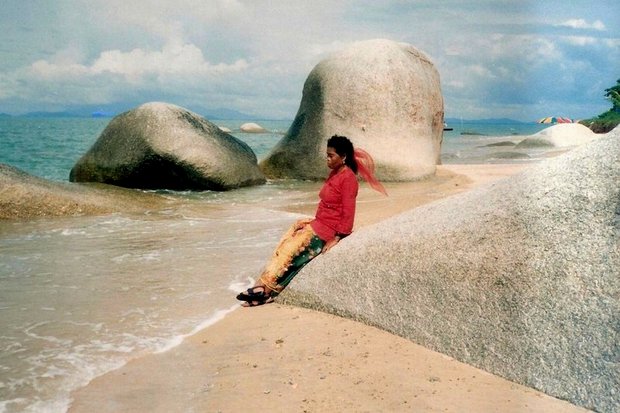
Minah Angong (14/9/1930 ~ 21/9/1999), better known as Mak Minah, greets the sea at 
Batu Ferringhi, Penang (photo: Rafique Rashid)
Minah, as she appears on the cover of Akar Umbi  Songs of the Dragon - an album released 
3 years after her untimely return to the spirit realms in September 1999 (photo: Antares)


Minah and her younger sister Indah in Kampung Pertak (photo: Antares)
Antares on Balinese flute at the Rainforest World Music Festival in Sarawak, 
August 1998 (photo: Wayne Tarman)
Nai Anak Lahai aka Mak Nai, bamboo percussionist and oldest woman in the village 
(photo: Antares)
Mak Minah & Antares with Dr Chandrabhanu after performance of 
"Birthplace Reclaimed" in January 1994 (photo by Rafique Rashid)
Mak Minah: celebrated Temuan ceremonial singer of the dragon clan 
(photo: Peter Lau)

LISTEN TO  AKAR UMBI ~ Songs of the Dragon HERE!
[First posted 5 May 2012, reposted 21 September 2014]

Wednesday, September 18, 2024

Deconstructing the Rukunegara (reprise)


Malaysia's Rukunegara or "national ideology" was proclaimed on 31 August 1970 and thereafter all schoolkids were compelled to memorize and pledge allegiance to it. I was already a father myself when that happened and so escaped the early indoctrination. In fact, I paid little heed to the Rukunegara, which I perceived as a low-grade set of bureaucratic commandments promulgated for the sole purpose of programming future generations of Malaysians into robotic, unquestioning acquiescence with the status quo.

On 22 January 2009 I stumbled upon the Merdeka Blog and was amused to learn that it was "founded on the principles of the Rukunegara." I guess the blog is operated by post-1969 Malaysians who perhaps spent the first 13 years of their life reciting by rote this piece of utter crap every day in school. I felt compelled to leave a long comment on the Merdeka Blog deconstructing the Rukunegara so these young people could see what an outright sham the notion of a "national ideology" actually is.


This is a slightly revised and expanded version of the comment I left...

My friends, perhaps you guys ought to find something more intelligent on which to base your guiding principles than the Rukunegara, which is actually quite a fascinating package of erroneous assumptions blended with flatfooted stupidity.

Allow me to deconstruct the Rukunegara and you will see why I feel you would be doing yourselves a big favor by outgrowing the severe limitations of accepting such a mental straitjacket.


* BELIEF IN GOD - This is outright dumb! Every culture has a different understanding of what constitutes the divine and the sacred. For some, the rivers, trees and mountains are sacred; for others, a particular book supposedly containing messages from the Supreme Being is considered sacred; for yet others, a human being with kind eyes, overflowing with charisma, is regarded as God.

It’s like telling us it’s okay to believe ANYTHING - as long as you BELIEVE in SOMETHING! How about all the honest, compassionate and generous humans who happen to be students of Consciousness and who do not “believe” in anything - although they are open to all perceptual and sensory inputs and spend considerable time pondering the universal mysteries?

Isn’t it high time humans outgrew the need to BELIEVE? By being more adventurous we can explore and experience an increasingly wider spectrum of reality options. Experience becomes knowing - and knowing can be distilled into wisdom. Belief is quite unnecessary. Belief and blind faith belong in humanity’s early infancy along with all our ancestors’ superstitions founded on fear and ignorance.


* LOYALTY TO KING AND COUNTRY - To be a true King or Queen one must be loyal, first of all, to the physical landscape (which represents the Sacred Feminine or Mother Nature); then to the people who inhabit the land; and then to universal ideals. It doesn’t work the other way around. Why? Because a true leader has to be far more conscious, more knowledgeable, more farsighted and more mature than all the others in the kingdom or queendom. So, in many ways, the leader has to play the roles of Father/Mother, Brother/Sister and Trusted Friend to the rest of the tribe.

Most people are unable to keep their promises, because they are still immature and have yet to acquire sufficient will power and inner discipline. No use making them swear to anything, because chances are they won’t be able to maintain their oath when temptation comes along. So a mature and wise ruler loves and accepts his or her people exactly as they are; sees them as beautiful children with infinite potential to be tenderly nurtured, and therefore vows to be loyal to them unto forever - because the only reason for a King or Queen to exist is to LOVE AND SERVE THE PEOPLE.

Anyone who thinks otherwise (that is, citizens have a duty to love and prop up their monarchs' inflated egos) has completely missed the point and must therefore be the descendant of usurpers. In short, such myopic leaders are genetically unfit to rule, since they serve only their own vanity and are incapable of seeing (and understanding) the big picture.

* UPHOLDING THE CONSTITUTION - Well, that was the original intention, but Barisan Nasional with its two-thirds majority has repeatedly amended the Federal Constitution to suit its own devious agenda. Now the Constitution is in tatters and is no longer worth "upholding" - unless we restore it to its original state prior to the advent of Mahafiraun Mahathir.

* RULE OF LAW - Hah! I’d like to see those thugs in Umno/BN follow the Rule of Law. They’re so used to Ruling BY Law, they can’t remember what “Rule of Law” actually means! So this one is totally meaningless unless we remove all the samseng and lanun from power, beginning with the scoundrel pictured at right.

* GOOD BEHAVIOR AND MORALITY - Bloody nonsense this one! What’s "good” in the eyes of one person may be "bad” in the eyes of another. There can be no OBJECTIVE SET OF RULES that can apply to everybody. Any attempt to impose such an artificial code of conduct can only breed more crime and hypocrisy and therefore more criminals and hypocrites. What must be encouraged, nurtured and supported is the individual’s internal guidance system - his or her IN-TUITION without which humans will forever be like automatons, controlled by external programs. With the IN-TUITION activated, every individual will ultimately become a Self-Governing Entity or Master. The need for external control and law enforcement will simply evaporate.

Some may agree with me in principle but opine that such a process might take generations. I beg to differ. We're in a phase of "accelerated acceleration" in evolutionary terms. What used to occur over millennia, or even millions of years, during the early stages of our evolution as Homo sapiens now happens from one year or month or week - or even day - to the next. If you find that hard to accept, consider this: back in the mid-1950s a letter sent via surface mail from Malaya to Britain could take 4-6 weeks to deliver. In less than 50 years satellite communications and rapid advances in digital technology can deliver an email or the complete manuscript of a book within a matter of seconds. Computer chips today incorporate nanotechnology which operates at near lightspeed. However, our ways of thinking about social interactions, mass communications and management for the most part remain trapped in an analog timewarp.

I rest my case, friends. Thanks for giving me this opportunity to elaborate.

[First published 8 February 2009, reposted 18 September 2011]

Overview of the Malaysian music scene since the 1970s (repost)

Below is a September 2013 email questionnaire sent by Marco Ferrarese, a PhD student, punk-rock guitarist & travel writer residing in Penang, who requested my input, to be included in his dissertation on the evolution of various musical genres in Malaysia...
Marco Ferrarese monkeying around as a freelancce cultural anthropologist

1) You have been exposed to Malaysian alternative culture and music since the '70s. Can you tell me something about that scene and its development in the early years? I know about kugiran bands, pop yeh-yeh and the likes... but how did Western music arrive in Malaysia? Do you remember some of the ways it did (i.e, radio, television etc.), and how it impacted you as a young man? Why people loved the budaya kuning so much as to try to reproduce it?
Actually, as far back as I can recall, Western music was already a major influence among urbanized Malayans. My dad told me he played saxophone & drums in a ragtime combo in the 1930s. As a kid growing up in the 1950s, I remember my parents – both Anglophonic & middle-class 2nd generation urban Chinese – had a collection of 78 rpm lacquer discs (later replaced by 45 & 33 rpm vinyl records) mostly consisting of 1940s & 1950s orchestral hits by the likes of Victor Silvester, Norrie Paramor, Percy Faith & Xavier Cugat. My dad wasn’t into black musicians or he might have also collected records by Billie Holiday, Louis Armstrong & Duke Ellington.
In the early 1960s my classmates exposed me to radio hits by groups like Cliff Richard & The Shadows, Blue Diamonds, Pat Boone, Elvis Presley & Ricky Nelson. I recall buying only a few of these singles, as I didn’t really go for pop music. For some reason I preferred Broadway musicals (especially more adventurous ones like “West Side Story”) & movie soundtrack albums (specifically epics like “Ben Hur” or “Exodus” or “Cleopatra”)… till the Beatles showed up & convinced me there was intelligent life on the radio.
A Peace Corps Volunteer named Duncan Catling was assigned to my small-town high school when I was 14 and he introduced me to neo-classical symphonic works like Stravinsky’s “Rite of Spring” & George Gershwin’s “Rhapsody in Blue.” So you see, my musical upbringing was hardly typical but the fact that it was entirely Western rather than Eastern reflects the fact that my parents were English-speaking (for the most part) & had absolutely no interest in Chinese history or culture – or for that matter any other Asian culture, which they probably deemed “inferior” or “antiquated.”
2) How did Malaysian youth react to Western music in the 1970s? Were these behaviors about to change drastically a few years later, when Malaysia became increasingly Islamicized in the 1980s?


The Beatles & psychedelic rock made an enormous impact on me as a teenager. This was an era when marijuana became a popular recreational sensory stimulant throughout the world; followed by more powerful utopiates like LSD & psilocybin. With dramatically enhanced awareness & swiftly mutating neural circuitry came the appreciation & ingestion of this brave new music as an evolutionary agent. It was undoubtedly a trigger for accelerated synaptic growth leading to an entirely different perspective on life, reality, everything.
Compared to consciousness-altering, life-changing groups like The Doors, Cream, the Jimi Hendrix Experience, Pink Floyd, Frank Zappa & The Mothers of Invention, the saccharine, predictable, entirely prosaic local radio hits favored by Malay, Chinese or Tamil speaking households seemed like a couple of centuries past their expiry date.
So in the mid-1970s it was common to see Malaysian bands doing cover versions of more accessible Western rock groups like Santana, the Beatles, Rolling Stones, Jimi Hendrix, Deep Purple, Led Zeppelin, The Eagles, Bob Marley & Bob Dylan. The reason Western music grabbed the youths’ attention was simply because it carried more immediate excitement than traditional Asian music. The youth of Malaysia were looking for powerful evolutionary stimulants, too young as they were to wallow in cultural nostalgia & country music.
The insidious influence of Ayatollahism that crept into Malaysia in the mid-1980s didn’t really impact on those already hip to mutant or alternative culture – but it certainly squashed all possibility of exciting, innovative, liberating music ever getting played on the radio. Kids in the rural areas, trying to break free from stultifying tradition, were drawn to the angry, rebellious sound of punk, metal & trash – and soon found themselves finger-wagged & persecuted by officialdom.
The more docile ones became lulled by maudlin mainstream Malay pop music which poses no threat to the power structure. Islamization merely had the effect of depriving Malaysian music-lovers of ever getting to see sexy or radical acts on stage. Access to underground music, however, remained largely uncontrolled, though mostly confined to niche audiences.
3) You have described Heavy Metal kutus in your book Adoi!, but you didn't mention punks. How did these two subcultures interact in KL in the 70s and 80s? Is there any peculiarity in their behaviors that you consider more authentic, in the sense of reproducing/imitating or reinventing the music they borrowed from the West?
Adoi! was written in 1988, just as punk & new wave acts like Sid Vicious & Boomtown Rats were beginning to influence Joe Kidd’s generation. My loyalty still lay pretty much with the psychedelic, exploratory music of the late 1960s & mid-1970s. I found punk, metal & trash too angry, too aggressive for my taste. By 1971, in fact, I was already father to two girls and preoccupied with earning money & maintaining a family. I was more inclined to listen to Dave Brubeck, Charlie Mingus, Thelonius Monk, Sun Ra, John Coltrane & Keith Jarrett.
Malaysian heavy metal band Nuclear Strikes 
Amy,  lead singer with popular metal band Search
The rise of the underground punk/metal/trash scene in Malaysia can be interpreted as a covert rebellion against the mundane materialism of Mahathir’s shallow Vision 2020. True, the anger felt by Malaysian youth wasn’t quite as intense or extreme - or self-destructive - as examples from the industrialized West – nevertheless, it was an authentic gut reaction to the systematic dehumanization that accompanies industrial development. In that sense, I would say it was as “authentic” as the punk/metal/trash movement in the West.
The Heavy Metal crowd favored long hair, tight jeans & Scorpion-flavored sentimental rock ballads, while the Punks were into Mohicans, piercings & noise. I don’t recall seeing these subcultures interacting. It was as if they inhabited different dimensions, orbital paths rarely if ever intersecting. It may be oversimplifying things to say that the Heavy Metal crowd was more into just being sexy (Amy of Search used to transform into a satyr on stage, making his female fans cream their panties); while the Punks embraced anarchy & leftist ideals as a political statement.
KD Possum & The Flying Fox in 1979 (l-R): Antares, Ping, Shamala Devi, Nashville Slim,
Rob Stuebing, Lightnin' Fooch & John Davis


4) What about KD Possum & The Flying Fox, the first and only Malaysian bluegrass band? How did you get involved in this project, and how do you consider it in terms of its musical authenticity? After all, there was an American performer, among Malaysians... but bluegrass in Malaysia, well, it sounds quite peculiar.
In 1976 I found myself auditioning for a local production of “West Side Story.”  That experience gave me a taste for performing, so I immediately agreed when a former Peace Corps Volunteer named Rob Stuebing invited me to join the bluegrass group he was forming with a banjo-player colleague named John Davis. All I could play at first was the blues harp (at one time I owned 17 of them). Subsequently I contributed a bit of mandolin, backing vocals & eventually began writing my own songs. To me, it was simply a chance to make music with a bunch of good friends & have some fun. It didn’t cross my mind that a Malaysian bluegrass band was anything “peculiar.” Hilarious, perhaps, but as a group we didn’t take ourselves too seriously. I didn’t actually like country music, what more hillbilly songs – but it was a good foundation to learn how to create music, starting with the roots.
KD Possum & The Flying Fox was a truly Malaysian phenomenon in that at its height we had 2 Americans on guitar, dobro & banjo, 1 Indian vocalist, 1 Malay bassist/vocalist & 3-4 Chinese members on harp, mandolin, autoharp, kazoo & backing vocals – and we attracted equally diverse audiences. We may even qualify as the first Malaysian band to release a live album (Out of the Woods, 1982). As to whether our brand of bluegrass was authentic – well, Rob & John sounded like Appalachian hillbillies & our bassist Lat went by the name Nashville Slim. That’s authentic enough for me.
5) After this band and your personal decision to move into nature, you have recorded a lot of what can be categorized as "world music". Was this an evolution of your tastes, a conscious decision dictated by the circumstances, or did you just decide to perform more "authentic" Malaysian music?

Akar Umbi in August 1995 (clockwise from left): Antares, Stanley Nickam, Philip Boyle Jr,
Rafique Rashid, John Hagedorn, Nai Anak Lahai, Minah Angong, Xiong Lee 

Malaysia, truth be told, is a political artifice. There is no authentic “Malaysian” culture or identity – apart from the titillating blend of all the cultural influences to be found here, whether Indonesian, Indian, Chinese, Siamese, Burmese, Cambodian, Arab, Turkish, Portuguese, Dutch or British.

Minah Angong, Temuan ceremonial singer 
The work Rafique Rashid & I did with the Temuan ceremonial singer Minah Angong (whose niece I later married) arose spontaneously after hearing her sing at a drunken party. We were astonished by the soulful quality & shamanic power of her voice. Tried dropping her a capella voice on top of an instrumental piece we had recorded – and it worked marvelously, this “ethnic-trance fusion” experiment that became known as Akar Umbi - after our celebrated performance in September 1994 at the Shah Alam Stadium before an audience of 42,000 plus a nationwide live TV broadcast.

The universal appeal of Minah Angong’s medicine songs was a surprise to all of us, especially her. She couldn’t believe sophisticated audiences would be so receptive to her humble, unschooled voice. I had to laugh when it dawned on me that I was still stuck with a hillbilly band – this time from the Titiwangsa Range instead of the Appalachians.

My 2nd solo album reissued as a CD in September 2010
So, to remove the bland taste of folk music from my eclectic palate, I ventured into idiosyncratic expressionist solo experiments, mostly extemporized because I’m musically illiterate. I regard myself as a Malaysian citizen, so however my artistic output turns out, it’s always “Malaysian” – though the authenticity of “Malaysian” as an adjective can be questioned.

6) Talking about authenticity and Malaysia to me is a bit of an oxymoron. However, as you have spent so much time among orang asli - ideally, the authentic inhabitants of this country -, would you consider their lifestyle as authentic to Malaysia? If not, do you believe there is any kind of cultural/artistic authenticity in this country?
Allow me to quote playwright Huzir Sulaiman as the only appropriate response:
“It angers me when after hundreds of years of importing aspects of other people’s culture some politician in a 4,000-ringgit Italian suit complains about Western values and such-and-such a thing is not from our culture. Our culture is everybody else’s culture. We’ve never had our own. Deal with it and grow up." ~ Huzir Sulaiman, Notes on Life & Love & Painting (1999)

7) Sorry If I insist on the authenticity point, but you state that KD Possum & the Flying Fox was "authentic enough for you". How do you envision authenticity in music, then? Don't you think that music should be more localized and reflecting of a people's environment and traditions, social history and politics, rather than use the stereotypes of global genres such as rock/punk/psychedelia etc.? I am not arguing that there should be no globalization of sounds in this world, but don't you think that, let's say, a Malaysian punk band would be more authentic if they sang about actual political and social problems, rather than the higher stereotypical ideas of the genre crafted in the West?
Os Pombos, a popular Malaysian cowboy band,
has been around for decades
What are you driving at? Are you suggesting it’s “inauthentic” for blue men to sing the whites?
I don’t represent any kind of cultural tradition. Some people do, some don’t. Why on earth should I insist that music be more localized, reflecting “Malaysian” culture & traditions? Nobody knows what “Malaysian” means. It depends on your political orientations. If you’re an Umno member, for example, you’ll insist that national culture must smell & taste Melayu.

I don’t insist that anyone or anything must smell & taste Chinese or Eurasian or whatever. If something sounds good, I’ll listen to it over & over again & share it with friends. I’m not the national arbiter of musical fashion & taste. I value originality more than technical precision, it’s true - and the idea of a Bollywoodized version of “Thriller” or a bunch of Malay kids with baseball caps & oversized clothes rapping in a shopping mall strikes me as fairly comic. But why can’t they be left to do whatever pleases them?

M. Nasir in action
There will always be a few individual artists, like M. Nasir, who focus on musically exploring their own tribal roots & regional influences. Or the short-lived Thavil Blues Band formed by Allan Perera & Paul Ponnudurai in the mid-1990s which introduced curry-flavored blues to the world.  Bluegrass wasn’t & will never be my idea of music. My solo musical experiments were purely for fun & they express my personal idiosyncrasies rather than some national culture.

8) Returning to KD Possum & the Flying Fox: it was a multi-ethnic band. How did the members come together in friendship? Based on my current observations, I have noted that, especially in punk and metal, there is a majority of Malay players and fans, and the Chinese have instead focused more on other fringes of indie and post-rock, while the Indians have at times created a localized Tamil version of hard rock. I understand that your musical involvement today is lesser than before, but do you feel that back in the 1970s it was easier to mingle as Malaysians, without the silly racial divisions which are reified in the public as of today?

You’re making an intellectual mountain out of a circumstantial molehill here. KD Possum & The Flying Fox was really just a few good friends getting together to make some sweet noise. Our female vocalists Ping & Shamala happened to be married to Rob & Lightnin’ Fooch. Lat @ Nashville Slim was a regular visitor at the Fooch household where I first met him & none of us was aware that we were the embodiment or forerunners of some stupid slogan like “1Malaysia.” There was a great deal of camaraderie among us, that’s for sure. We had a lot of fun.

KD Possum & The Flying Fox in 1980 (clockwise L-R): Lightnin' Fooch, Shamala Devi,
Rob Stuebing, Antares, Ping
Other guest musicians were roped in for bigger concerts. I mean, how likely is it to find a Chinese banjo-player from Penang named Willy Chin? Nobody thought in terms of race or nationality. We weren’t embarrassed to be playing Appalachian folk music. If Rob were Greek & played the bouzouki, we would have been just as happy performing Mediterranean folk music. I enjoyed being part of a band. It so happened none of us owned amps & drumkits or we might have been churning out rock - or jazz, but the truth is, none of us was that much of a virtuoso on any instrument.  

Marco Ferrarese's latest book:
click here to order!
My checkered musical career includes a very brief stint as part of a madrigal choir performing medieval songs. I did it at the insistence of the choir conductor, my great buddy Hans Sallmann who was director of Goethe-Institut & an enthusiastic cellist. Guess I was grateful to Hans for appreciating my weird musical output. I gave him my second solo album & he called the next morning to say it was “the most interesting music” he had heard since arriving in Malaysia.

There are no serious racial divisions – apart from the ones fabricated & orchestrated by Barisan Nasional to keep itself in power indefinitely. Artists, especially musicians, don’t give a shit about race & religion & such crap. They’re usually in it for whatever buzz they get out of jamming together.


[First posted 5 November 2014, reposted 30 June 2017 & 
23 September 2019]


Mak Minah would have celebrated her 94th birthday...


Video footage featuring the Chiling, Luit and Selangor rivers in Ulu Selangor, Malaysia edited to the song 'Sungai Makao' by Akar Umbi. This video officially launches the Ecowarriorz blogspot and is my personal tribute to Mak Minah who was a true guardian of the environment and an inspiration to many. ~ Mary Maguire


A Tribute to Mak Minah
(14.9.1930 ~ 21.9.1999)

Ceremonial singer... noblewoman... cultural representative of the Temuan tribe... free spirit and a friend to all.

Mak Minah (Menah Kuntom) was born in Pertak, Ulu Selangor, between the First and Second World Wars. Those who remember her in her youth report that she was extremely feisty and perhaps even a little wayward. But her second husband, Batin Angong of Gerachi, was a mature tribal leader who groomed Minah for the important role of Batin’s wife, and taught her all the songs he knew. They had a daughter and five sons – the eldest of whom, Ramsit, is now Batin of Gerachi.

When Batin Angong died, Mak Minah moved back to Pertak to live with her sister Indah. It was around this time that Minah befriended Antares and Rafique, two musicians seeking sanctuary in Kuala Kubu Bharu from the clangor of the Klang Valley. Before long a musical collaboration began which led to the formation of Akar Umbi – a “trance-ethnic” fusion group – and widespread acclaim for Mak Minah as a cultural representative of her tribe. Her goodnatured willingness to be a friend to all made her an ideal ambassador for the marginalized Orang Asli community.

Audiences everywhere were uplifted by Mak Minah’s soulful voice. Her songs reflected the love and reverence indigenous peoples feel for the land. They were a powerful antidote to the cynicism and myopia of a “modern” worldview centered on money and power.

Offstage, Mak Minah was a fearless and outspoken advocate of cultural and spiritual autonomy for the Orang Asli. She fiercely opposed the State government’s plan to relocate two Temuan villages for a dam project on Sungai Selangor which would destroy the wild beauty and sanctity of the Pertak area.

“I will fight the dam as long as I live,” Mak Minah repeatedly said. But it is a heart-rending fight that has set brother against brother, mother against son, neighbor against neighbor. The psychological conflict and uncertainty exhausted her.

Mak Minah’s passionate love for the rainforest where her tribe has lived for countless generations is an inspiration to all of us who share an alternative vision – one where mutual respect for all tribes and the healing of the earth take precedence over economic and political
expediency.

POSTSCRIPT

The last time I saw Minah alive was around midday on the 21st of September, 1999. The day before I had taken her to the clinic because she was complaining of aches all over her chest and back, and she had no appetite. The doctor said Minah had a viral infection and prescribed some medicine, suggesting that she drink lots of Glucolin to get her energy back. I was on my way to Kuala Lumpur and told Minah I'd look in on her the next day.

At 3 a.m. I received a phone call informing me that she had died in her sleep at 7:03 p.m. at the Kuala Kubu Bharu hospital.

Her granddaughter Sembo and another friend were by her side. A week ago she turned 69 and three weeks earlier she had returned happy and fulfilled from Sarawak, after performing with Akar Umbi at the 2nd Rainforest World Music Festival.

Mak Minah had a very sweet smile on her face when they buried her on a hill we shall henceforth call Bukit (Mount) Minah. Ironically, she was the first to be interred in a virtually inaccessible new tribal gravesite allocated to Gerachi Villagers in view of the government's determination to inundate the old Temuan burial site with the proposed Selangor Dam. Minah swore to resist the dam to her last breath and she did.

[Reposted 14 September 2011. Source: Magick River website. Listen to Mak Minah's musical legacy here!]