Sunday, June 27, 2010

Increasing Intensity of the Chaotic Node: The Gulf of Mexico

A Hathor Planetary Message Through Tom Kenyon...


You are entering a very difficult passage in this phase of the Chaotic Node. Danger to planetary life has been created through human arrogance, greed and stupidity.

We are speaking here of the disaster in the Gulf of Mexico. You have not been told the entire truth about the situation by your media or by your government. The situation is dire and there are multiple possible timelines that intersect this event.

We wish to discuss some of these, but then shift our attention to you, the individual human. These timeline possibilities we are discussing are malleable, changeable. They are not written in stone, as the saying goes. There are so many factors involved in the ecological disaster unfolding in the Gulf; it is difficult to predict the actual outcome, as it will appear in your three-dimensional reality. And as we have said before, things can radically change even in the eleventh hour.

The oil and gas reserves that have been punctured are vast, and if it is not contained it will unfold into several possibilities.

One of these extreme possibilities is the extinction of much (if not all) sea life in the Gulf region and a transporting of the contaminants into the Atlantic Ocean through the Gulf Stream to the coast of Europe, where a high level of toxicity will negatively affect ocean life in these regions of the Atlantic. If the puncture is not sealed, pollution of the entire Atlantic Ocean is a distinct possibility, and eventually the rest of the world¹s oceans will be compromised. The further away from the Gulf region, the less toxicity there will be. But one distinct possibility is an eventual contamination of the entire Earth's oceans.

In a worsening scenario, the methane gas, the natural gases in this field, could erupt and break through the ocean floor creating a tsunami of immense destructive capability as well as the release of poisonous gases into the region.

Another worse case scenario would unfold if the rift in the ocean floor were large enough to create a tectonic shift that rises up from the Gulf into the Mississippi and into the Great Lakes. This would be a disastrous scenario far beyond imagination.

Again, the current situation in the Gulf is a direct result of human arrogance, greed and stupidity on the part of the corporations involved in this incident and due to governmental negligence.

The primary value that drives these corporate interests is profit, and so risks were taken that should have never been taken had the sanctity of life been included in the equation, but such was not the case.
Sadly this is a trait of the age you are now leaving, and you are witnessing, first hand, the defamation of the waters of the Earth by a culture that depends upon oil and corporate interests that prevent the utilization of other technologies, all in the name of profit.

What will your money be worth if life is compromised? This simple intelligence test seems to have been failed. You are literally at the brink of the collapse of the old world and a chaotic birthing into the new.

The Chaotic Nodes are upon you in ever-increasing intensity. We view these as birth contractions, the birthing of a new Earth. And while the birthing of the new world is unfolding before you, if you are caught in one of the contractions it can be quite difficult.

In our opinion there is no place on Earth that will not be affected by the planetary changes, both natural and manmade. Some areas of the world will be less intensely affected, but all will be radically altered. Life on your planet is an interconnected web.

We advise those who are currently living in the Gulf region from twenty miles inland to the coastline to be mentally, emotionally, and spiritually prepared. This is a time for honed intuition and instinct. If you feel an intuition to leave the area, this will be an intelligence test. Who will pass and who will fail is simply the impersonal force of evolution at hand.

If the Gulf incident continues without mitigation, then this will be a time of immense challenges for the entire planet. And so even if you are not living near the Gulf, this is a time for intuition and instinct. Our advice is to hone these abilities within you and to act on the revelations that come to you. Each of you will be in the place, the circumstances and the timing based upon your level of evolution and what you came to Earth to experience.

However bleak a situation may appear to you, we wish to convey clearly this message: you are the co-creator of your reality. Move upward in consciousness, even if those around you move downward. If the situation deteriorates it will be a difficult time, in that, mass hysteria will increase, and you will have to find the center path, the narrow passage that leads upward. In the past we have given suggestions on how to bootstrap your consciousness. We won¹t go into those here. You may find them in the Archives.

Now is the time to step into your spiritual authority if you have not already done so. A dividing line is being drawn by evolution. The planet is responding to human greed, arrogance and stupidity. Gaia will survive this. It is not clear if the bulk of humanity will.

But even in the midst of this moving darkness there are exquisite opportunities to move upward in consciousness, both as individuals and as culturally creative and cooperative human communities.

You can also expect a continual deterioration of your financial system. The seeming recovery was a result of propping up a house of cards, and that house is beginning to shake again.

Our suggestion is to not be frightened by these changes that are upon you, but recognize them as breaks in the walls of a prison that have been erected around you. Step through the cracks into your freedom. You are creator gods and goddesses. You hold an immense power in your hands, but you have been sleeping and unaware of the immensity that you possess. Perhaps with this crisis in the Gulf, more of humanity will awaken and demand an end to the old ways that threaten all life.

The Hathors
June 23, 2010

Tom's Thoughts and Observations
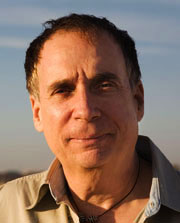
Personally, I find this to be quite a powerful message. While some may think the communication is based on fear, I think it is based on intelligence.

Some of us in the human potential movement (especially many of us in that niche often labeled the New Age) think that by not looking at potential problems, those problems will somehow miraculously go away.

I am reminded, in this, of my dog Merlin who also believed that not facing problems was a way to deal with them. You see, Merlin was part bloodhound, and he measured about six feet from tail to snout and weighed in at 165 pounds. He was also a very evolved being, who I suspect, was not really a dog at all, more like an angel in a dog suit. One day I hope to write a tribute to Merlin and describe some of the little miracles he created in our lives. But he was also a hound and loved to roll in deer shit. Something happened when the deer droppings combined with the oils in his skin, and it was terrible. To him it was the most wonderful cologne, while to us it was a truly horrid aroma. Ah, the relativity of perception between humans and canines!

In addition to his propensity for deer droppings, Merlin loved to sit on the sofa and watch TV with us. But after his deer encounters, we wouldn't want him to either sit with us or, god-forbid, lie down next to us.

When he had dowsed himself with some... ah... deer cologne, Merlin would slink into the den and try to sneak onto the couch. The funny thing was that he would look away from us as he slowly, ever so slowly, slid his hulk onto the couch. He was convinced that if he couldn't see us, we couldn¹t see him. Inevitably, someone in the family would speak to him in a disapproving voice "Merrrrrrlin!!" And every time, Merlin would get a look of utter shock and surprise, as if to say, "How did you see me?"

Many of us humans are also gifted artists of denial. When something is too difficult to deal with, many of us just pretend it isn't occurring. While this may offer some delusional solace, it is just that - delusion.

It is far better, I think, to be aware of the facts in a situation, no matter how dire, so that we can more intelligently deal with it. And that is what, I think, the Hathors are presenting in this message.

For the record, they are not saying (I repeat, NOT SAYING) that any of the terrible scenarios they described will, in fact, become a reality. But they are saying that these are real possibilities, and we need to hone our intuition and gut instincts as we encounter the multifold and multi-dimensional effects of the Chaotic Nodes (which they have essentially defined as ever-increasing levels of chaos).

In a discussion with them after they gave this message, the Hathors referred to the Gulf crisis as a critical moment of creative potentials. By that they mean there are many possible outcomes co-existing simultaneously, and which of these will emerge as the primary three-dimensional reality is yet to be determined.

Hopefully, those in charge will somehow find a way to fix this latest assault on Gaia. But the whole situation reminds me of a Dutch turn of phrase that I find particularly apt when discussing governments and the media - mushroom treatment. With a few exceptions, they are all giving us the mushroom treatment - keeping us in the dark and feeding us shit! It is, indeed, a time to hone our intuition and our instincts to see past the smoke screens and determine what right courses of action are needed.

The Hathors also mentioned, in passing, the Archives where one could find some of the methods they have shared for bootstrapping consciousness and beginning the ascent. To save you time in searching for these, I have posted direct links to them at the end of my comments.

Finally, I would like to share a personal snafu that happened to me some time ago. I was in a high-rise building and pushed the elevator button to go up. The doors closed, but nothing happened. I again pushed the button, and again, the elevator refused to budge. I yelled something obscene at the contraption, and started banging on it, as if that would make it work better. Anyway, I finally looked at the button I had been pushing. It was for the floor I was on! After regaining my composure, I gently pushed the button for one of the upper floors, and, voila, the elevator made its ascent to the floor I wanted.

Putting my personal comedy of errors aside for the moment, I think this episode is a lot like our civilization at the moment. I think a lot of us know we need to go to a higher floor, metaphorically speaking (both as individuals and as a culture), but we keep unconsciously pushing the same button.

We will have to change what we have been doing, if we are to survive this passage.

Tom Kenyon
Teacher-Scientist-Sound Healer-Psychotherapist-Musician-Songwriter-Singer-Shaman-Author

Links to the Archives:

Ecstasy and the Heart
A discussion of ecstatic states and bliss as evolutionary catalysts. Joy is the pathway.

The Holon of Balance
Instructions on how to use the octahedron as an imaginal object to stabilize consciousness.

The Holon of Ascension

Instructions on how to create the Holon of Ascension for accelerated movement in consciousness.

Evolutionary Opportunities Within Chaotic Nodes

A discussion of Dimensional Attunements as psychoacoustic catalysts for accelerated evolution.

The Pineal Dimensional Attunement (mp3 file)
A sound meditation for activation of the Pineal Gland¹s unused potentials.

The Heart Dimensional Attunement
A sound meditation for activation of the Heart Chakra as an energetic anchor for a new Earth.

Who are the Hathors?

Note: If you received this message indirectly, you might not be able to access the links above. In this case, simply go to www.tomkenyon.com and go to the Hathor section on the website. Go to the Archives and scroll down to find the articles mentioned above.

An Interesting Coincidence: the only Hathor event of this year in the United States

After reading over the Hathor message, I went to our calendar to see what they had said about the upcoming Hathor Intensive, The Crystal Palace Within and Opening the Halls of Amenti in Seattle, Washington (October 29- 31, 2010). One line, in particular, caught my attention when they talked about this event:

"It is a key to the higher creative mind, and it is through this aspect of consciousness that new solutions to personal, social and global challenges can be discovered."

"It" refers to both the Crystal Palace (the pineal gland and its unused potentials) as well as to the act of opening the Halls of Amenti (which gives access to one¹s Higher Mind). When they asked me to do this event, I thought that it would be a very interesting thing to watch as doorways to our Higher Minds were opened since such an action would instill within us inspiration, and give us (and humanity) access to new types of knowledge that could benefit life. Little did I know that this act of opening the Halls of Amenti would take on such sobering tonality - as we face, what could be, one of the greatest ecological disasters in human history.

As this event will also be a major Hathor Planetary Activation, there will be an opportunity to participate with this Intention from a distance. For those who are unable to physically attend the event, directions will be given through this website on how to take part in the work that we will undertake in Seattle. If you are signed up to receive the Hathor messages, you will automatically receive this information when it is available. Otherwise, revisit the website to read the instructions when they are posted‹probably sometime in September.

To view the full description of this event, click here, or go to the Calendar page of the website.


© 2010 Tom Kenyon All Rights Reserved. You may copy and distribute this message in any media so long as you do not alter it in any way, do not charge for it, credit the author and include this copyright notice. To subscribe: If you received this posting as a forward and you would like to receive Hathor Planetary Messages in the future, please go to http://tomkenyon.com/contact and follow the directions to "opt in" and join the Hathor mailing list.

[Brought to my attention by Olivia de Haulleville]


Saturday, June 26, 2010

LONG TIME SINCE I HEADED SOUTH...

The newly completed Marina Bay Sands Complex in Singapore

I just returned from a three-day visit to Singapore. My last trip was almost two years ago, to attend my niece Rebecca's wedding to her Dutch beau Dennis Kool. Back in the 1980s I used to spend half the year in the Merlion City, producing multimedia extravaganzas and chilling with a secret colony of Bohemians in Bedok.

Indeed, an early initiation into my lifelong fascination with metaphysics was triggered at the Singapore national library in 1968.

The old National Library in Singapore, circa 1968

A friend of mine had casually mentioned a teenaged Jewish girl he often saw hanging around the library; people were scared of her because she was overfriendly, so they concluded she was mad. I felt a powerful compulsion to try and find that Jewish girl and befriend her (at the time I was obsessed with Jewish princesses). So I loitered outside the library for an hour or so, hoping to catch sight of the girl - but saw nobody that looked remotely Jewish or even slightly crazy.

That's when I decided to nose around inside the library, which was huge and had a whole section labeled "Philosophy." I headed there and two books caught my eye: one was Richard Wilhelm's translation of the I Ching and the other was the Tao Te Ching (translated by Lin Yutang).

I remember making some notes about binary codes (yin-yang) and trigrams, and how they combine to generate the 64 hexagrams that constitute the Book of Changes or I Ching. Then, as I began reading the first verse of the Tao Te Ching, I felt goosebumps appear on both my arms and was suddenly aware of the central airconditioning....

On the Absolute Tao

The Tao the can be told of
Is not the Absolute Tao;
The Names that can be given
Are not Absolute Names.

The Nameless is the origin of Heaven and Earth;
The Named is the Mother of All Things.

Therefore:
Oftentimes, one strips oneself of passion
In order to see the Secret of Life;
Oftentimes, one regards life with passion,
In order to see its manifest forms.

These two (the Secret and its manifestations)
Are (in their nature) the same;
They are given different names
When they become manifest.

They may both be called the Cosmic Mystery:
Reaching from the Mystery into the Deeper Mystery
Is the Gate to the Secret of All Life.


Later, while sipping a cup of tea in a cafe near the library, I caught sight of a long-haired girl seated several tables away. She smiled at me and, for a moment, I thought she might be the mad Jewish girl I'd been looking for. But I didn't feel prompted to walk up to her and start a conversation. When she got up to leave, I felt the moment slipping away - but paralysis stopped me from leaping up and running after her.

This episode marked a turning point in my quest for meaning. It was as if a seed had been planted in me that afternoon which would subsequently germinate and bloom into a sacred tree, offering enlightenment and shade and whose fruit provided spiritual nourishment.

Singapore has always been good to me, even though I can't see myself living there. Things were a lot different in the 1980s. Areas like Bedok and Serangoon Gardens where I used to hang out still possessed a slightly rural feel. In fact, a few minutes' walk from the housing estate in Serangoon Gardens (built for British servicemen's families in the 1960s), there was a real kampong with chickens, ducks and geese flapping around - plus a few musangs and monkeys and an occasional cockatoo.

In recent years, however, the city appears to have become more sanitized and regimented. The wildman in me feels a bit overwhelmed by the glitter and false glamor of Singapore's futuristic shopping malls. You can't even enjoy a smoke without worrying about getting slapped with a $1,000 fine. That's one reason why I kept putting off seeing my son-in-law about my dental issues.

However, apart from a massive queue at the Second Link that delayed my arrival for an hour, I was warmly welcomed to Singapore by a bunch of young Polytechnic students I met at the Novena Square MRT station. One of them, a 19-year-old named Chris Tan, insisted on carrying my heavy bag a few blocks and made sure I was headed in the right direction before running off to catch the last train to Outram. It's little things like this that reassure me Singapore is not quite as soulless as she's made out to be by her detractors. The PAP government's attempt to robotize the people and turn them into kiasu consumers hasn't been entirely successful.

And I have lots of family living in the gleaming glass-steel-and-concrete Republic that Lee Kuan Yew built - and which his son Brigadier-General Lee Hsien Loong now runs like a giant corporation.

For a start my first daughter Moonlake lives there with her husband Ansgar and their adorable daughters Allie (7) and Hana (5). Hongkong-born Ansgar - now Dr Ansgar Cheng - met my daughter at a friend's party in Singapore 20 years ago. Moon helps Ansgar promote and develop his thriving prosthodontic practice by taking care of corporate communications and the Specialist Dental Group website through which his international clients can make appointments for treatment.

Ansgar has always been a high achiever. Having obtained certification to practise his craft in Canada, America, England, Australia, Hongkong and Singapore, he finally decided to build a base in Singapore - to be near Moon's parents in Malaysia and his own in Hongkong. Dr Ansgar Cheng today ranks among the top maxillofacial prosthodontists in the Asia-Paific region. So when I began having serious issues with my teeth (or the ridiculous lack of them), I kept postponing the inevitable - partly because it was a hassle to commute to Singapore for treatment, but mainly because I didn't want to impose on his goodwill.

Moon was greatly amused by the fact that this was the first time, in the 18 years since they were married, that I had consulted my son-in-law about my teeth. Well, I suppose I wanted Ansgar get exceptionally good at his craft before subjecting myself to his professional ministrations ;-)...


Two years down the line Rebecca and Dennis are enjoying a robust family life in Pasir Ris with their two beautiful kids - Aydan and Nadya (note that their names are perfect palindromes!) Rebecca cut her teeth as a corporate lawyer and recently teamed up with Helen Chia LLC as a partner. Dennis Kool has enjoyed a checkered career - mostly as a kitchen designer, professional chef and F&B manager (yes, he likes his food!) - but he also happens to be a deeply passionate musician with a keen ear for audio engineering.

Over the years he has acquired an impressive array of multi-track mixers, studio-quality mics, Wharfedale speakers, and taught himself to use the amazing range of sophisticated sound sculpting software now available. Not only was Dennis Kool gifted with an excellent pair of ears, he also has a vast and wonderfully eclectic musical archive packed between them - plus the technical aptitude and taste to be a topnotch audio engineer. Dennis had asked me on a recent visit to Magick River to avail myself of his studio if I wanted to record my songs - so I took him up on his offer and managed to get two songs mixed down, one of which (Share The Beauty) I've uploaded. I wasn't 100% satisfied with my own performance (we didn't have unlimited time), but I now have no doubts about Dennis Kool's skill as sound engineer/producer. Dennis has decided on the name Trax Studio for his modest recording and mixing set-up.

Aydan (18) and Nadya (11) with their doting mum. Years ago, on her first visit to Magick River when I was still living at the High Hut, the 6-year-old Aydan got into trouble at Lubok Pusing and Rebecca jumped in to rescue him. The water was too strong and turbulent for her and she, too, got drawn into the whirlpool (that's what Lubok Pusing means). Fortunately, Mary Maguire jumped in and pulled Aydan out by his hair - though she experienced a few moments of panic herself (triggered by a "past-life memory" of drowning, perhaps?) Rebecca has sworn that she will sue the pants off anybody who says anything nasty about Mary Maguire!

Rebecca invited her mother (my big sister Mae) and Moon's family over for dinner the night before I left. I stuffed myself on sushi and 8-week-old prime beef, followed by taufoo-fa (beancurd in syrup) for dessert. Aydan played a few lyrical pieces on the piano and we even managed to persuade Nadya to sing (such a painfully shy girl she is, but she does sound like a little angel).

Well, these are moments to cherish at the end of the day - when a visit with the family reminds us how sweet it is to be loved and cherished, and how blessed one is to have such lovable, big-hearted family members.

Monday, June 21, 2010

Gulf oil spill: A Hole in the World

The Deepwater Horizon disaster is not just an industrial accident – it is a violent wound inflicted on the Earth itself. In this special report from the Gulf coast, a leading author and activist shows how it lays bare the hubris at the heart of capitalism.


By Naomi Klein
The Guardian

June 19, 2010 - Everyone gathered for the town hall meeting had been repeatedly instructed to show civility to the gentlemen from BP and the federal government. These fine folks had made time in their busy schedules to come to a high school gymnasium on a Tuesday night in Plaquemines Parish, Louisiana, one of many coastal communities where brown poison was slithering through the marshes, part of what has come to be described as the largest environmental disaster in US history.

"Speak to others the way you would want to be spoken to," the chair of the meeting pleaded one last time before opening the floor for questions.

And for a while the crowd, mostly made up of fishing families, showed remarkable restraint. They listened patiently to Larry Thomas, a genial BP public relations flack, as he told them that he was committed to "doing better" to process their claims for lost revenue – then passed all the details off to a markedly less friendly subcontractor. They heard out the suit from the Environmental Protection Agency as he informed them that, contrary to what they have read about the lack of testing and the product being banned in Britain, the chemical dispersant being sprayed on the oil in massive quantities was really perfectly safe.


But patience started running out by the third time Ed Stanton, a coast guard captain, took to the podium to reassure them that "the coast guard intends to make sure that BP cleans it up".

"Put it in writing!" someone shouted out. By now the air conditioning had shut itself off and the coolers of Budweiser were running low. A shrimper named Matt O'Brien approached the mic. "We don't need to hear this anymore," he declared, hands on hips. It didn't matter what assurances they were offered because, he explained, "we just don't trust you guys!" And with that, such a loud cheer rose up from the floor you'd have thought the Oilers (the unfortunately named school football team) had scored a touchdown.

The showdown was cathartic, if nothing else. For weeks residents had been subjected to a barrage of pep talks and extravagant promises coming from Washington, Houston and London. Every time they turned on their TVs, there was the BP boss, Tony Hayward, offering his solemn word that he would "make it right". Or else it was President Barack Obama expressing his absolute confidence that his administration would "leave the Gulf coast in better shape than it was before", that he was "making sure" it "comes back even stronger than it was before this crisis".


It all sounded great. But for people whose livelihoods put them in intimate contact with the delicate chemistry of the wetlands, it also sounded completely ridiculous, painfully so. Once the oil coats the base of the marsh grass, as it had already done just a few miles from here, no miracle machine or chemical concoction could safely get it out. You can skim oil off the surface of open water, and you can rake it off a sandy beach, but an oiled marsh just sits there, slowly dying. The larvae of countless species for which the marsh is a spawning ground – shrimp, crab, oysters and fin fish – will be poisoned.

It was already happening. Earlier that day, I travelled through nearby marshes in a shallow water boat. Fish were jumping in waters encircled by white boom, the strips of thick cotton and mesh BP is using to soak up the oil. The circle of fouled material seemed to be tightening around the fish like a noose. Nearby, a red-winged blackbird perched atop a 2 metre (7ft) blade of oil-contaminated marsh grass. Death was creeping up the cane; the small bird may as well have been standing on a lit stick of dynamite.

And then there is the grass itself, or the Roseau cane, as the tall sharp blades are called. If oil seeps deeply enough into the marsh, it will not only kill the grass above ground but also the roots. Those roots are what hold the marsh together, keeping bright green land from collapsing into the Mississippi River delta and the Gulf of Mexico. So not only do places like Plaquemines Parish stand to lose their fisheries, but also much of the physical barrier that lessens the intensity of fierce storms like hurricane Katrina. Which could mean losing everything.


How long will it take for an ecosystem this ravaged to be "restored and made whole" as Obama's interior secretary has pledged to do? It's not at all clear that such a thing is remotely possible, at least not in a time frame we can easily wrap our heads around. The Alaskan fisheries have yet to fully recover from the 1989 Exxon Valdez spill and some species of fish never returned. Government scientists now estimate that as much as a Valdez-worth of oil may be entering the Gulf coastal waters every four days. An even worse prognosis emerges from the 1991 Gulf war spill, when an estimated 11m barrels of oil were dumped into the Persian Gulf – the largest spill ever. That oil entered the marshland and stayed there, burrowing deeper and deeper thanks to holes dug by crabs. It's not a perfect comparison, since so little clean-up was done, but according to a study conducted 12 years after the disaster, nearly 90% of the impacted muddy salt marshes and mangroves were still profoundly damaged.

We do know this. Far from being "made whole," the Gulf coast, more than likely, will be diminished. Its rich waters and crowded skies will be less alive than they are today. The physical space many communities occupy on the map will also shrink, thanks to erosion. And the coast's legendary culture will contract and wither. The fishing families up and down the coast do not just gather food, after all. They hold up an intricate network that includes family tradition, cuisine, music, art and endangered languages – much like the roots of grass holding up the land in the marsh. Without fishing, these unique cultures lose their root system, the very ground on which they stand. (BP, for its part, is well aware of the limits of recovery. The company's Gulf of Mexico regional oil spill response plan specifically instructs officials not to make "promises that property, ecology, or anything else will be restored to normal". Which is no doubt why its officials consistently favour folksy terms like "make it right".)


If Katrina pulled back the curtain on the reality of racism in America, the BP disaster pulls back the curtain on something far more hidden: how little control even the most ingenious among us have over the awesome, intricately interconnected natural forces with which we so casually meddle. BP cannot plug the hole in the Earth that it made. Obama cannot order fish species to survive, or brown pelicans not to go extinct (no matter whose ass he kicks). No amount of money – not BP's recently pledged $20bn (£13.5bn), not $100bn – can replace a culture that has lost its roots. And while our politicians and corporate leaders have yet to come to terms with these humbling truths, the people whose air, water and livelihoods have been contaminated are losing their illusions fast.

"Everything is dying," a woman said as the town hall meeting was finally coming to a close. "How can you honestly tell us that our Gulf is resilient and will bounce back? Because not one of you up here has a hint as to what is going to happen to our Gulf. You sit up here with a straight face and act like you know when you don't know."


This Gulf coast crisis is about many things – corruption, deregulation, the addiction to fossil fuels. But underneath it all, it's about this: our culture's excruciatingly dangerous claim to have such complete understanding and command over nature that we can radically manipulate and re-engineer it with minimal risk to the natural systems that sustain us. But as the BP disaster has revealed, nature is always more unpredictable than the most sophisticated mathematical and geological models imagine. During Thursday's congressional testimony, Hayward said: "The best minds and the deepest expertise are being brought to bear" on the crisis, and that, "with the possible exception of the space programme in the 1960s, it is difficult to imagine the gathering of a larger, more technically proficient team in one place in peacetime." And yet, in the face of what the geologist Jill Schneiderman has described as "Pandora's well", they are like the men at the front of that gymnasium: they act like they know, but they don't know.

BP's mission statement

In the arc of human history, the notion that nature is a machine for us to re-engineer at will is a relatively recent conceit. In her ground-breaking 1980 book The Death of Nature, the environmental historian Carolyn Merchant reminded readers that up until the 1600s, the Earth was alive, usually taking the form of a mother. Europeans – like indigenous people the world over – believed the planet to be a living organism, full of life-giving powers but also wrathful tempers. There were, for this reason, strong taboos against actions that would deform and desecrate "the mother", including mining.


The metaphor changed with the unlocking of some (but by no means all) of nature's mysteries during the scientific revolution of the 1600s. With nature now cast as a machine, devoid of mystery or divinity, its component parts could be dammed, extracted and remade with impunity. Nature still sometimes appeared as a woman, but one easily dominated and subdued. Sir Francis Bacon best encapsulated the new ethos when he wrote in the 1623 De dignitate et augmentis scientiarum that nature is to be "put in constraint, moulded, and made as it were new by art and the hand of man".

Those words may as well have been BP's corporate mission statement. Boldly inhabiting what the company called "the energy frontier", it dabbled in synthesising methane-producing microbes and announced that "a new area of investigation" would be geoengineering. And of course it bragged that, at its Tiber prospect in the Gulf of Mexico, it now had "the deepest well ever drilled by the oil and gas industry" – as deep under the ocean floor as jets fly overhead.

Imagining and preparing for what would happen if these experiments in altering the building blocks of life and geology went wrong occupied precious little space in the corporate imagination. As we have all discovered, after the Deepwater Horizon rig exploded on 20 April, the company had no systems in place to effectively respond to this scenario. Explaining why it did not have even the ultimately unsuccessful containment dome waiting to be activated on shore, a BP spokesman, Steve Rinehart, said: "I don't think anybody foresaw the circumstance that we're faced with now." Apparently, it "seemed inconceivable" that the blowout preventer would ever fail – so why prepare?

This refusal to contemplate failure clearly came straight from the top. A year ago, Hayward told a group of graduate students at Stanford University that he has a plaque on his desk that reads: "If you knew you could not fail, what would you try?" Far from being a benign inspirational slogan, this was actually an accurate description of how BP and its competitors behaved in the real world. In recent hearings on Capitol Hill, congressman Ed Markey of Massachusetts grilled representatives from the top oil and gas companies on the revealing ways in which they had allocated resources. Over three years, they had spent "$39bn to explore for new oil and gas. Yet, the average investment in research and development for safety, accident prevention and spill response was a paltry $20m a year."

These priorities go a long way towards explaining why the initial exploration plan that BP submitted to the federal government for the ill-fated Deepwater Horizon well reads like a Greek tragedy about human hubris. The phrase "little risk" appears five times. Even if there is a spill, BP confidently predicts that, thanks to "proven equipment and technology", adverse affects will be minimal. Presenting nature as a predictable and agreeable junior partner (or perhaps subcontractor), the report cheerfully explains that should a spill occur, "Currents and microbial degradation would remove the oil from the water column or dilute the constituents to background levels". The effects on fish, meanwhile, "would likely be sublethal" because of "the capability of adult fish and shellfish to avoid a spill [and] to metabolise hydrocarbons". (In BP's telling, rather than a dire threat, a spill emerges as an all-you-can-eat buffet for aquatic life.)

Best of all, should a major spill occur, there is, apparently, "little risk of contact or impact to the coastline" because of the company's projected speedy response (!) and "due to the distance [of the rig] to shore" – about 48 miles (77km). This is the most astonishing claim of all. In a gulf that often sees winds of more than 70km an hour, not to mention hurricanes, BP had so little respect for the ocean's capacity to ebb and flow, surge and heave, that it did not think oil could make a paltry 77km trip. (Last week, a shard of the exploded Deepwater Horizon showed up on a beach in Florida, 306km away.)


None of this sloppiness would have been possible, however, had BP not been making its predictions to a political class eager to believe that nature had indeed been mastered. Some, like Republican Lisa Murkowski, were more eager than others. The Alaskan senator was so awe-struck by the industry's four-dimensional seismic imaging that she proclaimed deep-sea drilling to have reached the very height of controlled artificiality. "It's better than Disneyland in terms of how you can take technologies and go after a resource that is thousands of years old and do so in an environmentally sound way," she told the Senate energy committee just seven months ago.

Drilling without thinking has of course been Republican party policy since May 2008. With gas prices soaring to unprecedented heights, that's when the conservative leader Newt Gingrich unveiled the slogan "Drill Here, Drill Now, Pay Less" – with an emphasis on the now. The wildly popular campaign was a cry against caution, against study, against measured action. In Gingrich's telling, drilling at home wherever the oil and gas might be – locked in Rocky Mountain shale, in the Arctic National Wildlife Refuge, and deep offshore – was a surefire way to lower the price at the pump, create jobs, and kick Arab ass all at once. In the face of this triple win, caring about the environment was for sissies: as senator Mitch McConnell put it, "in Alabama and Mississippi and Louisiana and Texas, they think oil rigs are pretty". By the time the infamous "Drill Baby Drill" Republican national convention rolled around, the party base was in such a frenzy for US-made fossil fuels, they would have bored under the convention floor if someone had brought a big enough drill.

Obama, eventually, gave in, as he invariably does. With cosmic bad timing, just three weeks before the Deepwater Horizon blew up, the president announced he would open up previously protected parts of the country to offshore drilling. The practice was not as risky as he had thought, he explained. "Oil rigs today generally don't cause spills. They are technologically very advanced." That wasn't enough for Sarah Palin, however, who sneered at the Obama administration's plans to conduct more studies before drilling in some areas. "My goodness, folks, these areas have been studied to death," she told the Southern Republican leadership conference in New Orleans, now just 11 days before the blowout. "Let's drill, baby, drill, not stall, baby, stall!" And there was much rejoicing.

In his congressional testimony, Hayward said: "We and the entire industry will learn from this terrible event." And one might well imagine that a catastrophe of this magnitude would indeed instil BP executives and the "Drill Now" crowd with a new sense of humility. There are, however, no signs that this is the case. The response to the disaster – at the corporate and governmental levels – has been rife with the precise brand of arrogance and overly sunny predictions that created the disaster in the first place.


The ocean is big, she can take it, we heard from Hayward in the early days. While spokesman John Curry insisted that hungry microbes would consume whatever oil was in the water system, because "nature has a way of helping the situation". But nature has not been playing along. The deep-sea gusher has bust out of all BP's top hats, containment domes, and junk shots. The ocean's winds and currents have made a mockery of the lightweight booms BP has laid out to absorb the oil. "We told them," said Byron Encalade, the president of the Louisiana Oysters Association. "The oil's gonna go over the booms or underneath the bottom." Indeed it did. The marine biologist Rick Steiner, who has been following the clean up closely, estimates that "70% or 80% of the booms are doing absolutely nothing at all".

And then there are the controversial chemical dispersants: more than 1.3m gallons dumped with the company's trademark "what could go wrong?" attitude. As the angry residents at the Plaquemines Parish town hall rightly point out, few tests had been conducted, and there is scant research about what this unprecedented amount of dispersed oil will do to marine life. Nor is there a way to clean up the toxic mixture of oil and chemicals below the surface. Yes, fast multiplying microbes do devour underwater oil – but in the process they also absorb the water's oxygen, creating a whole new threat to marine life.

BP had even dared to imagine that it could prevent unflattering images of oil-covered beaches and birds from escaping the disaster zone. When I was on the water with a TV crew, for instance, we were approached by another boat whose captain asked, ""Y'all work for BP?" When we said no, the response – in the open ocean – was "You can't be here then". But of course these heavy-handed tactics, like all the others, have failed. There is simply too much oil in too many places. "You cannot tell God's air where to flow and go, and you can't tell water where to flow and go," I was told by Debra Ramirez. It was a lesson she had learned from living in Mossville, Louisiana, surrounded by 14 emission-spewing petrochemical plants, and watching illness spread from neighbour to neighbour.

Human limitation has been the one constant of this catastrophe. After two months, we still have no idea how much oil is flowing, nor when it will stop. The company's claim that it will complete relief wells by the end of August – repeated by Obama in his Oval Office address – is seen by many scientists as a bluff. The procedure is risky and could fail, and there is a real possibility that the oil could continue to leak for years.

The flow of denial shows no sign of abating either. Louisiana politicians indignantly oppose Obama's temporary freeze on deepwater drilling, accusing him of killing the one big industry left standing now that fishing and tourism are in crisis. Palin mused on Facebook that "no human endeavour is ever without risk", while Texas Republican congressman John Culberson described the disaster as a "statistical anomaly". By far the most sociopathic reaction, however, comes from veteran Washington commentator Llewellyn King: rather than turning away from big engineering risks, we should pause in "wonder that we can build machines so remarkable that they can lift the lid off the underworld".


Make the bleeding stop

Thankfully, many are taking a very different lesson from the disaster, standing not in wonder at humanity's power to reshape nature, but at our powerlessness to cope with the fierce natural forces we unleash. There is something else too. It is the feeling that the hole at the bottom of the ocean is more than an engineering accident or a broken machine. It is a violent wound in a living organism; that it is part of us. And thanks to BP's live camera feed, we can all watch the Earth's guts gush forth, in real time, 24 hours a day.

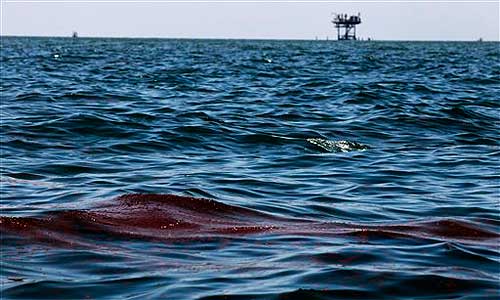
John Wathen, a conservationist with the Waterkeeper Alliance, was one of the few independent observers to fly over the spill in the early days of the disaster. After filming the thick red streaks of oil that the coast guard politely refers to as "rainbow sheen", he observed what many had felt: "The Gulf seems to be bleeding." This imagery comes up again and again in conversations and interviews. Monique Harden, an environmental rights lawyer in New Orleans, refuses to call the disaster an "oil spill" and instead says, "we are haemorrhaging". Others speak of the need to "make the bleeding stop". And I was personally struck, flying over the stretch of ocean where the Deepwater Horizon sank with the US Coast Guard, that the swirling shapes the oil made in the ocean waves looked remarkably like cave drawings: a feathery lung gasping for air, eyes staring upwards, a prehistoric bird. Messages from the deep.


And this is surely the strangest twist in the Gulf coast saga: it seems to be waking us up to the reality that the Earth never was a machine. After 400 years of being declared dead, and in the middle of so much death, the Earth is coming alive.

The experience of following the oil's progress through the ecosystem is a kind of crash course in deep ecology. Every day we learn more about how what seems to be a terrible problem in one isolated part of the world actually radiates out in ways most of us could never have imagined. One day we learn that the oil could reach Cuba – then Europe. Next we hear that fishermen all the way up the Atlantic in Prince Edward Island, Canada, are worried because the Bluefin tuna they catch off their shores are born thousands of miles away in those oil-stained Gulf waters. And we learn, too, that for birds, the Gulf coast wetlands are the equivalent of a busy airport hub – everyone seems to have a stopover: 110 species of migratory songbirds and 75% of all migratory US waterfowl.

It's one thing to be told by an incomprehensible chaos theorist that a butterfly flapping its wings in Brazil can set off a tornado in Texas. It's another to watch chaos theory unfold before your eyes. Carolyn Merchant puts the lesson like this: "The problem as BP has tragically and belatedly discovered is that nature as an active force cannot be so confined." Predictable outcomes are unusual within ecological systems, while "unpredictable, chaotic events [are] usual". And just in case we still didn't get it, a few days ago, a bolt of lightning struck a BP ship like an exclamation mark, forcing it to suspend its containment efforts. And don't even mention what a hurricane would do to BP's toxic soup.

There is, it must be stressed, something uniquely twisted about this particular path to enlightenment. They say that Americans learn where foreign countries are by bombing them. Now it seems we are all learning about nature's circulatory systems by poisoning them.

In the late 90s, an isolated indigenous group in Colombia captured world headlines with an almost Avatar-esque conflict. From their remote home in the Andean cloud forests, the U'wa let it be known that if Occidental Petroleum carried out plans to drill for oil on their territory, they would commit mass ritual suicide by jumping off a cliff. Their elders explained that oil is part of ruiria, "the blood of Mother Earth". They believe that all life, including their own, flows from ruiria, so pulling out the oil would bring on their destruction. (Oxy eventually withdrew from the region, saying there wasn't as much oil as it had previously thought.)

Virtually all indigenous cultures have myths about gods and spirits living in the natural world – in rocks, mountains, glaciers, forests – as did European culture before the scientific revolution. Katja Neves, an anthropologist at Concordia University, points out that the practice serves a practical purpose. Calling the Earth "sacred" is another way of expressing humility in the face of forces we do not fully comprehend. When something is sacred, it demands that we proceed with caution. Even awe.

If we are absorbing this lesson at long last, the implications could be profound. Public support for increased offshore drilling is dropping precipitously, down 22% from the peak of the "Drill Now" frenzy. The issue is not dead, however. It is only a matter of time before the Obama administration announces that, thanks to ingenious new technology and tough new regulations, it is now perfectly safe to drill in the deep sea, even in the Arctic, where an under-ice clean up would be infinitely more complex than the one underway in the Gulf. But perhaps this time we won't be so easily reassured, so quick to gamble with the few remaining protected havens.

Same goes for geoengineering. As climate change negotiations wear on, we should be ready to hear more from Dr Steven Koonin, Obama's undersecretary of energy for science. He is one of the leading proponents of the idea that climate change can be combated with techno tricks like releasing sulphate and aluminium particles into the atmosphere – and of course it's all perfectly safe, just like Disneyland! He also happens to be BP's former chief scientist, the man who just 15 months ago was still overseeing the technology behind BP's supposedly safe charge into deepwater drilling. Maybe this time we will opt not to let the good doctor experiment with the physics and chemistry of the Earth, and choose instead to reduce our consumption and shift to renewable energies that have the virtue that, when they fail, they fail small. As US comedian Bill Maher put it, "You know what happens when windmills collapse into the sea? A splash."


The most positive possible outcome of this disaster would be not only an acceleration of renewable energy sources like wind, but a full embrace of the precautionary principle in science. The mirror opposite of Hayward's "If you knew you could not fail" credo, the precautionary principle holds that "when an activity raises threats of harm to the environment or human health" we tread carefully, as if failure were possible, even likely. Perhaps we can even get Hayward a new desk plaque to contemplate as he signs compensation cheques. "You act like you know, but you don't know."


Naomi Klein visited the Gulf coast with a film-crew from Fault Lines, a documentary programme hosted by Avi Lewis on al-Jazeera English Television. She was a consultant on the film.

[Brought to my attention by Miriam Hayman]
Friday, June 18, 2010

BEST OF THE BLOGS THIS WEEK

There's a lot going on locally and much being said about it in the blogosphere. If you've been as busy as I have with other concerns, you might find it useful to read my personal pick of the best sociopolitical blogposts of the week...


Tuesday, June 15th, 2010

Canadian properties worth in excess of a hundred million dollars

Twin glass towers and a swish shopping complex at Preston Square in downtown Ottawa form just part of an enormous foreign property portfolio controlled in Canada by the family of Sarawak Chief Minister, Abdul Taib Mahmud, according to our exclusive investigations.

These buildings alone are worth at least one hundred million dollars and generate a healthy rental income from some of Canada’s top corporations, including Xerox, Adobe and Sun Life, who rent office space and retail outlets. Numerous Canadian Government Ministries are also listed at the building.

[Read the full exposé here!]

Bodoh, Bangang atau Bahlul?
16 June 2010

When I was in Form One (which seems like a million years ago), a class-mate asked me "Engkau ni bodoh ke, bangang ke atau bahlul?" That's when I learnt that there are 3 categories of stupid. I forgot all about it untill this week - when I suddenly remembered that question. It was triggered by 3 pieces of news, all about money, splashed in our newspapers.

News 1
Government comtemplates building a new Parliament building in Putrajaya at a cost of RM 800 million.

News 2
Cost of building the new palace escalates to RM 811 million.

News 3
Datuk Nazri Abd Aziz says "Government hasn't got enough money to provide our students with scholarships.


Seeking might out of rights
by uppercaise
14 June 2010

Myth-making gets a new stage today when the postponed intimidatory May 13 rally organised by a devout idoliser of Mahathir Mohamad is held in Kuala Terengganu. The Mamak or Mamak Kutty (as he is widely and vulgarly known) will be there with a so-called keynote address, ready to clothe intimidation with cloying references to the uplifting of Malay society.

Postponed or not, there can be no mistaking the nexus between the original choice of date and that day of blood-letting in 1969 when Umno Malay political hegemony seemed to have shattered.

Nor can one overlook the nexus between the rally and Dr Mahathir, the person around whom this has been organised (the continuing references to his preferably-forgotten-ancestry aside) and his long-established politics of race-baiting.

[Read the rest here.]

Heil 1Rosmah, queen of our hearts? HAH!
by uppercaise
18 June 2010

Did you notice? The Malaysian constitution just got rewritten.

There’s a new menu at Parliament — tripe and waffles, served piping hot. Not in the canteen, but in the chamber itself. The prime minister himself was dishing it out this week, protecting the presumed position of his wife Rosmah Mansor, the usurper and pretend queen of the land, while pretending to defend the position of the constitutional Queen, the Raja Permaisuri Agong.

In the process, he just about rewrote the constitution. And all the papers went along with the gag, bending every which way to avoid calling out the plain facts.

[Read the whole ridiculous story here.]


STUDY LOAN DEFAULTERS, SHAME ON YOU!
17 June 2010

The Malaysian government’s decision to eventually scrap the 1,500 Public Service Department (PSD) scholarships has drawn much flak from all quarters. This move will deprive academically gifted students, particularly those from low income families, of an opportunity to further their education and contribute to the future development of the country.

[Read the rest here.]


Thursday, June 17, 2010

Gulf of Mexico: Will the Gas Bubble Burst?


(Coast2Coast) – According to Richard C. Hoagland, insider sources in BP and in U.S. Government say that there is a gas bubble 15-20 Miles across 10+ feet high near BP’s oil well head in the Gulf of Mexico. It may cause an explosion with apocalyptic proportions in weeks or months. The pressure at the well is 100,000 PSI and when the gas explodes it will be like Mount St. Helens going off underwater. It will create a cloud of death and a tsunami wave traveling at 400-600 MPH sinking all vessels around the area as well as drive all hazardous materials including the oil inland.


"As things stand now, the human race is dreaming a hell. But as individuals and as a collective humanity it is our potential to dream of paradise and to create the kingdom of heaven on our Mother Earth. Could it be that the pain in our hearts caused by the hell we have created will spur us on into visions and creations of a world formed in love? It is my prayer and dream, along with a multitude of others who have taught me to dream the Rainbow dream, that each and every one of us learn to dream both while awake and sleeping, the dream of unity and love through divine transformation. This prophecy is a dream and vision that is a potential reality for mankind. It is not an ultimatum. But it is ours to behold and to create if we only dare to dream it together." ~ Aleran (from The Rainbow Dream Vision of Hope)

Wednesday, June 16, 2010

THIS NEWS REPORT MADE MY DAY

German student attacks Hell’s Angels with puppy

BERLIN, June 15 – A German student created a major traffic jam in Bavaria after making a rude gesture at a group of Hell’s Angels motorcycle gang members, hurling a puppy at them and then escaping on a stolen bulldozer.

German police said yesterday that after making his getaway from the Hell’s Angels club, the 26-year-old dumped the bulldozer, causing a 5km (3 miles) traffic jam near the southern town of Allershausen, local police said.

He then fled to his home nearby where he was apprehended by the police.

“What motivated him to throw a puppy at the Hell’s Angels is currently unclear,” said a spokesman for local police, adding that the student had lately been suffering from depression.

The puppy was now in safe hands, the spokesman added.
~ Reuters

[Source: The Malaysian Insider]


Monday, June 14, 2010

Making a fortune by managing misfortune...


BREAKING >> CONFIRMED: VATICAN OFFICIAL TIED TO BP, GOLDMAN-SACHS, AND MEDIA CENSORSHIP IN THE OIL FIASCO INCREASING EVIDENCE OF FOUL PLAY
Tetrahedron, LLC
Health Science Communication for People Around the World

BREAKING NEWS FEATURE
Release: No. 8-CHASE-42
Date Mailed: June 9, 2010
For Immediate Release
Contact: Rhonda Ghoade - 949-715-2217; info@healthyworldaffiliates.com

VATICAN OFFICIAL TIED TO BP, GOLDMAN-SACHS, AND MEDIA CENSORSHIP IN THE OIL FIASCO INCREASING EVIDENCE OF FOUL PLAY

by Sherri Kane and Leonard G. Horowitz

News unfolding from the oil crisis in the Gulf of Mexico has linked media censorship to investment bankers at Goldman Sachs (GS) stewarding the Vatican's wealth, and increasing evidence that the explosion was intended.

A near total news blackout from independent sources, and arrests of anyone caught photographing and filming the devastation, show the Halliburton-British Petroleum (BP) oil crisis is being criminally controlled, implicating some of Wall Street's heaviest hitters.

According to a report issued by frightened, yet faithful, documentary filmmaker, James Fox, interviewed from the Gulf's Grand Isles by Mel Fabregas on the Internet's Veritas Radio Show, "There is a complete media blackout" on news coverage broadcast from the region.


"They are arresting people with cameras and anyone off camera that is caught talking to a reporter," Fox testified.

Another reporter told Fox,"You call this a free country? Right here, in the United States of America, there's no freedom of press. There's no freedom of speech. They're closing down the airspace above the oil spill, so reporter's can't fly over to determine how bad these oil plumes really are."

Suspicious pieces of this deadly puzzle feature Halliburton, the world's second largest oil field services company, headquartered in Houston and Dubai, whose negligence is blamed for the timely and profitable explosion.

Three weeks before the "natural gas leak," the George Bush/Dick Cheney 9-11-linked Halliburton company negotiated the purchase of the world's largest oil-spill cleanup firm (Boots & Coots) at the exact time keen observers on Wall Street - financial intelligence agents at Goldman Sachs (GS; often called "Government Sachs") - unloaded 44% of their stock in BP.

These facts parallel the shorting of airline stocks by those in the know prior to the World Trade Center (WTC) 9-11 attacks that new scientific evidence proves were followed by building demolitions, given the red thermite incendiary powder found everywhere around ground zero.


The WTC lessor, Larry Silverstein, partnered with Lloyd Blankfein of GS in the little known Partnership for New York City (PFNYC), took out a General Electric insurance policy just six weeks before the attacks. PFNYC "partners," in charge of assessing financial damages to NYC, and reconstruction plans for the WTC, obviously "veered" insurance payoffs and additional private equity investments to Las Vegas for the construction of the 9-11 memorial - speciously called the "Veer Towers" in the "New World Center." (Watch PHARMAWHORES, the movie; 1-888-508-4787.)

Blankfein, the PFNYC Co-Chairman and GS CEO, was barraged with indictments and rising media infamy regarding Goverment Sachs's conflicting interests effectively demolishing the US economy through the "shorting" of the housing industry - scrutiny suspended by Halliburton's oil rig synchronously exploding most profitably for GS and its CEO.


GS is covertly invested in the Bush-Cheney-linked Halliburton Company according to veteran observers. GS and Halliburton both had massive financial incentives to cause the profitable explosions - the three 9-11 WTC building demolitions, and the most recent "accident" in the Gulf.

The media's gross neglect of the full extent of the crisis obviously supports GS's damage control and incriminating connections. These include Blankfein's PFNYC Co-Chairman, Rupert Murdoch, and their pernicious influence over the major networks and the PFNYC - the world's leading petrochemical-pharmaceutical-biotechnology consortium profiting from death, disease, and environmental destruction. This unholy alliance best explains the media's aversion to responsible reporting in the Gulf and elsewhere.

Besides Blankfein and Government Sachs backing stock in both BP and Halliburton, another red oil-drenched herring is Peter D. Sutherland (right) - the outgoing Chairman of BP is also the current Non-Executive Chairman of Goldman Sachs International.

The scariest part of this whole story is that Mr. Sutherland, the man standing with one foot in GS, and the other on the burning Halliburton-BP oil rig, is the Consultor of the Extraordinary Section of the Administration of the Patrimony of the Apostolic See. In other words, Sutherland is the chief financial adviser to the Pope.


In 2010, Mr. Sutherland finished a 13-year stint as Chairman of BP, Europe's largest oil company. A former Attorney General of Ireland, he is President of the Federal Trust for Education and Research, a British think tank whose efforts might better be called corporatist indoctrination than trustworthy "education." He is Chairman of The Ireland Fund of Great Britain, and a member of the advisory council of Business for New Europe - a pro-New-World-Order European think-tank based in Britain.


From 1993-95, Sutherland was the Director-General of the World Trade Organization.

In January 2006, the current Non-executive Chairman of Goldman Sachs International, was appointed by United Nations Secretary General, Kofi Annan, as his Special Representative for Migration.

Now, ironically, Sutherland's mission impossible is to migrate marine flora and fauna, fishermen, and coastal residents out of harm's way in this spreading international emergency.

NOTE TO JOURNALISTS:
Sherri Kane, previously a news writer for FOX News in Los Angeles, is a freelance investigative journalist and Co-Founder, with Dr. Leonard G. Horowitz, of Healthy World Organization (HWO) currently advancing as an alternative to the duplicitous World Health Organization (WHO). To request interviews e-mail: info@healthyworldaffiliates.com

----------------------
E-bulletin circulated by:
ECETI - Enlightened Contact with Extraterrestrial Intelligence -
Send email to ecetievents@gmail.com

AWESOME BOOKS AND VIDEOS covering UFOs their origins and intentions, Earth Changes, the origin and history of humanity and the Earth, Healing unseen negative influences and the path to awakening and healing. http://www.eceti.org/Eceti-Store/Eceti.Store.html "Pass them on to a friend."


ALEX JONES INTERVIEWS LINDSEY WILLIAMS