By Naomi Klein
The Guardian
June 19, 2010 - Everyone gathered for the town hall meeting had been repeatedly instructed to show civility to the gentlemen from BP and the federal government. These fine folks had made time in their busy schedules to come to a high school gymnasium on a Tuesday night in Plaquemines Parish, Louisiana, one of many coastal communities where brown poison was slithering through the marshes, part of what has come to be described as the largest environmental disaster in US history.
"Speak to others the way you would want to be spoken to," the chair of the meeting pleaded one last time before opening the floor for questions.
And for a while the crowd, mostly made up of fishing families, showed remarkable restraint. They listened patiently to Larry Thomas, a genial BP public relations flack, as he told them that he was committed to "doing better" to process their claims for lost revenue – then passed all the details off to a markedly less friendly subcontractor. They heard out the suit from the Environmental Protection Agency as he informed them that, contrary to what they have read about the lack of testing and the product being banned in Britain, the chemical dispersant being sprayed on the oil in massive quantities was really perfectly safe.
But patience started running out by the third time Ed Stanton, a coast guard captain, took to the podium to reassure them that "the coast guard intends to make sure that BP cleans it up".
"Put it in writing!" someone shouted out. By now the air conditioning had shut itself off and the coolers of Budweiser were running low. A shrimper named Matt O'Brien approached the mic. "We don't need to hear this anymore," he declared, hands on hips. It didn't matter what assurances they were offered because, he explained, "we just don't trust you guys!" And with that, such a loud cheer rose up from the floor you'd have thought the Oilers (the unfortunately named school football team) had scored a touchdown.
The showdown was cathartic, if nothing else. For weeks residents had been subjected to a barrage of pep talks and extravagant promises coming from Washington, Houston and London. Every time they turned on their TVs, there was the BP boss, Tony Hayward, offering his solemn word that he would "make it right". Or else it was President Barack Obama expressing his absolute confidence that his administration would "leave the Gulf coast in better shape than it was before", that he was "making sure" it "comes back even stronger than it was before this crisis".

It all sounded great. But for people whose livelihoods put them in intimate contact with the delicate chemistry of the wetlands, it also sounded completely ridiculous, painfully so. Once the oil coats the base of the marsh grass, as it had already done just a few miles from here, no miracle machine or chemical concoction could safely get it out. You can skim oil off the surface of open water, and you can rake it off a sandy beach, but an oiled marsh just sits there, slowly dying. The larvae of countless species for which the marsh is a spawning ground – shrimp, crab, oysters and fin fish – will be poisoned.
It was already happening. Earlier that day, I travelled through nearby marshes in a shallow water boat. Fish were jumping in waters encircled by white boom, the strips of thick cotton and mesh BP is using to soak up the oil. The circle of fouled material seemed to be tightening around the fish like a noose. Nearby, a red-winged blackbird perched atop a 2 metre (7ft) blade of oil-contaminated marsh grass. Death was creeping up the cane; the small bird may as well have been standing on a lit stick of dynamite.
And then there is the grass itself, or the Roseau cane, as the tall sharp blades are called. If oil seeps deeply enough into the marsh, it will not only kill the grass above ground but also the roots. Those roots are what hold the marsh together, keeping bright green land from collapsing into the Mississippi River delta and the Gulf of Mexico. So not only do places like Plaquemines Parish stand to lose their fisheries, but also much of the physical barrier that lessens the intensity of fierce storms like hurricane Katrina. Which could mean losing everything.

How long will it take for an ecosystem this ravaged to be "restored and made whole" as Obama's interior secretary has pledged to do? It's not at all clear that such a thing is remotely possible, at least not in a time frame we can easily wrap our heads around. The Alaskan fisheries have yet to fully recover from the 1989 Exxon Valdez spill and some species of fish never returned. Government scientists now estimate that as much as a Valdez-worth of oil may be entering the Gulf coastal waters every four days. An even worse prognosis emerges from the 1991 Gulf war spill, when an estimated 11m barrels of oil were dumped into the Persian Gulf – the largest spill ever. That oil entered the marshland and stayed there, burrowing deeper and deeper thanks to holes dug by crabs. It's not a perfect comparison, since so little clean-up was done, but according to a study conducted 12 years after the disaster, nearly 90% of the impacted muddy salt marshes and mangroves were still profoundly damaged.
We do know this. Far from being "made whole," the Gulf coast, more than likely, will be diminished. Its rich waters and crowded skies will be less alive than they are today. The physical space many communities occupy on the map will also shrink, thanks to erosion. And the coast's legendary culture will contract and wither. The fishing families up and down the coast do not just gather food, after all. They hold up an intricate network that includes family tradition, cuisine, music, art and endangered languages – much like the roots of grass holding up the land in the marsh. Without fishing, these unique cultures lose their root system, the very ground on which they stand. (BP, for its part, is well aware of the limits of recovery. The company's Gulf of Mexico regional oil spill response plan specifically instructs officials not to make "promises that property, ecology, or anything else will be restored to normal". Which is no doubt why its officials consistently favour folksy terms like "make it right".)

If Katrina pulled back the curtain on the reality of racism in America, the BP disaster pulls back the curtain on something far more hidden: how little control even the most ingenious among us have over the awesome, intricately interconnected natural forces with which we so casually meddle. BP cannot plug the hole in the Earth that it made. Obama cannot order fish species to survive, or brown pelicans not to go extinct (no matter whose ass he kicks). No amount of money – not BP's recently pledged $20bn (£13.5bn), not $100bn – can replace a culture that has lost its roots. And while our politicians and corporate leaders have yet to come to terms with these humbling truths, the people whose air, water and livelihoods have been contaminated are losing their illusions fast.
"Everything is dying," a woman said as the town hall meeting was finally coming to a close. "How can you honestly tell us that our Gulf is resilient and will bounce back? Because not one of you up here has a hint as to what is going to happen to our Gulf. You sit up here with a straight face and act like you know when you don't know."

This Gulf coast crisis is about many things – corruption, deregulation, the addiction to fossil fuels. But underneath it all, it's about this: our culture's excruciatingly dangerous claim to have such complete understanding and command over nature that we can radically manipulate and re-engineer it with minimal risk to the natural systems that sustain us. But as the BP disaster has revealed, nature is always more unpredictable than the most sophisticated mathematical and geological models imagine. During Thursday's congressional testimony, Hayward said: "The best minds and the deepest expertise are being brought to bear" on the crisis, and that, "with the possible exception of the space programme in the 1960s, it is difficult to imagine the gathering of a larger, more technically proficient team in one place in peacetime." And yet, in the face of what the geologist Jill Schneiderman has described as "Pandora's well", they are like the men at the front of that gymnasium: they act like they know, but they don't know.
BP's mission statement
In the arc of human history, the notion that nature is a machine for us to re-engineer at will is a relatively recent conceit. In her ground-breaking 1980 book The Death of Nature, the environmental historian Carolyn Merchant reminded readers that up until the 1600s, the Earth was alive, usually taking the form of a mother. Europeans – like indigenous people the world over – believed the planet to be a living organism, full of life-giving powers but also wrathful tempers. There were, for this reason, strong taboos against actions that would deform and desecrate "the mother", including mining.

The metaphor changed with the unlocking of some (but by no means all) of nature's mysteries during the scientific revolution of the 1600s. With nature now cast as a machine, devoid of mystery or divinity, its component parts could be dammed, extracted and remade with impunity. Nature still sometimes appeared as a woman, but one easily dominated and subdued. Sir Francis Bacon best encapsulated the new ethos when he wrote in the 1623 De dignitate et augmentis scientiarum that nature is to be "put in constraint, moulded, and made as it were new by art and the hand of man".
Those words may as well have been BP's corporate mission statement. Boldly inhabiting what the company called "the energy frontier", it dabbled in synthesising methane-producing microbes and announced that "a new area of investigation" would be geoengineering. And of course it bragged that, at its Tiber prospect in the Gulf of Mexico, it now had "the deepest well ever drilled by the oil and gas industry" – as deep under the ocean floor as jets fly overhead.
Imagining and preparing for what would happen if these experiments in altering the building blocks of life and geology went wrong occupied precious little space in the corporate imagination. As we have all discovered, after the Deepwater Horizon rig exploded on 20 April, the company had no systems in place to effectively respond to this scenario. Explaining why it did not have even the ultimately unsuccessful containment dome waiting to be activated on shore, a BP spokesman, Steve Rinehart, said: "I don't think anybody foresaw the circumstance that we're faced with now." Apparently, it "seemed inconceivable" that the blowout preventer would ever fail – so why prepare?
 This refusal to contemplate failure clearly came straight from the top. A year ago, Hayward told a group of graduate students at Stanford University that he has a plaque on his desk that reads: "If you knew you could not fail, what would you try?" Far from being a benign inspirational slogan, this was actually an accurate description of how BP and its competitors behaved in the real world. In recent hearings on Capitol Hill, congressman Ed Markey of Massachusetts grilled representatives from the top oil and gas companies on the revealing ways in which they had allocated resources. Over three years, they had spent "$39bn to explore for new oil and gas. Yet, the average investment in research and development for safety, accident prevention and spill response was a paltry $20m a year."
These priorities go a long way towards explaining why the initial exploration plan that BP submitted to the federal government for the ill-fated Deepwater Horizon well reads like a Greek tragedy about human hubris. The phrase "little risk" appears five times. Even if there is a spill, BP confidently predicts that, thanks to "proven equipment and technology", adverse affects will be minimal. Presenting nature as a predictable and agreeable junior partner (or perhaps subcontractor), the report cheerfully explains that should a spill occur, "Currents and microbial degradation would remove the oil from the water column or dilute the constituents to background levels". The effects on fish, meanwhile, "would likely be sublethal" because of "the capability of adult fish and shellfish to avoid a spill [and] to metabolise hydrocarbons". (In BP's telling, rather than a dire threat, a spill emerges as an all-you-can-eat buffet for aquatic life.)
Best of all, should a major spill occur, there is, apparently, "little risk of contact or impact to the coastline" because of the company's projected speedy response (!) and "due to the distance [of the rig] to shore" – about 48 miles (77km). This is the most astonishing claim of all. In a gulf that often sees winds of more than 70km an hour, not to mention hurricanes, BP had so little respect for the ocean's capacity to ebb and flow, surge and heave, that it did not think oil could make a paltry 77km trip. (Last week, a shard of the exploded Deepwater Horizon showed up on a beach in Florida, 306km away.)

None of this sloppiness would have been possible, however, had BP not been making its predictions to a political class eager to believe that nature had indeed been mastered. Some, like Republican Lisa Murkowski, were more eager than others. The Alaskan senator was so awe-struck by the industry's four-dimensional seismic imaging that she proclaimed deep-sea drilling to have reached the very height of controlled artificiality. "It's better than Disneyland in terms of how you can take technologies and go after a resource that is thousands of years old and do so in an environmentally sound way," she told the Senate energy committee just seven months ago.
Drilling without thinking has of course been Republican party policy since May 2008. With gas prices soaring to unprecedented heights, that's when the conservative leader Newt Gingrich unveiled the slogan "Drill Here, Drill Now, Pay Less" – with an emphasis on the now. The wildly popular campaign was a cry against caution, against study, against measured action. In Gingrich's telling, drilling at home wherever the oil and gas might be – locked in Rocky Mountain shale, in the Arctic National Wildlife Refuge, and deep offshore – was a surefire way to lower the price at the pump, create jobs, and kick Arab ass all at once. In the face of this triple win, caring about the environment was for sissies: as senator Mitch McConnell put it, "in Alabama and Mississippi and Louisiana and Texas, they think oil rigs are pretty". By the time the infamous "Drill Baby Drill" Republican national convention rolled around, the party base was in such a frenzy for US-made fossil fuels, they would have bored under the convention floor if someone had brought a big enough drill.
Obama, eventually, gave in, as he invariably does. With cosmic bad timing, just three weeks before the Deepwater Horizon blew up, the president announced he would open up previously protected parts of the country to offshore drilling. The practice was not as risky as he had thought, he explained. "Oil rigs today generally don't cause spills. They are technologically very advanced." That wasn't enough for Sarah Palin, however, who sneered at the Obama administration's plans to conduct more studies before drilling in some areas. "My goodness, folks, these areas have been studied to death," she told the Southern Republican leadership conference in New Orleans, now just 11 days before the blowout. "Let's drill, baby, drill, not stall, baby, stall!" And there was much rejoicing.
In his congressional testimony, Hayward said: "We and the entire industry will learn from this terrible event." And one might well imagine that a catastrophe of this magnitude would indeed instil BP executives and the "Drill Now" crowd with a new sense of humility. There are, however, no signs that this is the case. The response to the disaster – at the corporate and governmental levels – has been rife with the precise brand of arrogance and overly sunny predictions that created the disaster in the first place.

The ocean is big, she can take it, we heard from Hayward in the early days. While spokesman John Curry insisted that hungry microbes would consume whatever oil was in the water system, because "nature has a way of helping the situation". But nature has not been playing along. The deep-sea gusher has bust out of all BP's top hats, containment domes, and junk shots. The ocean's winds and currents have made a mockery of the lightweight booms BP has laid out to absorb the oil. "We told them," said Byron Encalade, the president of the Louisiana Oysters Association. "The oil's gonna go over the booms or underneath the bottom." Indeed it did. The marine biologist Rick Steiner, who has been following the clean up closely, estimates that "70% or 80% of the booms are doing absolutely nothing at all".
And then there are the controversial chemical dispersants: more than 1.3m gallons dumped with the company's trademark "what could go wrong?" attitude. As the angry residents at the Plaquemines Parish town hall rightly point out, few tests had been conducted, and there is scant research about what this unprecedented amount of dispersed oil will do to marine life. Nor is there a way to clean up the toxic mixture of oil and chemicals below the surface. Yes, fast multiplying microbes do devour underwater oil – but in the process they also absorb the water's oxygen, creating a whole new threat to marine life.
 BP had even dared to imagine that it could prevent unflattering images of oil-covered beaches and birds from escaping the disaster zone. When I was on the water with a TV crew, for instance, we were approached by another boat whose captain asked, ""Y'all work for BP?" When we said no, the response – in the open ocean – was "You can't be here then". But of course these heavy-handed tactics, like all the others, have failed. There is simply too much oil in too many places. "You cannot tell God's air where to flow and go, and you can't tell water where to flow and go," I was told by Debra Ramirez. It was a lesson she had learned from living in Mossville, Louisiana, surrounded by 14 emission-spewing petrochemical plants, and watching illness spread from neighbour to neighbour.
Human limitation has been the one constant of this catastrophe. After two months, we still have no idea how much oil is flowing, nor when it will stop. The company's claim that it will complete relief wells by the end of August – repeated by Obama in his Oval Office address – is seen by many scientists as a bluff. The procedure is risky and could fail, and there is a real possibility that the oil could continue to leak for years.
The flow of denial shows no sign of abating either. Louisiana politicians indignantly oppose Obama's temporary freeze on deepwater drilling, accusing him of killing the one big industry left standing now that fishing and tourism are in crisis. Palin mused on Facebook that "no human endeavour is ever without risk", while Texas Republican congressman John Culberson described the disaster as a "statistical anomaly". By far the most sociopathic reaction, however, comes from veteran Washington commentator Llewellyn King: rather than turning away from big engineering risks, we should pause in "wonder that we can build machines so remarkable that they can lift the lid off the underworld".

Make the bleeding stop
Thankfully, many are taking a very different lesson from the disaster, standing not in wonder at humanity's power to reshape nature, but at our powerlessness to cope with the fierce natural forces we unleash. There is something else too. It is the feeling that the hole at the bottom of the ocean is more than an engineering accident or a broken machine. It is a violent wound in a living organism; that it is part of us. And thanks to BP's live camera feed, we can all watch the Earth's guts gush forth, in real time, 24 hours a day.
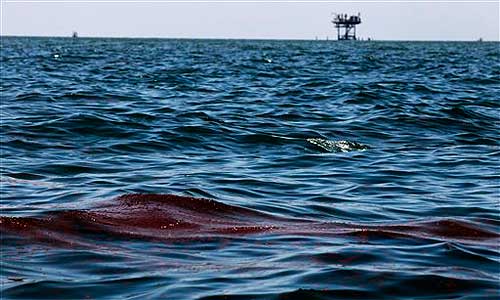
John Wathen, a conservationist with the Waterkeeper Alliance, was one of the few independent observers to fly over the spill in the early days of the disaster. After filming the thick red streaks of oil that the coast guard politely refers to as "rainbow sheen", he observed what many had felt: "The Gulf seems to be bleeding." This imagery comes up again and again in conversations and interviews. Monique Harden, an environmental rights lawyer in New Orleans, refuses to call the disaster an "oil spill" and instead says, "we are haemorrhaging". Others speak of the need to "make the bleeding stop". And I was personally struck, flying over the stretch of ocean where the Deepwater Horizon sank with the US Coast Guard, that the swirling shapes the oil made in the ocean waves looked remarkably like cave drawings: a feathery lung gasping for air, eyes staring upwards, a prehistoric bird. Messages from the deep.

And this is surely the strangest twist in the Gulf coast saga: it seems to be waking us up to the reality that the Earth never was a machine. After 400 years of being declared dead, and in the middle of so much death, the Earth is coming alive.
The experience of following the oil's progress through the ecosystem is a kind of crash course in deep ecology. Every day we learn more about how what seems to be a terrible problem in one isolated part of the world actually radiates out in ways most of us could never have imagined. One day we learn that the oil could reach Cuba – then Europe. Next we hear that fishermen all the way up the Atlantic in Prince Edward Island, Canada, are worried because the Bluefin tuna they catch off their shores are born thousands of miles away in those oil-stained Gulf waters. And we learn, too, that for birds, the Gulf coast wetlands are the equivalent of a busy airport hub – everyone seems to have a stopover: 110 species of migratory songbirds and 75% of all migratory US waterfowl.
 It's one thing to be told by an incomprehensible chaos theorist that a butterfly flapping its wings in Brazil can set off a tornado in Texas. It's another to watch chaos theory unfold before your eyes. Carolyn Merchant puts the lesson like this: "The problem as BP has tragically and belatedly discovered is that nature as an active force cannot be so confined." Predictable outcomes are unusual within ecological systems, while "unpredictable, chaotic events [are] usual". And just in case we still didn't get it, a few days ago, a bolt of lightning struck a BP ship like an exclamation mark, forcing it to suspend its containment efforts. And don't even mention what a hurricane would do to BP's toxic soup.
There is, it must be stressed, something uniquely twisted about this particular path to enlightenment. They say that Americans learn where foreign countries are by bombing them. Now it seems we are all learning about nature's circulatory systems by poisoning them.
 In the late 90s, an isolated indigenous group in Colombia captured world headlines with an almost Avatar-esque conflict. From their remote home in the Andean cloud forests, the U'wa let it be known that if Occidental Petroleum carried out plans to drill for oil on their territory, they would commit mass ritual suicide by jumping off a cliff. Their elders explained that oil is part of ruiria, "the blood of Mother Earth". They believe that all life, including their own, flows from ruiria, so pulling out the oil would bring on their destruction. (Oxy eventually withdrew from the region, saying there wasn't as much oil as it had previously thought.)
Virtually all indigenous cultures have myths about gods and spirits living in the natural world – in rocks, mountains, glaciers, forests – as did European culture before the scientific revolution. Katja Neves, an anthropologist at Concordia University, points out that the practice serves a practical purpose. Calling the Earth "sacred" is another way of expressing humility in the face of forces we do not fully comprehend. When something is sacred, it demands that we proceed with caution. Even awe.
If we are absorbing this lesson at long last, the implications could be profound. Public support for increased offshore drilling is dropping precipitously, down 22% from the peak of the "Drill Now" frenzy. The issue is not dead, however. It is only a matter of time before the Obama administration announces that, thanks to ingenious new technology and tough new regulations, it is now perfectly safe to drill in the deep sea, even in the Arctic, where an under-ice clean up would be infinitely more complex than the one underway in the Gulf. But perhaps this time we won't be so easily reassured, so quick to gamble with the few remaining protected havens.
Same goes for geoengineering. As climate change negotiations wear on, we should be ready to hear more from Dr Steven Koonin, Obama's undersecretary of energy for science. He is one of the leading proponents of the idea that climate change can be combated with techno tricks like releasing sulphate and aluminium particles into the atmosphere – and of course it's all perfectly safe, just like Disneyland! He also happens to be BP's former chief scientist, the man who just 15 months ago was still overseeing the technology behind BP's supposedly safe charge into deepwater drilling. Maybe this time we will opt not to let the good doctor experiment with the physics and chemistry of the Earth, and choose instead to reduce our consumption and shift to renewable energies that have the virtue that, when they fail, they fail small. As US comedian Bill Maher put it, "You know what happens when windmills collapse into the sea? A splash."

The most positive possible outcome of this disaster would be not only an acceleration of renewable energy sources like wind, but a full embrace of the precautionary principle in science. The mirror opposite of Hayward's "If you knew you could not fail" credo, the precautionary principle holds that "when an activity raises threats of harm to the environment or human health" we tread carefully, as if failure were possible, even likely. Perhaps we can even get Hayward a new desk plaque to contemplate as he signs compensation cheques. "You act like you know, but you don't know."
 Naomi Klein visited the Gulf coast with a film-crew from Fault Lines, a documentary programme hosted by Avi Lewis on al-Jazeera English Television. She was a consultant on the film.
[Brought to my attention by Miriam Hayman]