Tuesday, July 1, 2025

ICELAND ~ A LIVING, CHANGING LANDSCAPE (repost)

3D map showing glacial zones in Iceland

Emerging from the ocean depths a mere 16 million years ago, Iceland is still a living, constantly changing landscape, with more than 300 volcanoes, 30 of them active.

Its location astride the mid-Atlantic ridge, on the edge of two tectonic plates, gives rise to frequent tremors and makes it less than hospitable for human habitation. Rarely do you find shrubs or trees growing beyond 5 feet, except in urban centers where buildings offer young trees a measure of protection from strong icy winds.

Grass struggling to green on old lava fields in the Þingvellir National Park

While whales, seals, and other marine creatures have inhabited the cold waters of the northernmost latitudes for millennia, the only indigenous land animals found in Iceland are the Arctic fox and reindeer, although Polar bears from Greenland have been known to visit, hitching a ride on ice floes. All other species were imported by early settlers beginning in the 9th century CE. The good news is, no biting insects or poisonous snakes can survive Iceland’s near arctic winters - although huge swarms of harmless midges occasionally darken the air in some areas.

Snowcapped moraine hills and glacial ponds

Given the harsh conditions, it is indeed a wonder that a handful of hardy humans have managed to gain a permanent foothold on this island nearly the size of Great Britain. The population in January 2015 stands at 330,000 – with 260,000 concentrated in and around Reykjavik, the capital, which makes it the most thinly inhabited country in Europe. Yet the United Nations 2013 Human Development Index listed Iceland as the 13th most developed nation in the world.

One of hundreds of splendid waterfalls found all over Iceland 

Apart from an unlimited supply of the purest water found anywhere on the planet - icy cold aboveground and boiling hot beneath - the first settlers found resources extremely scarce and confined to specific areas. They shortsightedly wasted no time decimating whatever forest once existed, accelerating soil erosion and reducing arable land to a bare minimum. However, the abundant waters also provided a healthy supply of fish. Norsemen arrived in the middle of the 9th century with horses, cattle and sheep, plus a few basic tools. Driftwood and ship wreckage salvaged from treacherous stretches of the coastline were highly prized and carefully hoarded.


Remains of a stone & timber cottage built against a hillslope with a grass roof

Although the Norwegians claim to be the first settlers (followed by Danes and Swedes), the remains of a few cabins dating back at least a century earlier were subsequently discovered. Nobody knows who built these cabins, though some believe they may have been Scottish or Irish mystics seeking refuge from the Church’s relentless persecution.

A Magickal Mystery Gourmet Tour

Aesthetic lines of the airport terminal
Even before we landed at Keflavik Airport, 45 minutes from Reykjavik, our 3-hour flight from Copenhagen on Icelandic Air yielded some pleasant surprises. The first was the refreshingly aesthetic, unexpected programming of the in-flight entertainment, unlike the usual “inoffensive” mainstream fluff found on most international airlines. Checking out the music channels, I was delighted to discover that the classical offerings included contemporary symphonic works verging on the avant-garde. I watched a low-key Icelandic movie about an introvert schoolteacher and his father’s attempts to reconcile with him; nothing spectacular, just a human story sensitively told, shot on location in the desolate rural region of Iceland. And next to the video screen was a USB port from which to charge my phone. How civilized!

We ordered a ham and cheese baguette and were delighted to find it still hot from the oven, entirely flavorful and wholesome. It was evident that those responsible for feeding the passengers’ stomachs and souls on Icelandic Air were empathetic human beings, not cost-cutting, time-serving corporate minions.


Arrival Hall at Keflavik International Airport
The next surprise was the pinewood flooring and human-scale layout of the airport terminal which gave one the impression of arriving at somebody’s home, rather than some impersonal transport hub. Imagine my joy when I suddenly found myself at the exit, having encountered no immigration or customs check. This was the first time I have ever arrived in a country seemingly devoid of distrust and bureaucratic paranoia. There were no security personnel or CCTVs in sight.


View of Reykjavik from The Pearl

Interior of the Dome at The Pearl
We were amused to hear that the last bank robbery in Reykjavik was foiled when the police found the would-be robber standing at the nearest bus stop, hoping to make his getaway on public transport. He was totally drunk, of course.

Ragna Bachmann Egilsdóttir was assigned as our personal guide in Iceland. We couldn’t have asked for a more knowledgeable and passionate person to facilitate a condensed but intimate glimpse into the Icelandic mythos. A 34th generation descendant of the first wave of Viking settlers, Ragna has spent 25 years of her colorful life living and working abroad; indeed, a book has been written about her adventures (which regrettably we didn’t have the opportunity to investigate). Apart from that she happens to be natural-born mystic, folklorist, storyteller, ascensionist and healer whose profound love of her homeland is matched only by her interest in whatever goes on beyond the visible. For me it felt like a reunion of old souls right from the start.


Left: Ragna's magickal soapstone. Right: my Logo of Logos inspired by the Merkaba

Ragna Bachmann Egilsdóttir,
magickal tour guide & storyteller
At one point she showed me a carved soapstone she had found on the black sand beach of Mýrdalssandur in 2012. It was a Celtic pentagram, symbol of the Pythagoreans, and it was complementary to my own modified merkaba (based on the interlocking equilateral triangles commonly known as the Star of David). The five-pointed pentagram is associated with Venus, magick, and the Sacred Feminine; while the six-pointed star represents esoteric knowledge and the Masculine Principle. Both are integral components of the Flower of Life, a firm understanding of which leads inevitably to a comprehensive, inclusive and coherent perspective on reality.

On our second day in Iceland, Ragna presented me with two paperbacks – one on the Sagas and Myths of the Northmen and the other an English translation of Voluspa (The Prophecy of the Vikings). I reciprocated by giving her a copy of my book, Tanah Tujuh ~ Close Encounters with the Temuan Mythos.

Captain Palli taking a break
Our driver Guðni Palli Birgis Brettingz (Palli for short) left most of the talking to Ragna who told me he used to be captain of a merchant ship. We soon grew to trust Captain Palli’s skillful handling of the Mercedes mini-bus on treacherous hilly stretches in North Iceland, some completely covered with snow and ice. Most of the time, the sight of another vehicle every 15 or 20 minutes was all the traffic we saw.

Where Fire Meets Ice

Driving across mile after mile of lava fields in South Iceland we learn that a catastrophic volcanic eruption in June 1783 went on for more than eight months and left a whole portion of the island (an area roughly the size of Singapore) uninhabitable. For many years afterwards the air was murky with ash and nothing would grow in the sunless haze. A quarter of the population died of starvation and many Icelanders migrated to Canada, Denmark, Germany, wherever work could be found. The eruption affected most of North Europe as sulphur dioxide mixed with rainfall to poison crops and choke lungs (in Britain, an estimated 20,000 died in the summer of 1783 from the toxic atmosphere).


Driving across the vast tundra of North Iceland


Brittle, jagged lava rockpile

The lava fields of Eldhraun are possibly the most desolate landscape I have yet to experience. Jagged and brittle piles of volcanic rock dot the plains as far as the eye can see, the monotony occasionally broken by smoky plumes where geothermal springs have broken through. It is not a terrain one can easily traverse on foot or even on horseback.


232 years after the catastrophic 8-month-long eruption of Lakagigar starting on 8 June 1783

Occasionally a few barren hills come into view, the taller ones still capped with ice even in the late spring. They are mostly moraine deposited by long forgotten glaciers - an accumulation of crumbly, gravelly scree virtually impossible to climb. Indeed, a landscape unfriendly to creatures as fragile as humans – but certainly not so to elemental beings and extradimensional denizens of Tolkienish folklore like trolls, ogres, elves, fairies, goblins, gnomes, dwarves, and undines.

Dimmuborgir (Dark Castles) where a family of trolls became petrified when they stayed out till dawn

100-degree Celsius hotsprings atop a hillock
The only way the Icelanders could endure the extreme cold was to pipe geothermal water through their homes. Energy is also generated from the steaming hotsprings and countless waterfalls. Clean power and heating at its best, virtually free and unlimited. Iceland is undoubtedly the least polluted nation in the world. Every home looks humble and plain on the outside – but the interiors are often cozily furnished with furs and rugs and well-designed furniture.

Temperature differences between outdoors and indoors in Iceland are extreme. From below zero, you step into rooms warm enough to undress in.

Farmer's bedroom warmed by body heat 
With limited resources in a punishing climate and terrain, the Icelanders’ ancestors required tremendous ingenuity and advanced design skills to survive. Early farmers came up with the idea of warming their stone and wood cottages with body heat – from their livestock which they kept one floor below as well as by squeezing themselves  into tiny bedrooms with a minimum of two bodies per bed. They often built their dwellings snug against a hillside and allowed grass to grow atop their roofs in the summer to form a natural thatch.


Folk museum curator Brooks Walker with
handwoven horsehair ropes
In winter when ice formed over lakes and made travel difficult, they fashioned simple skates from the bones of horses, held in place with ropes woven from horse hair. Some became experts in tool-making, improvising with metal scraps and driftwood, because importing cost a lot more and took months to deliver by ship.

Every part of the whale was recycled, especially the vertebrae, which were converted into large food containers. Smaller bones from whales and other animals were used as hammers, pounders, grinders, or turned into ornaments. Smaller bones from sheep and pigs were given to children as toys.

At the Folk Museum outside the village of Skỏgar we found a special display of finely crafted tools hand-made by a farmer turned smithy named Sigurjỏn Magnủsson (1889-1969) – a shining example of Icelandic ingenuity, skill and resourcefulness.


Food container made of whale vertebrum

Also on display was an exquisitely tailored black gown believed to have been sewn by elves and presented to a human female who helped midwife a difficult birth in the fairy realm.

Rolling With The Punches

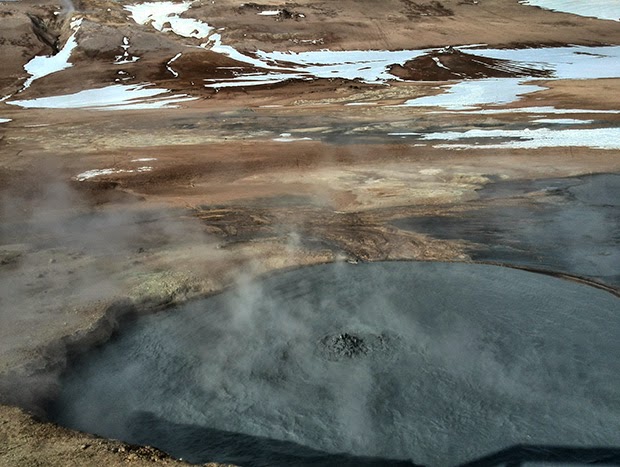
Geothermal pool bubbling with smelly sulphurous mud (where the Devil once pissed, according to folklore)
Frequent earth tremors have forced Icelanders to become the world’s foremost authorities on earthquake-proofing their homes. All modern structures are now bolted to steel frames with built-in shock absorbers designed to withstand seismic activity up to 8 on the Richter scale.


The famous Strokkur geyser erupts every 5-7 minutes

We arrived in Iceland five days after the devastating earthquakes that crippled Nepal and within 24 hours of setting foot in Reykjavik I got wind of some volcanic activity in the southwest. Our guide expressed a degree of anxiety but I felt certain nothing terrible would happen. When the volcano Eyjafjallajökull erupted in April 2010, the massive fallout of ash disrupted air travel in Northern Europe for weeks. More recently, Bárðarbunga erupted on 17 August 2014 and only quietened down on 27 February 2015. This time there was no problem with volcanic ash, but the massive lava flows released sulphur dioxide fumes which made breathing hazardous in many areas.


Glorious vistas every direction one turns, with angels cavorting in blue skies

Throughout our brief sojourn in Iceland, the skies were mostly a brilliant blue, especially as we headed farther north. Cirrus clouds cavorted in the high winds, forming angels and dragons and mythical creatures: to me, it was a clear sign that Iceland was pleased to reveal her otherworldly beauty and her abiding mysteries to appreciative souls. Within a single week we passed through so many unique, gobsmackingly spectacular landscapes found nowhere else on earth, and saw the most awe-inspiring waterfalls and rivers – but none warm enough to play in comfortably.

Skinnydipping, anyone? Brrrrrr!
“Three minutes,” Ragna solemnly informed us, “that’s how long you can stay alive if you fall into these icy waters, so please don’t try it!”

On the 1st of May, a nation-wide strike began with workers demanding a more reasonable share of the economic pie. The elite had recently given themselves a 30% pay hike and were offering less than 3% to the rest.

Magnús Tómasson's "Monument to the Unknown Bureaucrat" (basalt on bronze, 1994)

500 copies of the first Icelandic Bible were printed in 1584
Iceland was settled by migrants utterly fed up with the notion of monarchy. For centuries the island had been virtually a colony of Norway and all its citizens were subjects of the Norwegian king. The island was presented to Sweden as a gift and later taken over by the Danes. In the year 1000 CE the Icelandic parliament passed a resolution to officially embrace Christianity. This averted a civil war between recent converts and diehard pagans. One of the last Viking chiefs ritually consigned his pagan deities to the bottom of a majestic but perennially frost-covered waterfall in North Iceland named Goðafoss where they presumably await their resurrection at Ragnarök (or the Final Reckoning). Nevertheless, every summer neo-pagans convene by the thousands in the Viking Village, located in a picturesque suburb of Reykjavik, to celebrate the Nordic pantheon of their ancestors.


The Norse Gods sleep at the bottom of Goðafoss, a perenially frost-covered waterfall

Jónas Hallgrímsson, Icelandic intellectual
& contributor to the
Fjölnir, a journal that
inspired the Independence movement
In 1874, an independence movement fomented by Danish-educated poets and intellectuals led to Iceland being granted home rule – but full independence was attained only in 1944 after Denmark fell under German occupation. Today Icelanders are known to be fiercely anarchistic and egalitarian in outlook. Their contempt for bureaucratic authority and corporate arrogance can be seen in public artworks like the hilarious basalt and bronze statue by Magnús Tómasson in honor of the blockheads in power installed outside the Parliament (it was subsequently relocated to a spot less obvious).

The building where Ronald Reagan met Mikhail Gorbachev in 1986 to discuss nuclear disarmament and an end to the Cold War is now a tourist attraction. This event put Reykjavik on the world map as thousands of reporters gathered there to document the historic dẻtente between the Capitalist and Communist blocs.


Jón Gunnar Árnason's "Sun Voyager" (aluminum sculpture, 1990)

Icelandic twins in Húsavík
Ragna with her Glacier Queen Trophy
Even though Iceland has never had a standing army, it has aligned itself with NATO and during the Cold War, the Americans established a military base and even sent their astronauts to Iceland for training prior to the Apollo moonshot. Apparently, the African Americans among the military encampment were a novel sight to many Icelanders who had never seen Blacks before. I’m sure there are more than a few traces of African DNA in Iceland, left behind by the American military occupation. Now there will also be some Asian DNA too: we were surprised to find a Penang-born Chinese waitress at the Grand Hotel Reykjavik who said she met her Icelandic husband while holidaying in Phuket eight years ago. The hotel staff included an Indonesian girl and a couple of Filipinas.

Since the banking collapse of 2008 - which led to a change of government and the jailing of a few bankers - Iceland has managed to pull itself up by its own bootstraps, turning to tourism as a new source of revenue. The climate may be harsh and inhospitable, but the warmth and friendliness of every Icelander I encountered more than made up for it.


Captain Palli steady at the wheel while Ragna regales us with troll tales

I dedicate this account to Ragna and Palli, our wonderful guide and driver, who went beyond the call of duty to make us feel welcome and loved. Thanks also go to Karen Sin of the Universal Travel Corporation in Singapore who came along to ensure that everything went smoothly; and, of course, to my adorable travel companion, Adeline “Kimchi” Kang who turned whimsical fantasy into a memorable reality for me.


First posted 17 May 2015, reposted 2 May 2023. Text & photos © Antares 2015


Sunday, June 29, 2025

Fantastic States of Mind ~ The Amazing Raul Midón


[Special thanks to my ET-human hybrid brother Heiko Niedermeyer for introducing me to this phenomenal musical talent. Raul Midón inspires me so much I just have to repost this again for those who missed it the first time around. Last posted 6 October 2013. Reposted 26 June 2018]


Friday, June 27, 2025

TIGER ISLE ~ A GOVERNMENT OF THIEVES (BOOK REVIEW)

“If religion is the opiate of the masses, as it pretty much is in most of Asia and the Middle East, then Tiger Isle was the drug capital of the world. It did not help that most Tigerists lived in a state of denial, in particular about their religion.”

First-time novelist E.S. Shankar: encyclopedic erudition

E.S. Shankar is an erudite, articulate, Renaissance Man of multitudinous facets. A UK-trained accountant and management consultant by profession, Shankar also maintains a satirical blog called Donplaypuks where he lampoons local politics with a generous dollop of schoolboy humor laced with sagacious insight.

Recently he published his first novel, Tiger Isle, A Government of Thieves – a highly engaging 380-page study of the evils of kakistocracy (defined as “governance by a clique representing the worst elements of society, from the Greek, kakos, meaning foul, or filthy”). I don’t know if he has found a local distributor yet but the book can be easily ordered online. I can assure you, nobody will begrudge Shankar the $13.49 price tag, considering the massive amount of brilliance and sheer hard work the man has invested in this epic read, replete with evil machinations, murder, sex, and apocalyptic mayhem.

Shankar’s spicy fiction is based on depressing facts anyone who has been monitoring Malaysia’s political milieu since 1969 will be familiar with: the bureaucratic apartheid created by artificially imposed racial and religious boundaries; the boundless avarice and power lust of a privileged coterie that wields a deadly stranglehold on the national psyche through absolute control of the mass media; the audacious and systematic plunder of a nation’s wealth and the methodical hijacking of its destiny for private gain and ego gratification.

Indeed, while the events and characters depicted in Tiger Isle appear to be broadly inspired by actual events and characters in Malaysia, the scenario is easily modified to fit any post-colonial Southeast Asian nation (indeed, dissemblance and hypocrisy are skills necessary to establishing and maintaining political power anywhere on Earth). As such, Shankar’s lovingly crafted debut novel sheds valuable light on the nature and internal workings of corruption, hubris and megalomaniacal delusions of grandeur – and deserves to be prescribed as supplementary reading in any meaningful political science curriculum.

It’s no mean feat to construct a parallel universe populated by doppelgängers of clearly recognizable personalities - and yet allow the characters sufficient autonomy to generate the tension and drama necessary to animate this fictional domain called Pulipore, or Tiger Isle. There is enough narrative momentum to keep the reader turning pages – although one requires a photographic memory to keep track of unwieldy names like Rekha Krishnasamy Roshan Prasad, Adhi Sri Dr Bhairav Oak Broad Leaf Sivan, Kapalin Blowfish Black Panther Chandran, Maitreya Blue Dolphin Suryan, and Sri Sanatkumar Mutthiah Muralidharan. Those in the know will smile at the inclusion of a few “ascended masters” in the colorful cast of characters.

Not only are the names extended, Shankar gleefully provides genealogies for a few of them, going back several generations – in the process adding a wealth of side commentary on the fascinating diversity of cultures to be found in the region. Place names like Pulijayam, Chandrapore, Shaktipore and Suryapore evoke a subcontinental aroma – hinting at the lingering influence of ancient civilizations like the Srivijaya and Majapahit Empires.

With an accountant’s eye for detail, Shankar delves into a morass of financial shenanigans conducted under the corrupt aegis of UNTA (United National Tigerists Association). Indeed, one might conclude that Shankar is merely making it all up - were it not for the fact that most Malaysians are already aware – thanks to the internet - of the endless list of dubious deals signed behind closed doors and labeled Official Secrets.

I couldn’t help but smile wryly at the irony of it all. Whenever Shankar relishes his role as novelist and puts effort into fleshing out his fictional characters, he succeeds in giving his narrative a measure of realism; however, his intimately reconstructed accounts of high-level wheeling and dealing come across as pure fiction because their outrageousness simply boggles the mind. We shudder at the realization that Shankar didn’t have to invent anything – merely switch a few acronyms and names around.

And, just as happens in real life, we are confounded by a plethora of acronyms: PACC (Pulipore Anti-Corruption Council), CCCP (Chandrapore City Center Plaza), PPC (Pulipetrol Corporation), PSA (Patriot and Security Act), PSB (Police Special Branch), and PITS (Pulipore Information Technology Service) – so much so the reader is at times compelled to refer to the acronym list on page 382.

As a writer, E.S. Shankar occasionally suffers from what may be called “the fisheye lens” syndrome – in effect, his omniscience and encyclopedic knowledge compel him to throw in too many asides and insider jokes. This slows the pace down – but only minimally. On the whole I was impressed by Shankar’s fluid syntax and flashes of literary virtuosity, for instance, when he begins a chapter with a killer line like: “The economic picture was pretty from far, but actually far from pretty.”

The story acquires a hint of Ian Fleming towards the end, when Shankar conspires to put all the biggest crooks of Tiger Isle together on board a private jet – and then leaves them at the mercy of seven female amateur ninjas and a couple of renegade pilots. Regime change through the ballot box is simply too banal and boring, I suppose. Or too unlikely. Or perhaps the eternal child in E.S. Shankar just felt like giving the plot a tiny twist of Quentin Tarantino.

Regrettably, Shankar’s magnificent effort will not qualify for the epithet “The Great Malaysian Novel” – simply because it’s all about Tiger Isle, heh heh, not Malaysia.

GOOD NEWS! Shankar has found a local publisher, Gerak Budaya, and Tiger Isle ~ A Government of Thieves will be officially launched at the Royal Selangor Club at 7PM on 20 November 2012.
[First posted 28 September 2012. Reposted 23 November 2014, 28 May 2015, 23 June 2017 & 23 June 2020]


Thursday, June 26, 2025

KEMBALI KE BALI ~ RETURN TO BALI (reprise)

Finally I did it! I returned to the magickal Island of Bali after an absence of 26 years. It was only 5 days this time. In 1981 I was there for 5 weeks, and each day was a Technicolor dream overflowing with adventure, romance, and delicious sensations. I'm gathering my thoughts and feelings so I can write in greater detail about the invigoration and inspiration I felt - but, meanwhile, I'll share some photos I took with my dinky digital camera (a Sony Cybershot, believe it or not!)...

In Bali you'll always find a majestic old tree beside every temple. This magnificent green sanctuary that had shaped itself into a perfect archway was spotted on my way to Ubud, just outside Batubulan (what a romantic name, Moonstone!).

On both sides of the road leading to Ubud you'll find the finest artisans in Asia, a rich legacy of the Majapahit Empire which produced stonemasons comparable to those that built Angkor Wat, Khajuraho, and Tiahuanaco.
A colossal statue, presumably of Rama, greets every visitor to Ubud
Painters, painters everywhere in Ubud; modern as well as traditional
Mask-makers too!
Member of the Balinese Royal Household at the Royal Temple in Ubud
Five minutes outside the bustling tourist hub
that Ubud has become, soothing sounds of running water
and ducks romping in lush paddy-fields
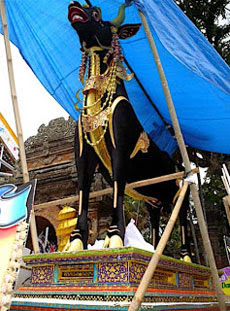
Ceremonial cow presides over ritual cremation of Balinese royalty
Women in Bentuyong, near Ubud, so alike the Orang Asli among whom I live
Hokkien chef in Ubud with two of his Balinese angel waitresses
Daily offerings to the Unseen Beings are an integral part of Balinese culture

PART TWO

[Originally published 12 September 2007. Reposted 4 July 2013]


Saturday, June 21, 2025

Close encounters with the remarkable Buckminster Fuller (repost)


[Adapted from a letter to Thomas Schöllhammer, dated 28 February 1986. Mr Schöllhammer, then a student of ‘American Culture’ at Munich University, was writing a dissertation on Buckminster Fuller and had requested a full account of my personal contact with ‘Grandpa’ Bucky.]

I’m not sure how I first heard of R. Buckminster Fuller.

But the first time I saw him was in Kuala Lumpur in 1973 when he gave a talk at the University of Malaya. He was extolling the virtues of non-specialization, which was to me an interesting change from the conventional Jack-of-all-trades doctrine that you can achieve nothing unless you concentrate on a very tiny area. In later life Bucky (as he liked being called) would describe himself as a Comprehensivist.

I was impressed by his awareness of 4-dimensional processes – the only way apparent contradictions can be reconciled and appreciated. It was the first time I had heard the word SYNERGY. He also expressed his belief in “syntropy” – the opposite of entropy. Whereas most scientists speak of “negative entropy” Bucky used the more pro-active term, syntropy: the antidote to pessimism (“things fall apart,” “the heat death of the universe,” “Murphy’s Law,” and so on).

SYNTROPY he defined as Scenario Universe’s counter-tendency towards greater coherence and integrity: the centripetal (returning to Source) counterforce to centrifugal “expanding Universe” theories. Bucky was a visionary who could sense transcendental Meaning and Higher Order beyond the apparent disorder and randomness of physical phenomena. I had no chance to talk with him, as he was hurried off to some official tea party immediately after the lecture.

Fuller poses with his Dymaxion car, circa 1933

In 1975 Bucky was invited to an international conference on “Malaysia in the Year 2000” organized by the Syed Kechik Foundation. Herman Kahn of the Hudson Institute (a research team entrusted with developing futurist ‘scenarios’ for the Pentagon, among other corporate interests in the U.S.) was also there; and so was Prof. Robert Jungk, the famous German sociologist-historian. I managed to get myself invited to the conference and that’s how I finally got to meet Bucky.

U.S. Pavilion at Expo 1967 designed by Buckminster Fuller

He was very approachable, very warm and saintly, radiating a very loving aura – in sharp contrast to Herman Kahn who was hugely aloof and sneering, radiating little warmth. In the two men you could see the polarities of intellectual vision. Kahn was convinced that the planet was in deep trouble and that Malthusian economics dictated Darwinian survival strategies (e.g., he advocated and defended America’s policy of exporting pollution to Third World countries). Fuller, on the other hand, was convinced that Universe is sentient, that Cosmic Intelligence always prevails, and that cooperation, not competition, was the key to real progress. Mentally I called Herman “Fat Hope” and Bucky “Slim Chance.”

Within hours I had decided Bucky would make the ideal grandfather. So when I found him sitting one row behind me at one of the talks, I scribbled my request on a sheaf of conference notes and handed it to him: “Do I have your permission to adopt you as my grandfather?”

Bucky scrawled an unhesitating response: “Indeed you do! It gives me great joy and an increase of responsibility.”

This simple act proved to me that Bucky represented the noblest spirit of humanity, the archetypal Community Elder who has grown beyond tribal concerns and was in effect one of the True Sages of Planet Earth. Such beings are not universally recognized under the military-industrial power structure – but I’m sure that as the Aquarian Age proceeds, they will come into their own.

The general atmosphere at the 1975 conference was pretty much a triumph of Optimism over Pessimism, of human over technocratic values.

Herman Kahn (pictured left) was loudly and repeatedly booed during his address in which he defended the hard-line “realist” approach to problem-solving (that whole pragmatic worldview founded on Original Sin, the contrariness and imperfectibility of Human Nature, and the overall untrustworthiness of the Cosmos; the scientific-materialist paradigm wherein “God” is essentially an abstraction to which political expediency demands payment of lip service, but in private nobody really gives a hoot about “moral authority” or any sense of ethics governing human existence; the Bottom Line being, of course, Economics).

In contrast, Bucky’s talk was very warmly received. Though a fair portion of the audience seemed to have difficulty following his non-linear, multidimensional way of thinking and speaking, Bucky was able to transmit a clear and direct feeling of genuine goodwill and high intelligence. He didn’t refer to notes and could have gone on for hours if there hadn’t been a time limit. I can recall only fragments of what he said, but those few fragments remain vividly imprinted in my mind:


Bucky speculated on the ascendancy of Muscle Power during a particular phase of our prehistory when kings and chiefs were chosen from the warrior caste and Power was equated with the weight of a man’s weapon. Cerebral individuals were given subordinate rôles as consultants, magicians, healers, and comedians. (“Put this little guy on the payroll, he tells funny jokes.”) These thoughts were neither new nor radical to me as I had covered the same contemplative ground in the course of my personal musings – but it was the first public utterance of these ideas I had encountered, and it served to reaffirm the validity of my own views on social hierarchies and power elites.

Buckminster Fuller's trademark geodesic dome

Bucky came up with another important analogy: that of the honey bee colony which serves a greater design (the propagation of plant species) without actually being aware of its nature-ordained function. To the bee, the whole purpose of existence is simply the gathering of nectar and the defence of its own hive until the next generation is ready to take over the endless cycle.

Dymaxion House (prototype revealed in 1929; redesigned in 1945)

This metaphor (perfectly illustrating precessional effects) was very mind-opening and allowed me to view even the multinational corporations in a more generous light: like the honey bees, most of them haven’t attained the 4-dimensional awareness of their higher function within the planet’s ecology. But, as Bucky pointed out, these Great Pirates (his name for the fortune-hunting, empire-building colonizers who have shaped the course of recent centuries) produced global navigation maps and introduced the concept of a continent- and culture-bridging spherical world through purely selfish, greedy motives. Bucky’s graphic thought processes approach a workable solution for all conflicting tendencies in human and animal behavior. For me, Bucky had successfully performed the alchemical marriage of Heaven and Hell, extending his mentations beyond simplistic “good” and “evil” to an enlightened state of dynamic equilibrium, of reintegration and reciprocity.

Bucky with his wife Anne Hewlitt and their daughter Allegra, circa 1927

Yes, Bucky was indeed a 20th-century Buddha with access to the harmonic overtones of Higher Consciousness. No wonder some "experts" are of the opinion that Fuller went “kind of nuts in his later life.” Bucky’s concepts had transformed into metaconcepts: to comprehend Whole Systems you need to exercise your mind in ever increasing spheres of interest. No way any die-hard academic specialist could ever publicly endorse Bucky’s work. It’s so much easier to protect our own petty interests by playing down or not noticing other people’s greatness.

Allegra Fuller Snyder, Bucky and Anne's only surviving child, visits the Eden Project 
in September 2009

Another very important thing Bucky pointed out was that no true scientist will ever describe anything as a “mistake.” In experimental procedure, all results lead to deeper understanding, whether “positive,” “negative,” or “ambivalent.” I view Bucky as a philosopher-guru using mathematical and technological terminology to express his mystical insights. In this respect he was often misunderstood and dismissed (and, to a certain extent, still is) by mainstream scholars. He was fond of describing himself as a “maverick” – the ox that refuses to run with the herd. In problem-solving it’s often the maverick idea that proves most valuable.

Buckminsterfullerene aka Buckyball - the C60 carbon molecule discovered in 1985


Most important to me was the fact that Bucky Fuller had devoted his life to developing a syntax and a geometrically achievable model of Utopia: a vision I have explored in mystical terms, but which I've found difficult to articulate “objectively.”

Bucky’s work with the miraculous behavior of Whole Systems, Synergetics, Syntropy, Reciprocity, Regenerative Intertransformations, Integrity, and Omnidimensionality put everything mystics had always spoken of in poetic code into clear, technical focus – the same way G.I. Gurdjieff and John C. Lilly made epistemology accessible to empirical investigation. However, don’t take my word for it – read Bucky’s Utopia or Oblivion (Pelican Books, 1968)!

The conference on “Malaysia in the Year 2000” lasted only five days – but I had the chance to have more contact with Bucky between sessions and at meals. The remarkable thing is that there was never much casual talk at these encounters: it was more like a reunion of intimate friends. He would perform childlike exercises on paper napkins, demonstrating how EVOLution derives from EVE and how EVOL is really LOVE spelt backwards.

I wrote a long letter elaborating my ideas on transport systems (from solar buggies to antimatter propulsion to mantra-powered lightships) and handed it to Bucky on the second day of the conference. When we met the next day he gave me a radiant smile and a warm handshake, saying: “It was the best letter I’ve ever received, I was absolutely delighted!”

He asked if I was interested in reading a new poem he’d drafted, something called Complexion 1975. He had only the original copy, so I was required to read it all at one sitting in his hotel room while he very kindly ordered me a glass of milk (perhaps I still looked like a baby to him). Since then I’ve read the published version of Complexion, but it didn’t read like the same document I saw in Bucky’s room. My memory informs me that the original draft was more science-fictionish – written from an extraterrestrial viewpoint. I had the feeling that Bucky was eager to communicate some earthshaking secret – but he apparently changed his mind and all he said to me before we left the room was: “Don’t worry about anything. It’s 99.9 per cent metaphysical!”

I did feel a pervasive sense of “unreality” – as though the view outside his hotel room was a holographic projection. I looked at him for further clarification and he kept smiling beatifically and insisting that the physical reality around us was such a minute section of the electromagnetic spectrum as to be actually quite insignificant.

Around this time, a half-mile or so away, the Japanese Red Army (a leftwing terrorist group) was getting ready to take over the AIA building on Ampang Road and hold 50 people hostage for several days. Mercifully, it all ended without bloodshed soon after the conference. A mere background detail to this account.

I wrote Bucky a few times after that. He would reply personally or get his secretary to send me his latest itinerary. Which is how I got wind of his brief visit to Kuala Lumpur in 1976. I met him at the airport with a gift of his favorite oolong tea and he suggested that I accompany his small entourage to the Hotel Equatorial for dinner.

Our conversation was mainly about John C. Lilly (right) - the multidisciplinary scientist best known for pioneering dolphin intelligence research and the sensory-deprivation tank. Bucky mentioned that he once saved Lilly’s life; he felt that Lilly was far too reckless, doing dangerous things to himself; but he agreed that the man was truly brilliant, if somewhat erratic. Then Bucky handed me some advice that has served me well over the decades:

“Just do what you feel you must do. Do it the best you can and trust that you’ll be looked after. Believe me, it’s true. I’m an old man, and I’m not in the habit of giving irresponsible advice.”

Six months later I quit my job in an advertising agency and have been gainfully unemployed since.

On October 12th 1979, I saw R. Buckminster Fuller for the last time. I’d written to his secretary earlier, saying I’d be passing through Philadelphia and asking if I could visit. The response was swift and warm. I found Bucky in his Market Street office, older and feebler but still as sensitive as ever.

Bucky's 1946 Dymaxion Map showing the relationship of land and ocean areas
The moment he laid eyes on me he said: “I hope you don’t succumb to disappointment. These things take time. Right now we can only try to cushion the impact.” I believe he was referring to my hopes (and his) that Utopian values would spread universally and rapidly, rendering the apocalyptic option unnecessary. This revealed Bucky’s more human dimensions, I felt. He seemed to be expressing his own sense of frustration that the world wasn’t listening to him; that his ideas were still being dismissed as “over-idealistic” or even “crank.” But he was visibly pleased that two groups of students had produced comprehensive reports on energy and food (Energy – Earth and Everyone, edited by Medard Gabel, published by Doubleday; and Ho-Ping: FOOD, also edited by Medard Gabel on behalf of the World Game Group, and published by Doubleday).

Bucky chuckled over the fact that the UN had finally endorsed his work by adopting these encyclopedic studies as standard references. “As to be expected, they don’t seem to be leaping into action,” he lamented. “The merchants are still calling the shots.” He wanted me to have these books – but the advance copies weren’t in yet.

Bucky autographing books for me in his Market Street office in Philadelphia. 
This photo, which I printed myself, has survived three decades of floods, termite invasions,
and several changes of address.


So he wrote the titles for me on the back of an envelope and decided he couldn’t let me leave without a small stack of autographed books. While he was putting his shaky signature on the books, I took a couple of photographs of him – one of which keeps reappearing at the oddest of times from within the pages of my favorite collection of Bucky poems: And It Came To Pass – Not To Stay.

[Bucky was recalled from Spaceship Earth on 1 July 1983, just 36 hours before his wife Anne also made the transition. Herman Kahn, oddly enough, died about a week later. Let's hope being free of all that mass has given him a Fuller perspective on everything.]

SELECTED BUCKYQUOTES

ETHICS by R. Buckminster Fuller

THE FULLER PERSPECTIVE


[First posted 12 July 2013, reposted 19 June 2021]

Thursday, June 19, 2025

The FULLER Perspective (by Antares Maitreya)

Architect, mathematician, inventor, poet, lecturer and whole-systems thinker, R. Buckminster Fuller was above all a planetary visionary who passionately believed that the human race was on the brink of Utopia or Oblivion.

Best known for his geodesic domes, Dymaxion car, and his concept of synergetics, Bucky (as he preferred to be called) would have celebrated his centennial on July 12, 1995 – but, alas, he was recalled by Mission Headquarters in 1983. Meanwhile, the rest of us on Spaceship Earth continue to waver between warfare and welfare, between “killingry” and “livingry” – when we could so easily focus our attention on regaining for ourselves and for posterity a perfectly functional paradise...

WE HAVE THE WHEREWITHAL to ensure that every single human life on Spaceship Earth is a total success.

That was Buckminster Fuller’s credo and he devoted his adult life to demonstrating how integrity and intelligence must eventually triumph over fear (ignorance/insularity) and greed (scarcity conditioning).

While established “experts” with vested interests dismissed him as a maverick and a crank, Bucky focused on the Big Picture. Aided by legions of bright, earnest university students, Bucky inaugurated the World Game, wherein players unlearn their built-in prejudices, develop trust in reciprocity, and cooperatively design win-win scenarios that will give everyone access to the glorious options awaiting us.

“Forget about Us and Them,” Bucky advised. “Remember it’s all us. Universe is a plural unity.”

At the age of 32 in 1927, Bucky saw himself as a dismal failure. His building business had collapsed, he couldn’t pay the rent, and his domestic reality was in serious crisis. He decided to take his own life. Since he was such a good-for-nothing he would go jump in a lake. But first he would meditate for a few minutes and see if any viable alternative to tragedy would present itself.

Standing in silent despair at the edge of the icy lake, Bucky suddenly heard the voice of his “phantom captain” or Higher Self: “Disengage your thoughts from petty personal problems. Remember your true work on this beautiful planet.”

And so Buckminster Fuller awoke to the cosmic dimensions of his being and his real mission on Earth: to restore a Fuller Perspective (pun fully intended) to a humanity blinded by primordial fears, force of habit, and sloppy thinking.

If we now agree that the Earth isn’t flat, why do we still say the sun rises and sets? We spin in and out of the sun’s sight. The world is spherical, and the surface of all spheres is at the same time concave and convex. Nothing is a fixed asset: everything is in dynamic flux. Reality cannot be grasped: it simply slips through the spaces between your atoms, the vast dimensions within your sub-atomic consciousness. Let go of it and you become Real: for in reality you are a perfect hologram of the One and the All.

These aren’t Bucky’s words (he had a unique syntax and vocabulary which was a miracle of economy and precision, but also made his writings less than transparent to the uninitiated). However, they do provide a glimpse into his essential work in epistemology and teleology. (Pardon me? Well, er… let’s just say “epistemology” and “teleology” are analytical and synthetical approaches to understanding the general principles and patterns underlying all phenomena.)

Bucky was a practitioner of mental weight-lifting. Every day he would raise a larger and larger question for private inspection. By the time he went public with his newfound insights, Bucky was prepared to tackle issues of any apparent size and gravity, including age-old questions like: “So what do we do about human nature?”

The human being is a marvelous, self-teaching, self-correcting, self-regenerating organism, perfectly equipped for survival in any physical and/or metaphysical context. No need to “reform” humans. Instead, let’s re-design our everyday reality so that it brings out the noblest in all of us. [This is a paraphrase, not a quote!]

Having made direct contact with his “phantom captain” (a mystic might call it “Atman” or “Buddha Self” or “Christ” or “Solar Angel”), Bucky soon evolved into a latter-day Pythagoras. (I was going to say Pythagorean but - time being not quite as linear as we’re in the habit of thinking – we might well find Pythagoras on some other sphere describing his philosophy as Buckyan!) Both minds were effective “crossover zones” open to inputs from all directions and disciplines; and each found his spiritual ground in the study of “energetic-synergetic” or “sacred” geometry. Born 25 centuries apart, each arrived at the same realization that provoked Pythagoras to exclaim: “Astonishing! Everything is intelligent!”

Bucky was constantly reminding his lecture audiences that Reality (or the Electromagnetic Spectrum) was 99.99% undetectable to our senses and our measuring instruments. In other words, the world defined by our physical senses occupies less than 0.1% of our full range of options. Yet the Great Unknown is not necessarily unknowable – so long as we’re anchored in the awareness of the interactive, interconnected integrity and unity of the Whole – of which we are each an integral and intimate part, as well as a microcosmic wholeness with an incredible degree of autonomy (Free Will?)

This neo-hermetic perspective was certainly a foreshadowing of the current hologram theory, which is an essential conceptual tool for thinking beyond the third dimension.

On a pragmatic level, Bucky applied his dynamic imagination and Yankee know-how to designing alternative transport, shelter, and socioeconomic systems. Ironically, the only faction that took his work seriously was the military. All their remote installations and bases are today housed in Fuller domes – from the Antarctica to the dark side of the moon.

With the help of a growing network of dedicated young thinkers and doers, Bucky compiled comprehensive inventories of the planet’s food and energy resources and proposed workable alternatives that would make hunger and scarcity merely a bad dream of an infant humanity. With our priorities set right, poverty and injustice will quickly become subjects of purely historical interest. Each free citizen of the planet must be regarded as an invaluable crewmember of Spaceship Earth and given unlimited access to the infinite abundance and wealth which is everyone’s divine inheritance.


What Bucky foresaw was that once the basic needs of individuals have been fulfilled, they will automatically move on to the next level of needs. Therefore, by fulfilling the material needs of all humanity (and Bucky insisted that we do have the technical wherewithal to achieve this; only the ethical and political will to bring it about are lacking), we shall as a species swiftly evolve into spiritual consciousness (though Bucky generally preferred to use the term “metaphysical”).

“I was born far-sighted,” Bucky was fond of quipping, “that’s why I find it easier to think universe rather than me.”

Perhaps some of us were born near-sighted. Not to worry, if you’re one of them, you can take a vacation from Myopia (and the present Dystopia) into Buckminster Fuller’s vision of Utopia simply by following up on the selected bibliography:


RECOMMENDED BUCKYBOOKS


Nine Chains to the Moon (J.B. Lippincott, 1938; Doubleday, 1982)

Untitled Epic Poem on the History of Industrialization

Ideas and lntegrities

No More Secondhand God (Southern Illinois University Press, 1963)

Education Automation

Utopia or Oblivion (Pelican, 1968)

Operating Manual for Spaceship Earth (Southern Illinois University Press, 1969)

And It Came To Pass - Not To Stay (Macmillan, 1976)

Synergetics: Explorations in the Geometry of Thinking

Critical Path (St. Martin's Press, 1981)


[First published in JOURNAL ONE, April 1996. Uploaded here 19 June 2021]